The China Mail - European bumblebee populations projected to plummet

USD -
AED 3.672498
AFN 65.000033
ALL 80.761235
AMD 360.982284
ANG 1.789785
AOA 916.999796
ARS 1547.435951
AUD 1.426218
AWG 1.8
AZN 1.711502
BAM 1.737655
BBD 2.013789
BDT 124.482471
BGN 1.747831
BHD 0.377511
BIF 2987.543757
BMD 1
BND 1.278142
BOB 12.12307
BRL 5.452597
BSD 0.999876
BTN 94.576825
BWP 13.727633
BYN 2.983457
BYR 19600
BZD 2.010946
CAD 1.396295
CDF 2315.000375
CHF 0.817865
CLF 0.024527
CLP 965.319821
CNY 6.669803
CNH 6.66649
COP 3229.13
CRC 454.196116
CUC 1
CUP 23.996482
CVE 97.96631
CZK 21.640991
DJF 178.04787
DKK 6.66219
DOP 60.044158
DZD 136.137727
EGP 53.944098
ERN 15
ETB 164.108289
EUR 0.89128
FJD 2.243203
FKP 0.743037
GBP 0.742305
GEL 2.604999
GGP 0.743037
GHS 11.633527
GIP 0.743037
GMD 74.488904
GNF 8859.999556
GTQ 7.640777
GYD 209.490556
HKD 7.844815
HNL 26.874159
HRK 6.76901
HTG 130.993736
HUF 323.475987
IDR 18051.6
ILS 3.16671
IMP 0.743037
INR 94.45525
IQD 1515.805747
IRR 1883408.498647
ISK 121.740028
JEP 0.743037
JMD 158.490264
JOD 0.708991
JPY 158.394499
KES 129.88984
KGS 87.449305
KHR 4065.567945
KMF 440.999862
KPW 899.999961
KRW 1344.009825
KWD 0.31085
KYD 0.8332
KZT 451.907529
LAK 22510.972511
LBP 89536.844537
LKR 332.702525
LRD 169.971747
LSL 16.458322
LTL 2.95274
LVL 0.60489
LYD 6.411145
MAD 9.767223
MDL 17.932726
MGA 4516.054516
MKD 54.86112
MMK 2099.845134
MNT 3601.453525
MOP 8.0795
MRU 40.672394
MUR 46.750138
MVR 15.454973
MWK 1733.74558
MXN 18.57415
MYR 4.046102
MZN 63.910608
NAD 16.458322
NGN 1344.919545
NIO 36.791229
NOK 9.282715
NPR 151.327626
NZD 1.77647
OMR 0.384469
PAB 0.999964
PEN 3.451055
PGK 4.486835
PHP 63.009499
PKR 276.584484
PLN 3.913615
PYG 6062.867601
QAR 3.645272
RON 4.758805
RSD 104.821031
RUB 81.626861
RWF 1471.300315
SAR 3.756339
SBD 8.051718
SCR 13.753827
SDG 601.494926
SEK 9.77764
SGD 1.276798
SHP 0.745545
SLE 22.910108
SLL 20969.504398
SOS 571.481881
SRD 37.564026
STD 20697.981008
STN 21.767813
SVC 8.74869
SYP 13001.999685
SZL 16.449882
THB 33.409965
TJS 9.223662
TMT 3.51
TND 2.979992
TOP 2.40776
TRY 50.0464
TTD 6.77808
TWD 32.916898
TZS 2647.377987
UAH 45.533522
UGX 4104.696412
UYU 40.202925
UZS 11888.515735
VES 893.768974
VND 25682.5
VUV 119.655093
WST 2.783161
XAF 584.641244
XAG 0.018961
XAU 0.000242230458
XCD 2.70255
XCG 1.801979
XDR 0.707052
XOF 584.641244
XPF 105.958029
YER 236.174989
ZAR 16.3842
ZMK 9001.198566
ZMW 20.278266
ZWL 321.999592
SSP 5745.516508
MXV 2.090199
  • RYCEF

    0.4000

    19.71

    +2.03%

  • CMSC

    0.0000

    20.4

    0%

  • BTI

    0.4200

    56.05

    +0.75%

  • BP

    0.2800

    44.43

    +0.63%

  • RBGPF

    1.6000

    67

    +2.39%

  • RIO

    -0.1500

    94.41

    -0.16%

  • AZN

    -0.4300

    166.15

    -0.26%

  • GSK

    0.4600

    49.7

    +0.93%

  • BCE

    -0.4100

    20.56

    -1.99%

  • NGG

    -0.2500

    75.24

    -0.33%

  • VOD

    -0.0400

    16.58

    -0.24%

  • RELX

    -0.4500

    33.07

    -1.36%

  • BCC

    -0.5500

    76.59

    -0.72%

  • CMSD

    -0.0300

    20.27

    -0.15%

  • JRI

    -0.2500

    10.77

    -2.32%

European bumblebee populations projected to plummet
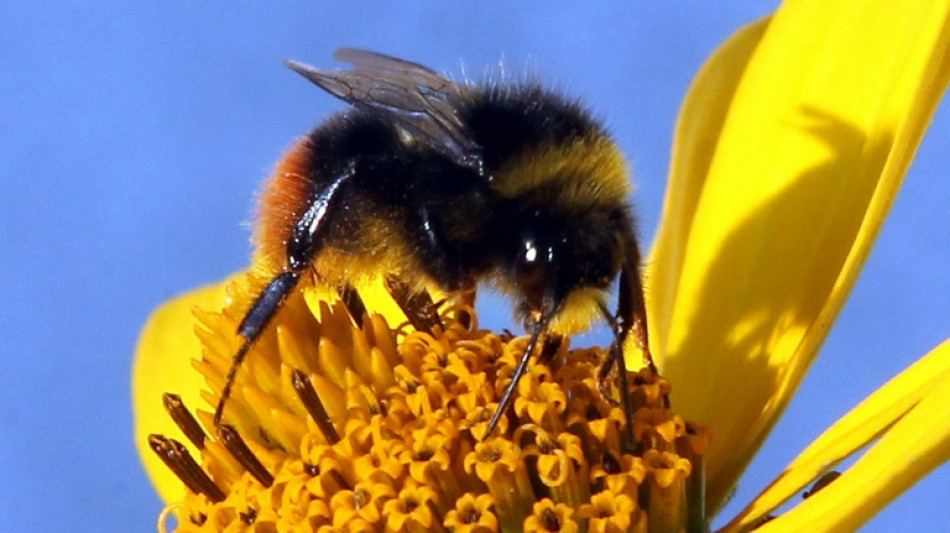
European bumblebee populations projected to plummet / Photo: © DPA/AFP/File

European bumblebee populations projected to plummet

Populations of European bumblebees are projected to fall drastically in the coming decades due to climate change and habitat loss, researchers warned on Wednesday.

Text size:

Europe's 68 species of bumblebees -- including the fluffy, black-and-yellow striped ones often seen buzzing through gardens -- play a crucial role in pollinating crops and wild plants.

But they are used to the cooler temperatures of the Northern Hemisphere, and a warming world caused by human-caused climate change is putting them increasingly under threat, according to the study in the journal Nature.

A team of Belgian researchers collected data on 46 bumblebee species across Europe, assessing the past (1901-1970) and present 2001-2014), comprising more than 400,000 different observations.

They combined this data with the latest modelling from the UN's IPCC climate change panel as well as predictions of changes in land use.

Under the worst-case scenario, they found that "up to 75 percent of bumblebee species which are not currently threatened will see their distribution area shrink 30 percent by 2061-2080," lead author Guillaume Ghisbain of the Universite Libre de Bruxelles told AFP.

This means that most of the European bumblebees currently classified as of "least concern" on the IUCN's list of threatened species could fall into the endangered category.

Bumblebee species in Arctic or alpine environments may even be pushed to the edge of extinction, with an expected loss of 90 percent of their habitat.

There was also bad news for the most common of Europe's bumblebees, Bombus terrestris, a plump bee often spotted pollinating flowers in backyards.

By 2080, it "would see the limit of its geographical distribution, which currently borders the Sahara Desert, pull back to the Loire Valley" in central France, said co-author Pierre Rasmont of the University of Mons.

- Sensitive to heat -

Part of the expected decline was due to how land is expected to be used in the next half century.

"Intensive agriculture fragments habitats and relies on synthetic fertilisers which artificially enrich the soil with nitrogen," Ghisbain said.

"However, bumblebees mainly consume plants which grow in soil poor in nitrogen," such as clover, he added.

Repeated droughts, made more frequent and severe by climate change, also kill off the plants eaten by bumblebees.

But heatwaves intensified by global warming pose an even bigger threat. Apart from a few resistant species, bumblebees are particularly sensitive to heat.

"We observed this in our laboratory one day when the air conditioning broke down -- it was 40 degrees Celsius (104 Fahrenheit) and our colonies died in less than an hour," Rasmont said.

"Some survive, but their sperm becomes deficient."

The researchers suggested that some bees could seek refuge in the cooler climes of Scandinavia.

They have even spotted a few industrious bees who have already made the trek north.

"One day I was collecting bumblebees in northern Norway and suddenly, among the Arctic species, I came across a Bombus terrestris," Rasmont said.

"It had leapt 800 kilometres (500 miles) north" of its natural habitat, he added.

B.Chan--ThChM