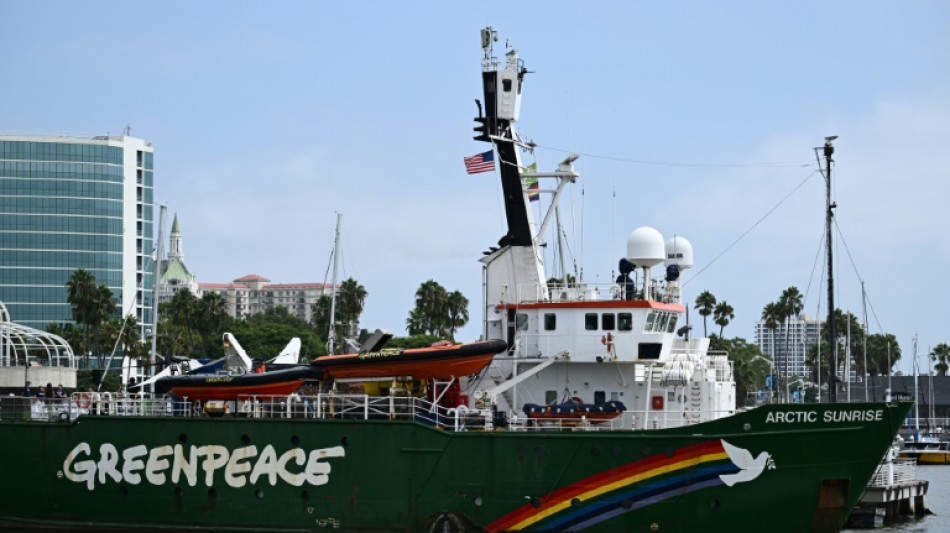
'Huge' overfishing problem shows need to ratify ocean treaty: Greenpeace / Photo: © AFP

Overfishing in international waters has surged in the past five years and demonstrates the need to ratify a recent global treaty to protect the high seas, a Greenpeace report said Wednesday.
The non-governmental network is calling on as many countries as possible to sign the treaty next week at the United Nations General Assembly in New York.
Finalized in June, the text was hailed as a "historic" accord with the potential to better safeguard the oceans.
A key element in the treaty is the creation of a legal framework to protect high seas marine areas -- beyond 230 miles (370 kilometers) from coastlines -- whose good health is vital to humanity.
But without enforcement of the accord, such protections are minimal, the report warned.
"Reality at sea is moving in the opposite direction from the ambition laid out in the Treaty," it said.
Governments must step up immediately, urged Greenpeace oceans campaigner Chris Thorne, aboard the group's ship Arctic Sunrise, which was docked Wednesday in Long Beach, California for an event marking the report's release.
To protect 30 percent of Earth's land and oceans by 2030, the target adopted last year by the COP15 convention on biological diversity, "there is no time to waste," he told AFP.
Fishing hours on the high seas increased by 8.5 percent between 2018 and 2022, according to the report, which compiles data from an organization capable of tracking boat movements via their transmitters.
Such intensification is especially pronounced in the ecologically sensitive areas identified by the UN as potential future marine sanctuaries. Greenpeace reported fishing there has increased by 22.5 percent over the same period.
"Overfishing is a huge problem," Thorne said.
"That fishing pressure is just absolutely unsustainable, and it's pushing our oceans to the brink."
Greenpeace's report notes that in the span of 30 years, stocks of Pacific bluefin tuna have collapsed by more than 90 percent.
It also draws attention to the damage caused in open seas by longline fishing, which uses cords fitted with thousands of baited hooks dozens of miles long.
The destructive method catches many sharks by mistake.
- 'Let her heal' -
Given such dire situations, using the treaty to create high seas sanctuaries is crucial, said Samantha Murray, a marine biodiversity specialist at the University of California San Diego.
"We have up to 670 percent greater biomass inside highly protected and fully protected reserves," she told reporters.
"When we sort of leave the ocean alone and let it be who she is and let her heal, we get more complex ecosystems that can be more resilient."
In order to come into force before the next UN Ocean Conference, in 2025, the treaty will need ratification from at least 60 nations. This would enable convening a conference of the parties, empowered to create the marine sanctuaries.
Scientists and non-governmental organizations have already identified a dozen priority high seas zones needing protection.
They include the Costa Rica Thermal Dome, a nutrient-rich marine biodiversity hotspot hospitable to blue whales; the Emperor seamount chain of underwater mountains near Hawaii; and the Atlantic's Sargasso Sea region.
In addition, the Salas y Gomez and Nazca ridges off Chile's coast may be among the first sanctuaries to see the light of day.
X.Gu--ThChM