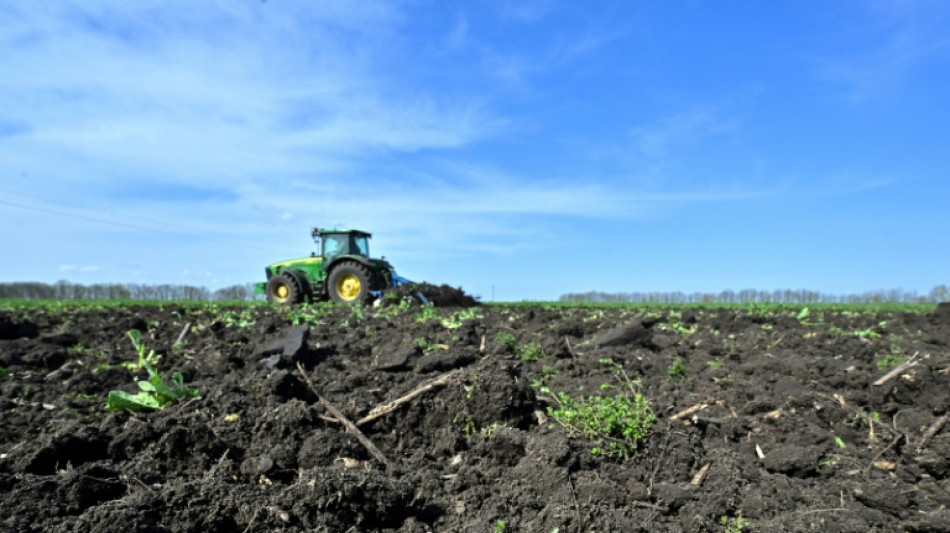
Polish farmers warn of EU threat from Ukraine grain / Photo: © AFP

At his family farm, Wieslaw Gryn voiced support for Poland's ban on Ukrainian grain imports, but said it had not reversed a price drop that threatens his livelihood and those of other European farmers.
The issue has become a hot-button topic ahead of Poland's general election on October 15 and threatens to create a major rift between Poland and Ukraine, as well as deepening mistrust between Warsaw and the EU.
"Since the start of the war in Ukraine, our situation has changed dramatically," said the 65-year-old, who grows wheat, oilseed rape, sugar beet and maize on 900 hectares in eastern Poland near the Ukrainian border.
"Following the Ukrainian grain imports, we do not have anywhere to sell our produce and the prices have fallen so much that they do not cover costs of production."
The European Union lifted customs duties on Ukrainian grain in May 2022 after Russia blockaded Ukraine's Black Sea ports -- the main route for its exports -- following Moscow's invasion of Ukraine.
Grain prices dropped sharply in several EU states.
Since his silos are already full, Gryn has filled his garages with grain in the hope prices will go up.
- 'Significant losses' -
Instead of being transported to markets in Africa or the Middle East as intended, much of the grain remained in Central Europe because of major logistical problems, massive fraud and a lack of sufficient surveillance.
"Following the opening of the market, a large number of Polish farmers found themselves in a very difficult situation," Polish President Andrzej Duda has said.
Together with several other countries neighbouring Ukraine, Poland banned imports.
Brussels authorised restrictions by several member states as long as transit was allowed to continue but it ordered the measures to be lifted on September 15.
Since then, Hungary, Poland and Slovakia have defied Brussels by extending their embargo saying they had to protect their farmers -- prompting Ukraine to seek an intervention by the World Trade Organization.
Ukrainian Economy Minister Yulia Svyrydenko has said Ukrainian exporters "continue to suffer significant losses" because of the bans and voiced hope that the countries would lift their restrictions.
Jaroslaw Kaczynski, leader of Poland's ruling Law and Justice (PiS) party, has said that agreements between Poland and Ukraine after Russia's invasion "did not include a clause to abolish Polish agriculture".
"Polish farming must be protected. Taking into account the scale of the territory and the climate in Ukraine, it would have no chance to remain competitive," he said.
Following talks between Warsaw and Kyiv on the issue on Sunday, Ukrainian Agriculture Minister Mykola Solsky on Monday said that Poland had shown "maximum solidarity and obviously we all expect this will continue".
- 'Rules should be the same' -
Three weeks before the elections, the issue has become particularly sensitive since the current government enjoys strong support in farming regions.
Rafal Mladanowicz, who farms 160 hectares in Rzecznica in northeast Poland, said the import ban would "change nothing" since there was still a surplus of grain that had accumulated when imports were allowed.
"Since the opening of the European market in May 2022 and until the embargo, 90 percent of grain that should have transited through Poland stayed here," he said.
"We can't just talk about an embargo. We have to invest in transit infrastructure and the government is not doing that," he said.
Mladanowicz said that, if nothing changes, "European agriculture, which is the best but also the most expensive in the world, will simply cease to exist."
Gryn said Ukrainian farmers were helped by cheaper fertilisers, labour costs and larger farming businesses.
He also said Ukraine allowed the use of pesticides that are banned in the EU, warning of their potential harm.
He said farmers in eastern Poland had felt the effects of the grain price drop particularly hard last year and those in the west were feeling it this year.
"Next year, it will be the whole European Union," he warned.
"I'm not afraid to compete with Ukraine but the rules should be the same for everyone."
C.Mak--ThChM