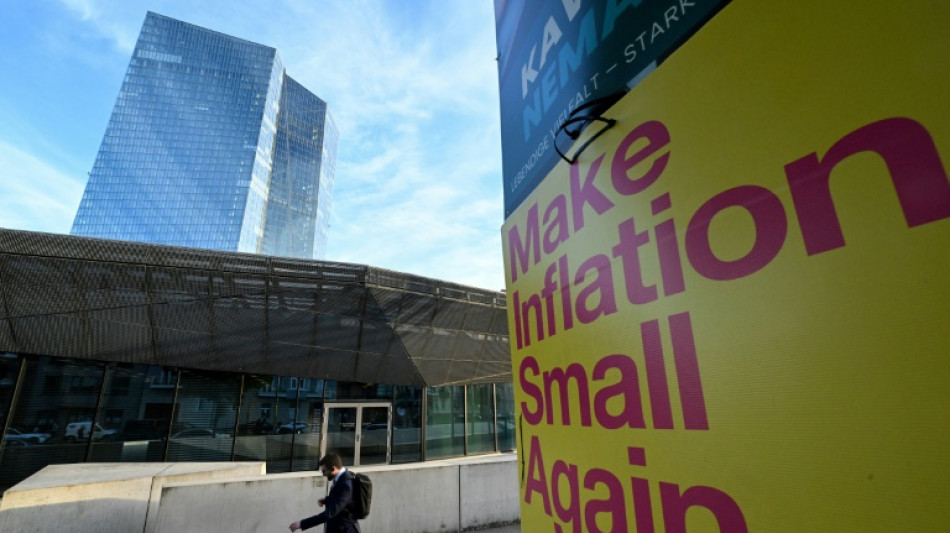
German inflation at lowest since start of Ukraine war / Photo: © AFP

German inflation slowed in September to the lowest level since the outbreak of the Ukraine war, data showed Thursday, offering a glimmer of hope even as Europe's top economy struggles to emerge from a recession.
Russia's invasion of Ukraine last year, and subsequent move to slash crucial gas exports, triggered an energy crisis and sent consumer prices surging in Europe, with Germany particularly hard hit.
But inflation came in at 4.5 percent year-on-year this month, down from 6.1 percent in August, according to preliminary data from national statistics agency Destatis, with sharply lower energy costs contributing.
The last time inflation was lower was in February, 2022, the month Russia sent its forces into Ukraine, it said.
"The abrupt drop in inflation is an important signal for the success of the fight against inflation," said Fritzi Koehler-Geib, chief economist at public lender KfW.
"This can help to continually weaken price increases in the coming months as consumers and companies adjust their inflation expectations downward under the impression of the positive news."
The news will come as a relief to the European Central Bank, which has hiked interest rates aggressively to fight inflation, and will bolster expectations of a pause at its next meeting in October.
It is also a boost for policymakers in Europe's industrial powerhouse as they battle myriad problems.
There is weakness in the key manufacturing sector and households are feeling the pain of the ECB rate hikes.
Problems in the global economy, and in particular a slow recovery from the pandemic in Germany's top trading partner China, are also weighing on the export giant.
- Gloomy outlook -
An updated joint forecast from leading economic institutes released Thursday highlighted the challenges -- they now predict the German economy will shrink by 0.6 percent across the whole of 2023, sharply lower than earlier predictions.
The economy is struggling to get back on its feet after falling into recession around the turn of the year, and stagnating in the second quarter.
There were positive signs at the start of the year that Germany may have weathered the energy crisis better than expected, and could avoid a sharp downturn this year.
But a string of gloomy signals in recent weeks -- from lacklustre exports to poor business confidence -- suggest the outlook is worsening.
The IMF has predicted that Germany will be the only major advanced economy to shrink this year, while the European Commission earlier this month said it expects the German economy to contract more sharply than previously forecast.
On the latest inflation reading, economists said the sharp fall was also driven by some one-off factors which distorted the comparison.
These included the end of a popular discount travel card system in Germany in September 2022, which pushed up prices then.
Still, ING economist Carsten Brzeski said the data has "made the call for a pause at the European Central Bank's October meeting even stronger," even if eurozone inflation remains well above the ECB's two-percent target.
"Confidence continues to weaken and inflation has come down, even though it is still nowhere near levels that would bring relief or comfort to the central bank," he said.
Y.Parker--ThChM