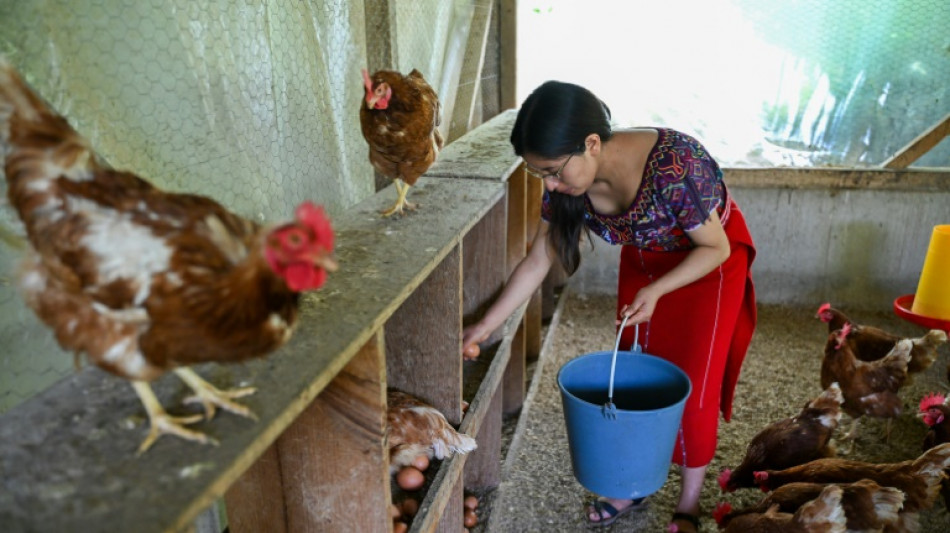
Chickens keep Indigenous Guatemalans from migration agonies, for now / Photo: © AFP

A brood of chickens cluck in the barn as Rebeca Perez collects eggs to sell in her village in western Guatemala -- an endeavor she hopes will keep her from emigrating to the United States as her brothers did, driven by poverty.
Many of her neighbors in the Mayan settlement of Santa Maria Nebaj have left, but the single mother of two children aged eight and 11 is intent on providing for her family with her feathery flock.
"You can generate income here, not only there" in the United States, the 28-year-old told AFP.
With about 250 other farmers from seven municipalities in the Quiche department, Perez is learning agricultural production and marketing techniques thanks to a program created in 2020 by the NGO Save the Children.
Run with US and Guatemalan government support, the project seeks to ensure that the children in Quiche -- one of the poorest regions of the country -- are fed with local food.
Although curbing migration was never the project's main aim, coordinator Lucrecia Mendez said it has lessened the push factor.
"Local producers have increased their incomes to cover their needs and improve the lives of their families, which has helped reduce irregular migration," she said.
Neighbor Jacinto Perez, 27 -- no relation to Rebeca -- grows tomatoes and other vegetables in Santa Maria Nebaj, which he delivers to ten schools.
In the nearby municipality of San Juan Cotzal, Edwin Lopez, 38, sells chickens and grows maize and beans with modified seeds provided by the NGO.
These two also do not see a future elsewhere, despite the nation's poverty -- which affects 59 percent of Guatemala's 17 million inhabitants -- and gang violence, both of which are fueling an ever-growing exodus north.
US authorities deported 40,713 Guatemalans in 2022 -- more than double the 2021 figure.
- 'Fight the battle here' -
Five years ago, Lopez tried to make the perilous journey via Mexico in the search for a better life in the United States after losing his teaching job.
After a nightmarish experience at the hands of smugglers, "hidden, like a slave, without sleeping or eating," he was arrested and spent 27 days in detention before being expelled.
"With everything one experiences there... I have no desire to return," he told AFP. "It is better to fight the battle here."
The return was not easy. Lopez's home was destroyed by hurricanes Eta and Iota in 2020.
He built another, out of wood, where he lives with his wife and two children, aged 13 and four.
It is here, in the hills of San Juan Cotzal, that Save The Children approached Lopez, and engaged him in training about soil conservation, fertilizer and climate change.
Rebeca Perez went to study at the ETCAE technical school funded by the NGO in 2023, learning skills to prevent diseases among chickens and increase their egg production.
She started a business in 2016 with a loan from one of her brothers living illegally in Florida. From a handful of hens, she now has 300 and is aiming for 1,000 by next year.
"I already have a market," Perez told AFP, proud to employ six women from her village in the small business.
Jacinto Perez, who also trained at ETCAE, employs three people.
"Going to the United States is risky... Here on the other hand, we advance bit by bit," he said.
E.Lau--ThChM