The China Mail - Alibaba shares collapse after cloud service spinoff cancelled

USD -
AED 3.672499
AFN 64.999981
ALL 80.973319
AMD 360.400812
ANG 1.789785
AOA 917.00006
ARS 1544.493132
AUD 1.432911
AWG 1.8
AZN 1.69565
BAM 1.742632
BBD 2.013837
BDT 124.53501
BGN 1.747831
BHD 0.377434
BIF 2988.029527
BMD 1
BND 1.276378
BOB 12.072829
BRL 5.468303
BSD 0.99988
BTN 94.413878
BWP 13.698105
BYN 2.983174
BYR 19600
BZD 2.010897
CAD 1.398925
CDF 2314.999902
CHF 0.815605
CLF 0.024634
CLP 969.530047
CNY 6.669797
CNH 6.66604
COP 3234.76
CRC 453.42968
CUC 1
CUP 23.9964
CVE 98.242128
CZK 21.68655
DJF 178.048444
DKK 6.66508
DOP 60.044461
DZD 135.888325
EGP 53.903902
ERN 15
ETB 164.103855
EUR 0.89171
FJD 2.244702
FKP 0.743037
GBP 0.742775
GEL 2.604999
GGP 0.743037
GHS 11.662561
GIP 0.743037
GMD 74.505074
GNF 8856.535705
GTQ 7.641212
GYD 209.491818
HKD 7.84435
HNL 26.873438
HRK 6.76901
HTG 131.039306
HUF 324.404499
IDR 18095.6
ILS 3.18926
IMP 0.743037
INR 94.47835
IQD 1515.768465
IRR 1883408.498647
ISK 121.979404
JEP 0.743037
JMD 158.589013
JOD 0.709038
JPY 158.0695
KES 129.900097
KGS 87.449296
KHR 4068.086547
KMF 441.000203
KPW 899.999961
KRW 1349.950303
KWD 0.310398
KYD 0.833278
KZT 449.579663
LAK 22503.085086
LBP 89535.66385
LKR 332.405209
LRD 169.973716
LSL 16.385571
LTL 2.95274
LVL 0.60489
LYD 6.400941
MAD 9.743884
MDL 17.877334
MGA 4533.405801
MKD 54.858075
MMK 2099.845134
MNT 3601.453525
MOP 8.079209
MRU 40.394356
MUR 46.750091
MVR 15.45503
MWK 1733.772887
MXN 18.617465
MYR 4.047196
MZN 63.910041
NAD 16.385571
NGN 1346.202177
NIO 36.798282
NOK 9.286915
NPR 151.060503
NZD 1.77915
OMR 0.384508
PAB 0.99988
PEN 3.443981
PGK 4.554749
PHP 62.978499
PKR 276.535615
PLN 3.918105
PYG 6160.371012
QAR 3.654913
RON 4.7598
RSD 104.865963
RUB 81.600692
RWF 1472.802602
SAR 3.756339
SBD 8.051718
SCR 13.798605
SDG 601.501901
SEK 9.79823
SGD 1.277615
SHP 0.745545
SLE 22.910048
SLL 20969.504398
SOS 571.392932
SRD 37.557021
STD 20697.981008
STN 21.829489
SVC 8.748374
SYP 13001.999685
SZL 16.379099
THB 33.44401
TJS 9.223717
TMT 3.51
TND 2.979413
TOP 2.40776
TRY 50.047702
TTD 6.771597
TWD 33.004957
TZS 2642.682972
UAH 45.418655
UGX 4044.247039
UYU 40.27318
UZS 11931.375213
VES 893.769016
VND 25682.5
VUV 119.655093
WST 2.783161
XAF 584.923388
XAG 0.019087
XAU 0.000243110551
XCD 2.70255
XCG 1.80199
XDR 0.707052
XOF 584.923388
XPF 106.260608
YER 236.174976
ZAR 16.454798
ZMK 9001.199877
ZMW 20.27148
ZWL 321.999592
SSP 5745.516508
MXV 2.095074
  • RYCEF

    0.4000

    19.71

    +2.03%

  • CMSC

    0.0000

    20.4

    0%

  • BTI

    0.4200

    56.05

    +0.75%

  • BP

    0.2800

    44.43

    +0.63%

  • RBGPF

    1.6000

    67

    +2.39%

  • RIO

    -0.1500

    94.41

    -0.16%

  • AZN

    -0.4300

    166.15

    -0.26%

  • GSK

    0.4600

    49.7

    +0.93%

  • BCE

    -0.4100

    20.56

    -1.99%

  • NGG

    -0.2500

    75.24

    -0.33%

  • VOD

    -0.0400

    16.58

    -0.24%

  • RELX

    -0.4500

    33.07

    -1.36%

  • BCC

    -0.5500

    76.59

    -0.72%

  • CMSD

    -0.0300

    20.27

    -0.15%

  • JRI

    -0.2500

    10.77

    -2.32%

Alibaba shares collapse after cloud service spinoff cancelled
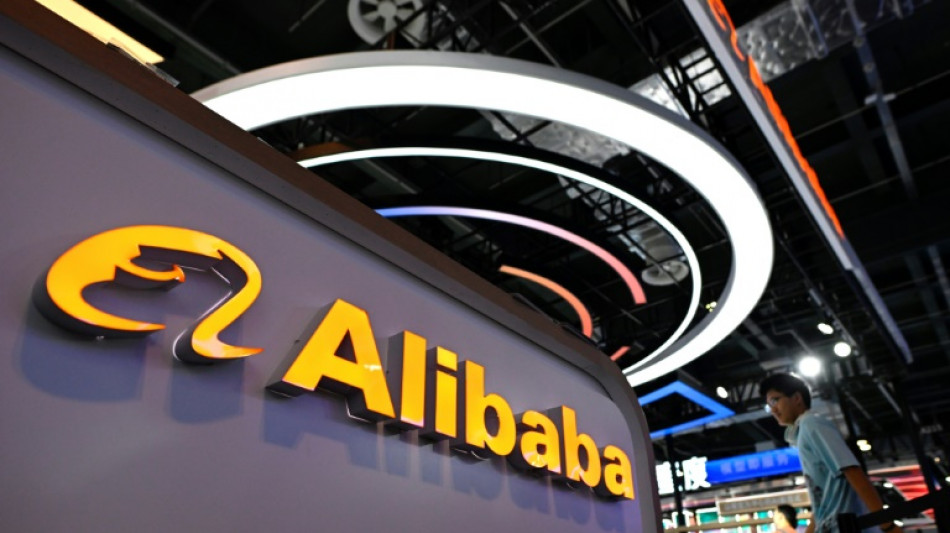
Alibaba shares collapse after cloud service spinoff cancelled / Photo: © AFP/File

Alibaba shares collapse after cloud service spinoff cancelled

Shares in Chinese ecommerce titan Alibaba tanked 10 percent in Hong Kong on Friday after the firm's surprise decision to call off part of its high-profile restructuring because of the US-China chip war.

Text size:

In a move that shocked investors, the Hangzhou-based tech giant said Thursday that US curbs on exports of advanced chips had forced it to call off the spinoff of its cloud computing arm.

The firm's stock dived 9.96 percent, tracking a collapse in its New York-listed shares.

Washington has moved to bar the shipment to China of powerful chips, including those from California-based Nvidia, which are crucial to the development of artificial intelligence, on national security grounds.

In one of its most wide-ranging restructurings, Alibaba said in March it planned to split the vast group into six distinct entities that would be able to separately pursue funding through public listings.

But on Thursday, it called off the creation of its Cloud Intelligence arm in light of "the recent expansion of US restrictions on export of advanced computing chips".

"We believe that a full spin-off of Cloud Intelligence Group may not achieve the intended effect of shareholder value enhancement," the company said in its earnings release.

"Accordingly, we have decided to not proceed with a full spin-off, and instead we will focus on developing a sustainable growth model for Cloud Intelligence Group under the fluid circumstances," Alibaba said.

Alibaba is a key player in China's expansive digital economy and the operator of a major online shopping platform.

The group's performance is considered a barometer of domestic consumption, which has flagged in recent months.

And the firm has faced new headwinds in recent years, with Beijing imposing tighter restrictions on the domestic tech sector and weak consumer spending leading it to record its third consecutive quarter of single-digit revenue growth earlier this year.

Alibaba has said it aims to achieve a "more nimble" structure in order to maintain competitiveness in the face of new regulatory challenges and mounting pressures on the global economy.

But it has now become one of the most high-profile Chinese firms to admit that trade tensions with Washington are affecting business.

The announcement took investors by surprise, with Kevin Net, head of Asian equities at Tocqueville Finance, telling Bloomberg News: "My initial thoughts are that the whole corporate restructuring... could be at risk."

Loop Capital Markets' Rob Sanderson said "Alibaba Cloud was the crown jewel within the restructuring plan".

And Stephen Innes at SPI Asset Management warned it could throw the restructruing into doubt.

"The potential upside from the breakup appears to be diminishing, as none of the subsidiaries have robust financial health," he said in a note.

"There is a caveat -- if consumer confidence rebounds in China, it could potentially change the outlook for the subsidiaries, creating an opportunity for improved valuations. But broader economic factors, particularly consumer sentiment and confidence levels in the Chinese market, are not good."

Y.Su--ThChM