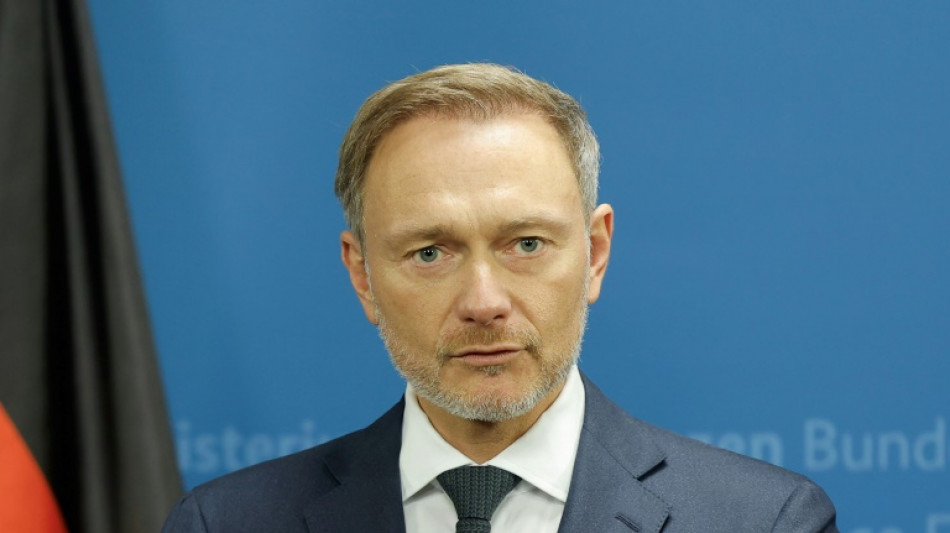
Crisis-mired Germany to blow through debt limit in 2023 / Photo: © AFP

Germany will seek to suspend a constitutional debt limit for a fourth straight year, its finance minister said Thursday, after a shock court ruling upended government spending plans and sparked a budget crisis.
"The federal government will present a supplementary budget to constitutionally secure the expenditures made this year," Finance Minister Christian Lindner said in a post on social media.
Along with the new fiscal plan, the government would put a resolution to parliament declaring an "exceptional emergency situation", the legal basis for suspending the debt rule, he said.
Germany's top court last week said Chancellor Olaf Scholz's government had broken the constitutional debt rule by transferring money earmarked for coronavirus pandemic support to a fund to fight climate change.
The ruling left Berlin with a 60-billion-euro ($65-billion) hole in its budget and threw sorely needed investments into doubt.
Following the decision, the government suspended most of the projects being financed through the climate fund and imposed a broad spending freeze for the rest of 2023.
Written into the constitution in 2009 under former Chancellor Angela Merkel, the debt brake caps new borrowing in Europe's top economy to 0.35 percent of gross domestic product.
The brake was suspended from 2020 to 2022 during the pandemic and energy crisis, but was set to come back into force this year.
- Coalition agreement -
Suspending the debt rule again will be a bitter pill for the coalition between the Social Democrats, Greens and pro-business FDP, which had pledged to reapply the constitutional brake this year.
The often-criticised commitment to balanced budgets has become a symbol of Germany's fiscal prudence.
The new suspension of the debt rule is a particular blow to Lindner, who has staked his reputation on sound financial management.
The finance minister, who has intoned on the importance of clear debt limits, avoided direct mention of the brake in an earlier press conference.
Lindner said would present the new budget for 2023 next week to "clear the decks" before "we can talk about 2024 and the next few years".
"No new debt will be taken on. Rather, the funds that have been used for crisis management will be put on a secure legal basis," Lindner said in his social media post.
The supplementary budget would be worth 40 billion euros, bringing Germany's total deficit for 2023 to 85 billion euros, German weekly Spiegel reported.
The total included money already largely paid out to help tackle households and businesses with soaring energy prices, Spiegel said.
- Vote delay -
The government this week delayed a planned vote on the budget for next year, while it reviewed the court's ruling. MPs were set to have their final vote on the budget next week.
The ruling had already fuelled tensions in Scholz's uneasy coalition, at odds over how best to spend its resources.
The clash has in particular pitted Lindner and his party, the FDP, against the other two parties, some of whom argue the constitutional rules should be reformed.
Worth 212 billion euros prior to the court ruling, the climate fund was aimed at speeding Germany's shift to an emissions-free economy.
Cash had also been earmarked for boosting domestic semiconductor production as Europe seeks to reduce its reliance on Asian chip imports.
The pot of money is one of several that sit outside the main government budget, including a 100-billion-euro fund to boost the military in response to Russia's war in Ukraine.
The defence ministry said on Thursday the armed forces fund was exempted from the government's 2023 spending freeze.
Q.Moore--ThChM