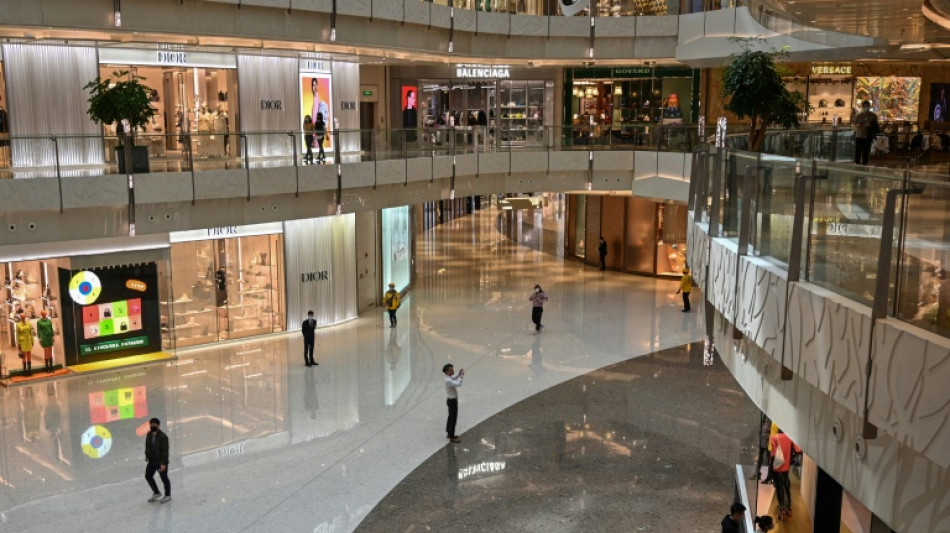
China's retail sales slump as lockdowns cause chaos / Photo: © AFP/File

China's retail sales and factory output slumped to their lowest levels in around two years, official data showed Monday, capturing the dismal economic fallout from Beijing's zero-Covid policy.
The world's second-largest economy has persisted with strict virus measures, choking up global supply chains as dozens of Chinese cities -- including key business hub Shanghai -- grapple with restrictions.
Although officials have said they plan to gradually reopen the city over the next month, there is no sign of Beijing shifting from the strict zero-Covid approach which analysts warn is severely hitting the economy.
The latest cut came Monday when the National Bureau of Statistics (NBS) announced data showing that retail sales shrank 11.1 percent on-year in April.
It is the biggest slump since March 2020, as consumers remained cooped up at home or jittery over restrictions as China battles its worst Covid outbreak since the early days of the pandemic.
"In April, the epidemic had a big impact on economic operations," NBS spokesman Fu Linghui told reporters Monday, adding that the outbreak had a "significantly larger-than-expected" effect.
But he stressed that the hit would be "short-term".
Industrial production growth sank 2.9 percent on-year, reflecting damage from shuttered factories and transportation woes as officials ramped up Covid restrictions last month.
This figure is down from 5.0 percent growth in March.
"The prolonged Shanghai lockdown and its ripple effect through China, as well as logistics delays resulting from highway controls... have severely affected domestic supply chains," said Tommy Wu, lead China economist at Oxford Economics.
He added that household consumption was "hit even harder" and disruption to activity could extend into June, with any rebound likely to take weeks.
- Shanghai shutdowns -
Shanghai was put under heavy restrictions in early April with some 25 million told to stay home in what was originally portrayed as an eight-day lockdown across two halves of the city.
But the shutdowns have dragged on weeks and wreaked havoc on supply chains, crushed small businesses and spread frustration across the city's population.
Officials promised over the weekend to start reopening the city in phases over the next month but business owners who spoke to AFP were sceptical.
"I don't have even the slightest expectation about (being able to reopen soon)," one restaurant owner told AFP, asking to remain anonymous.
"Why are people still believing them?"
The urban unemployment rate also climbed in April to 6.1 percent -- the highest in more than two years.
Beijing has announced measures to help young people find jobs, including social insurance subsidies for smaller firms that hire more graduates and a demand for state-owned enterprises to boost recruitment.
Officials have also lowered the mortgage rate for first-time homebuyers.
But there is a fear that stifling restrictions will hamper any growth plans.
Financial services firm Gavekal said in a recent note that previous suggestions that "meaningful policy easing is on the horizon have not played out."
"As Shanghai and Beijing struggle to reopen and the economic damage keeps growing... officials may yet be forced to crank up stimulus sooner," Gavekal added.
Economic experts called for more support for businesses and consumers at a forum on Saturday, with a top university professor saying the industrial chain cannot be forgotten while reducing infections.
But China cannot "rely on expanding investment and launching large projects," or on handouts to boost consumption, Premier Li Keqiang said in a speech published by state media Saturday.
Instead, he said, practice has proved that tax and fee reductions are "effective, fair and inclusive".
J.Liv--ThChM