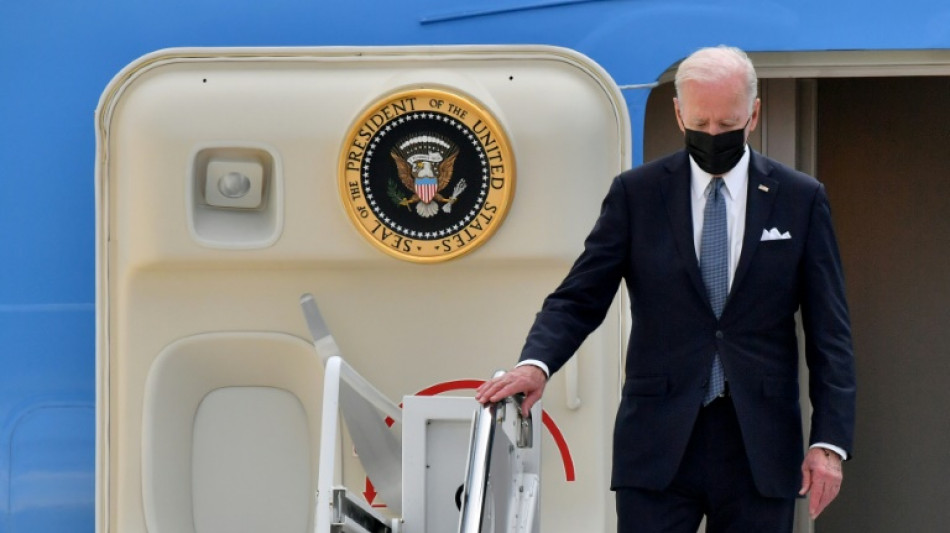
Biden reinforces Japan ties, unveils Asia trade initiative / Photo: © AFP

President Joe Biden meets with Japanese Prime Minister Fumio Kishida in Tokyo and unveils a multinational trade initiative Monday as part of his push to reinvigorate US strategic power across Asia.
Fresh from a three-day visit to another key US ally, South Korea, Biden will also have talks with Japanese Emperor Naruhito at the Imperial Palace.
US officials describe Japan and South Korea as linchpins in Washington's pushback against rising Chinese commercial and military power, as well as partners in a Western-led alliance to isolate Russia over its invasion of Ukraine.
On Tuesday, Biden reinforces the theme of American leadership in the Asia-Pacific by joining the prime ministers of Australia, India and Japan for a summit of the Quad group.
Biden praised the newly elected prime minister of Australia, Anthony Albanese, for deciding immediately on his victory this weekend to attend the summit.
This is "a vital opportunity to exchange views and continue to drive practical cooperation in the Indo-Pacific", the White House said, using the administration's term for the Asia-Pacific region.
However, Quad member India stands out for refusing to condemn Moscow openly or cut trade with Russia. Biden will also be meeting one-on-one Tuesday with Prime Minister Narendra Modi.
- North Korea ignores Biden -
Hanging over every step of Biden's Asia tour is fear that unpredictable North Korea will test a nuclear-capable missile or a bomb.
Speculation that this might even happen while Biden was just across the border in Seoul did not materialise over the weekend.
But US National Security Advisor Jake Sullivan told reporters that the threat remains and said that the dictatorship has a choice.
"If North Korea acts, we'll be prepared to respond. If North Korea doesn't act, North Korea has the opportunity, as we've said repeatedly, to come to the table," he said.
Pyongyang has so far declined to answer the United States' appeals for dialogue, officials say, even ignoring offers of help to combat a sudden mass outbreak of Covid-19, according to Biden.
The situation will be on the agenda for the Biden-Kishida talks, the White House said, as well as their "shared vision for a free and open Indo-Pacific" -- US diplomatic code for maintaining the status quo with a rising China.
The pair are expected to make a statement on the need for "stability" in the Taiwan Strait, as concern rises about Chinese pressure on the island.
And in a sign of Japan's worry about regional tensions, Kishida is expected to announce plans for increased defence spending, a sensitive issue in a country whose constitution limits the military to defence.
- Trade initiative -
After holding a joint press conference with Kishida, Biden will unveil a long-awaited trade initiative -- also meant to cement the US presence in the region -- dubbed the Indo-Pacific Economic Framework for Prosperity, or IPEF.
IPEF is being touted by Washington as a framework for what will ultimately become a tight knit group of trading nations.
Unlike traditional trade blocs there is no plan for IPEF members to negotiate tariffs and ease market access -- a tool that has become increasingly unpopular among American voters fearful of undermining homegrown manufacturing.
Instead, the programme foresees integrating the trading partners with agreed standards in four main areas: the digital economy, supply chains, clean energy infrastructure and anti-corruption measures.
The White House has so far been tight-lipped about how many countries are signing up and it faces questions over how agreed standards of behaviour between the partners can be enforced.
However, there is no political appetite within the United States for returning to a binding Asian trade deal following Trump's 2017 withdrawal from the Trans-Pacific Partnership.
That huge trading bloc was revived, without US membership, in 2018 as the Comprehensive and Progressive Agreement for Trans-Pacific Partnership.
Q.Moore--ThChM