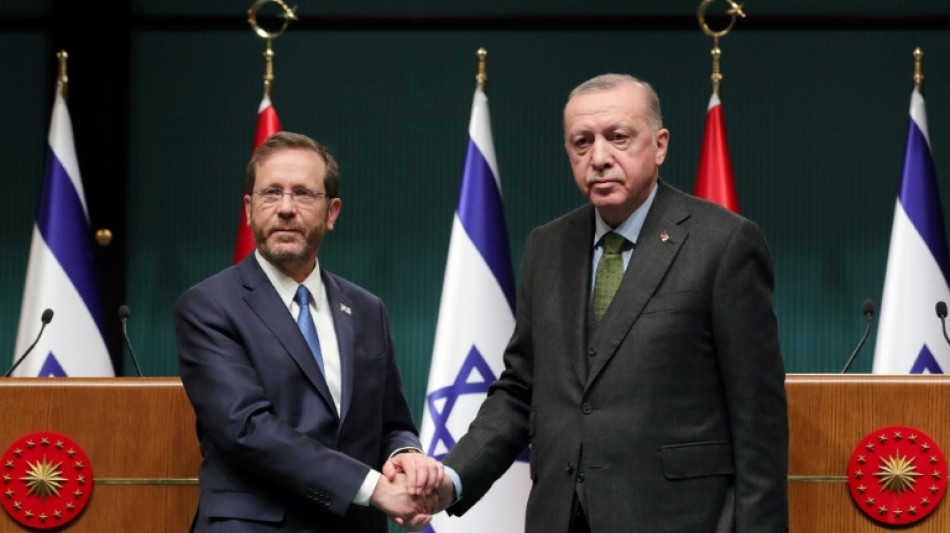
Turkey dreams of far-fetched gas pipeline with Israel / Photo: © TURKISH PRESIDENTIAL PRESS SERVICE/AFP

Turkey is ready for energy cooperation with Israel after years of enmity, reviving a project to pipe Israeli gas to Europe as Ankara seeks to reduce its dependence on Russia.
But the plan faces Israeli scepticism over past diplomatic tensions and seems a pipe dream in the eyes of experts due to its logistical complexity and cost.
President Recep Tayyip Erdogan has voiced readiness to "cooperate (with Israel) in energy and energy security projects" with the prospect of shipping Israeli gas to Europe through Turkey as the conflict in Ukraine triggers supply fears.
"Turkey has the experience and capacity to implement such projects. The recent developments in our region has shown once again the importance of energy security," he said in March.
Israeli President Isaac Herzog made a landmark visit to Ankara in March to build relations with his Turkish counterpart when both leaders proclaimed a new era following more than a decade of diplomatic rupture.
Turkish Foreign Minister Mevlut Cavusoglu will visit Israel on Wednesday. Energy Minister Fatih Donmez is also expected to travel but it was not immediately clear if he will accompany Cavusoglu.
But according to some experts, there is little Israeli interest in energy cooperation with Turkey.
- 'Erdogan an untrustworthy party' -
"Energy relations are forged by cooperative, trusting states -- certainly not how one would describe the current dynamics between the two countries," Gabi Mitchell, policy fellow at the Mitvim Institute in Israel, told AFP.
"There are those in Israel who argue that Erdogan is an untrustworthy party," he said.
The Turkish leader is known for his angry outbursts at the Jewish state, especially over its policy towards the Palestinians.
In 2009, he stormed out of a Davos panel after a heated exchange with the then Israeli president, Shimon Peres.
NATO member Turkey had been Israel's key ally in the Muslim world until a 2010 crisis where 10 civilians died in an Israeli raid on a ship seeking to breach a blockade on the Gaza Strip.
In 2016, the two countries agreed to start examining the feasibility of an undersea pipeline to pump Israeli gas to Turkish consumers and on to Europe.
But no progress has been made amid the tension between the two sides, with Erdogan seeing himself as a champion of the Palestinian cause and a strong backer of Hamas.
Yet Erdogan has been muted in his criticism in recent months and only voiced sadness over the Israeli-Palestinian violence at the flashpoint Al-Aqsa mosque compound, in a phone call with Herzog in April.
The pipeline project runs through controversial waters in the eastern Mediterranean, where Turkey and EU members Cyprus and Greece are often at odds.
Mitchell said: "This isn't something Israel is interested in pursuing as it would damage relations" with Cyprus, Greece and the European Union.
"I've never thought the project feasible," the Foreign Policy Research Institute's Middle East Program director Aaron Stein told AFP.
"The idea of the project comes back every time there is a thaw but the logistics needed to take it from a dream to reality is complicated and expensive," he said.
The pipeline from Israeli fields to Turkey could cost $1.5 billion, according to some media reports.
- 'Difficult but reasonable' -
Ankara is hugely dependent on Russia for its energy imports, with 45 percent of its gas demand last year met by Russian sources, and is keen to diversify supplies, with a close eye on Israel's developing resources.
Turkey imports natural gas through pipelines from Russia, Azerbaijan and Iran. It also buys liquefied natural gas (LNG) from suppliers including Qatar, Nigeria, Algeria and the United States.
"A gas pipeline crossing the south of Turkey in theory makes sense," said energy expert Necdet Pamir of Cyprus International University.
Turkey consumed 48 billion cubic metres of gas in 2020. This reached 60 billion in 2021 and is estimated to be 62-63 billion this year, he said.
"We need alternative gas supplies and new agreements are in Turkey's interests as long as the circumstances including the financing are ripe," Pamir added.
The Turkish option has reappeared on the agenda especially after the United States snubbed an eastern Mediterranean pipeline aimed at transferring natural gas from Israeli waters to Europe via Cyprus and Greece. That project excluded Turkey.
Turkey sees the gas project with Israel as more feasible than the EastMed pipeline despite the challenges.
"It is not a project that begins today and ends tomorrow," a Turkish official told AFP.
"It's difficult but it's reasonable and feasible, especially compared to the Greece-led EastMed," the official, who wished to remain anonymous, said.
With the basic economics of the Turkey-Israel pipeline still being questioned, some experts indicate LNG is a desirable, cheaper option.
"Beyond the politics, and the issue of Cyprus, land-based LNG terminals make more sense," Stein said. "Financially, and it's easier politically."
P.Ho--ThChM