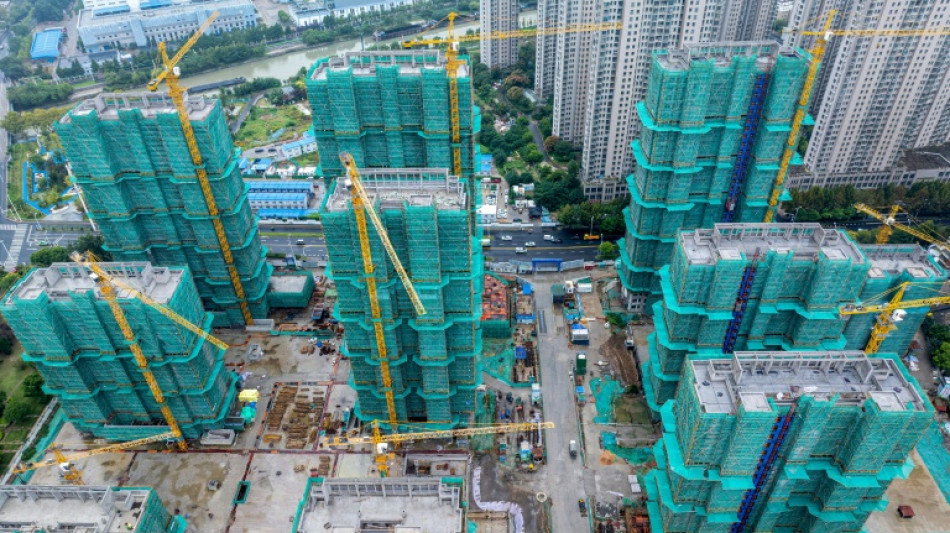
China's economy seen slowing further in 2024: AFP survey / Photo: © AFP

China's economic growth likely fell fractionally short of the government's five percent target last year, according to an AFP survey, as leaders head into 2025 steeling for the second presidency of Donald Trump amid fears of another painful trade standoff.
The reading would be the weakest the country has seen since 1990 -- outside of the pandemic -- as it struggles with weak domestic consumption and a protracted crisis in the once-booming property sector.
The survey of economists by AFP estimated growth in the world's number two economy hit 4.9 percent last year, down from the 5.2 percent recorded in 2023.
They also warned it could ease to just 4.4 percent this year and even drop below four percent in 2026.
The 2024 reading would be just shy of Beijing's target of "around five percent" -- reiterated by President Xi Jinping late last year -- and likely "close enough for officials to claim success", Harry Murphy Cruise from Moody's Analytics told AFP.
"But do not let that achievement fool you. Under the hood, the economy's engine is struggling to get into gear," he warned.
However, Francois Chimits from the Mercator Institute for China Studies said the figure should be regarded with some scepticism as it is "often subject to strategic adjustments to reflect internal objectives".
China's economy has so far failed to achieve a robust post-pandemic recovery as a prolonged real estate crisis spooks consumers and investors, while local governments grapple with soaring debt.
Woes in the property sector are particularly concerning given the vital role it plays in fuelling growth, Chimits said.
Friday's report comes after data last week showed the country narrowly avoided slipping into deflation last month as consumers remain wary of pulling out their wallets.
Beijing has recently unveiled some of the most aggressive measures in years aimed at boosting activity, including cuts to key interest rates, the easing of property purchase rules, hiking the debt ceiling for local governments and bolstering support for financial markets.
- Trump 2.0 -
Coupled with strong overseas demand for Chinese products -- last year's exports reached a historic high -- the measures have contributed to a moderate rebound in the final quarter, experts told AFP.
Without the measures, consumption would have been "much worse", said Michelle Lam, an economist at Societe Generale.
"Beijing has made some tweaks to support the buying of unsold properties by local governments," Lam told AFP.
"But the implementation has still been slow."
In one encouraging sign for the real estate sector, the total area of new residential property transactions in major cities increased 18 percent on-year in December, the finance ministry announced this month.
Compounding the issues heading for Beijing is the return of Trump to the White House next week after he pledged during his campaign to impose tougher trade measures against China than those he unleashed during his first term.
A hike in tariffs could batter Chinese exports -- a key economic pillar made even more vital in the absence of vigorous domestic demand.
A potential 20 percent increase in US levies on Chinese goods would result in a 0.7-percentage-point hit to real GDP this year, according to a Goldman Sachs report.
In a move to shore up the economy in preparation for any possible headwinds, Beijing has announced a relaxation of fiscal policy in 2025 and a plan to boost consumption by subsidising the replacement of old household items.
With exports facing greater uncertainty and the property sector stagnating, "officials need a new growth driver", said Murphy Cruise.
"Households could be that engine."
External pressure this year might necessitate even greater domestic policy support from Beijing, said Larry Hu, economist at Macquarie Group.
That could represent a "paradigm shift, with domestic demand outpacing external demand" as it did in 2009-19, he wrote.
Still, economists remain sceptical about the scale of upcoming stimulus measures, the details of which are unlikely to be revealed until China's annual parliamentary session in March.
"Officials will ramp up support, but it will not offset the pain of higher tariffs," Murphy Cruise warned.
N.Wan--ThChM