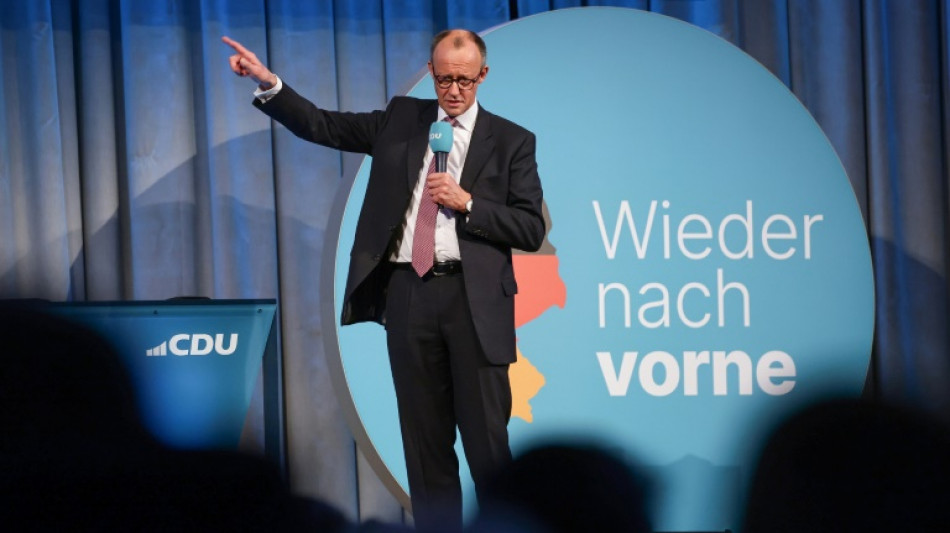
Conservative Merz leads Germany's turbulent election race / Photo: © AFP/File

When Germans vote on Sunday, conservative Friedrich Merz is the strong favourite to become the next chancellor after a bitterly fought campaign roiled by the rise of the AfD, a far-right party vocally backed by Team Trump.
Barring any last-minute upset, the CDU/CSU bloc of Merz is leading the polls and on course to defeat Chancellor Olaf Scholz's Social Democrats (SPD) to make the 69-year-old former investment lawyer the next leader of Europe's biggest economy.
His victory would cap months of political turmoil since Scholz's troubled three-party coalition imploded in November -- but grave challenges loom for Merz and his pledge to fix Germany's ailing economy and rebuild its international stature.
The election comes at a time of rapid and unsettling change for Germany and Europe, as US President Donald Trump has reached out over their heads to Russia to settle the Ukraine war, sparking grave fears for future transatlantic ties.
Whatever divides them, Merz, Scholz and other German politicians share a sense of alarm over what lies ahead for Germany, which built its post-war democracy under American tutelage and grew prosperous under the US-led NATO umbrella.
The one party to relish the disruption has been the far-right and Moscow-friendly Alternative for Germany (AfD), which has received strong support from Trump's inner circle, including Vice President JD Vance and tech billionaire Elon Musk.
Like Trump, it has strongly opposed irregular immigration, and has capitalised on fears stoked by a string of deadly knife and car-ramming attacks blamed on migrants and asylum seekers.
The AfD has been polling at a record 20 percent or higher, which would make it Germany's second strongest party and shatter the notion that the country still seeking to atone for the Holocaust is immune to a right-wing extremist revival.
- 'Firewall' breached -
"People are looking at the elections with concern," said one voter, Ralph Teschner, 57, who runs a catering company in Frankfurt.
He said that a country where the AfD could score over 20 percent "is not a country I like to be in".
Merz, a traditional conservative, has argued that, unless Germany wants to one day see the AfD win outright, its centrist parties must tackle the thorny issue of immigration head-on.
But his vows to shutter German borders and detain those awaiting deportation have sparked a strong backlash, worsened by a parliamentary gambit in which he allowed AfD backing to pass a motion on immigration.
The move shattered a long-standing agreement to maintain a "firewall" of non-cooperation with the AfD, sparking days of mass street protests in an increasingly polarised country.
Critics have accused Merz of running a campaign that stigmatises migrants and ultimately plays into the hands of the far-right party.
Fuelling the increasingly toxic debate, Vance weighed in at last week's Munich Security Conference with a blistering speech in which he accused European countries of stifling free expression and said there is "no room for firewalls".
- 'Negative ideas' -
Amid all the anger, a key challenge for Germany remains reviving an economy that has shrunk for two years, a decline punctuated by factory closures and mass lay-offs.
More trouble looms as Trump's tariff threats have raised fears of a trade war that could hammer Germany's export-dependent economy.
Despite the turmoil, Merz has projected the sure-fire confidence of a man certain to lead, with pledges to rebuild EU unity, deal confidently with Trump and bring sweeping reforms to help Germany Inc.
But the rise of the AfD and smaller parties means that if he wins he may face a difficult task in forging a governing majority.
His most likely junior partners are the SPD or the Greens -- the very parties whose quarrelsome alliance with the smaller FDP ended so spectacularly on November 6, the day Trump won reelection.
"Friedrich Merz is certainly poised to be the next chancellor of Germany, but the question remains how he will formulate a stable governing coalition," said Sudha David-Wilp of the German Marshall Fund of the United States.
"Will it be enough to just take one junior partner or will he have to form a three-party coalition, which could be very unwieldy?"
Under Scholz's coalition, she said, "we saw how it was very difficult to come to consensus among three parties with different political beliefs".
Teschner said that, looking ahead, Germany needs "a common vision, one that is oriented towards positive things, not negative things. Locking everyone up or keeping them out are all just negative ideas."
Y.Parker--ThChM