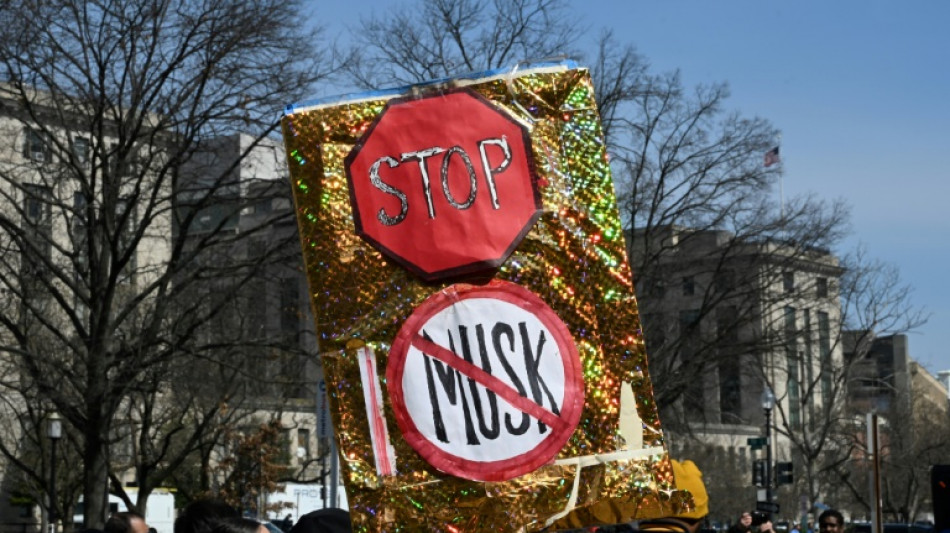
'Grieving': US federal workers thrown into uncertain job market / Photo: © AFP/File

Unprecedented cuts to the US government overseen by President Donald Trump's billionaire advisor Elon Musk are sending thousands of federal workers and contractors back to the labor market -- but experts warn that hiring is low at this time.
Official data released Friday showed federal government employment declined by 10,000 in February, the first full month of Trump's return to the White House.
"We're trying to shrink government and grow the private sector," Trump told reporters in the Oval Office after the data was released.
Analysts say the full effects of his government cuts are yet to be seen, and they warn of a possible mismatch between workers' skills and the jobs available in the marketplace.
For some, like staff in the international development sector, their whole industry has been upended.
"I'm grieving, trying to figure out what next to do for a paycheck," said a 38-year-old contractor for the US Agency for International Development (USAID).
The Trump administration has sought to dismantle USAID, ending many humanitarian and other support projects globally.
The worker, who declined to be named, told AFP: "It's going to be quite difficult to find alternative jobs, because basically an entire industry has been wiped out in less than a month."
She has been on unpaid leave since mid-February and is living on her savings.
She has applied for other jobs but not heard back, and said she cannot afford to live in Washington indefinitely without a job.
- Major employer -
The US unemployment rate is fairly low, at 4.1 percent, but how easily workers find new jobs will depend on whether their skills translate to the private sector.
The federal government is the country's largest employer, with around 2.4 million employees, excluding active-duty military and US Postal Service personnel.
While the thousands of layoffs within the federal workforce may not seem large on paper, numbers could balloon once government contractors are included, said Dean Baker, a senior economist at the Center for Economic and Policy Research.
Economists expect the government layoffs to show up in employment data over the coming months.
"We'll see it unfolding over time," said economist Aaron Sojourner at the W.E. Upjohn Institute for Employment Research.
In the US capital Washington and its neighboring states Maryland and Virginia, nearly six percent of employees work for the federal government, according to the Pew Research Center.
Sojourner points out that 80 percent of civil servants are based outside this area, however.
In states like Wyoming, New Mexico or Oklahoma, they represent more than two percent of total employment.
- Low hiring rate -
"It could be quite hard to find alternative employment if there's a big flood of people onto the market at once," Sojourner warned.
The hiring rate is currently low, noted economist Nancy Vanden Houten at Oxford Economics.
While some sectors have higher hiring rates, these include less skilled occupations in areas like leisure and hospitality, as well as retail trade.
This could prove to be a mismatch for federal workers who "are generally more educated and skilled than the private sector workforce," she said.
Baker noted that highly educated researchers, especially younger ones, may seek employment in other countries.
"It's a fantastic opportunity for them to pick up talent," he said.
F.Jackson--ThChM