US job market cools but resilient for now despite Trump tariffs / Photo: © AFP/File

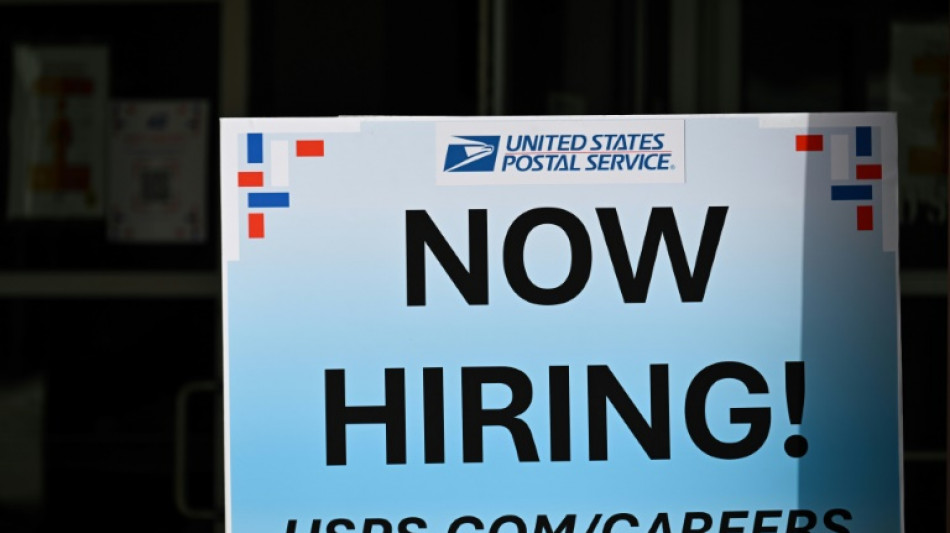
US hiring eased in May but remained resilient, government data showed Friday, in a gradual slowdown amid business uncertainty while scrutiny intensifies over the effects of President Donald Trump's widespread tariffs.
Hiring in the world's largest economy came in at 139,000 last month, down from April's level which was revised lower to 147,000, said the Labor Department.
The unemployment rate was unchanged at 4.2 percent, while pay gains exceeded expectations at 0.4 percent.
The headline figures indicate that the US employment market remains healthy despite jolts to financial markets, supply chains and consumer sentiment this year as Trump announced successive waves of tariffs.
But the market appears to be softening. Taken together, job growth in March and April was revised lower by 95,000, Friday's report said.
Trump has imposed a 10 percent levy on most trading partners and higher rates for dozens of economies, but experts say their effects take time to filter through on the domestic economy.
This is partly because of the president's on-again, off-again approach to the trade war.
His higher blanket tariff rates, although unveiled in April, were swiftly halted until early July, allowing room for negotiations.
Trump's tit-for-tat escalation with China brought both sides' levies on each other's products to triple digits too in April, a level effectively acting as a trade embargo.
But the countries reached a deal to temporarily lower duties in May.
- 'Tough summer' -
For now, economists are keeping tabs on signals that US employers might be pulling back on hiring.
"This is an 'abundance of caution economy' where businesses are only filling critical positions and job seekers, especially recent graduates, are struggling to find employment," said Heather Long, chief economist at the Navy Federal Credit Union.
She noted that nearly half the job gains were in health care, while the federal government continues to lose workers.
"A recession does not look imminent, but it will be a tough summer for anyone looking for full-time work," she said in a note.
Economist Samuel Tombs of Pantheon Macroeconomics said the labor market was "cracking, but not crumbling yet."
While the market is slowing, the pace of cooling remains too gradual for the US central bank to reduce interest rates at upcoming meetings. Officials have been awaiting more clarity on how much Trump's new tariffs might lift inflation.
But Tombs warned that revisions to May's employment data could "reveal a sharper slowdown."
On Wednesday, data from payroll firm ADP showed that private sector employment cooled to 37,000 in May, down from 60,000 in the prior month and marking its slowest rate since 2023.
This prompted Trump to issue a fiery response urging the independent Federal Reserve Chair Jerome Powell again to cut interest rates.
Initial jobless claims also picked up in the week ending May 31, with economists warning that this could be a sign of a weakening labor market in response to Trump's tariffs and the resulting uncertainty.
Anecdotal data such as the Fed's beige book survey of economic conditions and recent surveys of businesses have also indicated the levies are causing many firms to pause investment and hiring.
All these mean that such effects could soon show up in government employment numbers.
"Certainly, employment growth is going to slow down over the next few months," said Dan North, senior economist at Allianz Trade North America.
"We just haven't seen the full effect of the tariffs, and we probably won't for a few more months, especially given that they're so choppy, on and off," North told AFP.
J.Thompson--ThChM