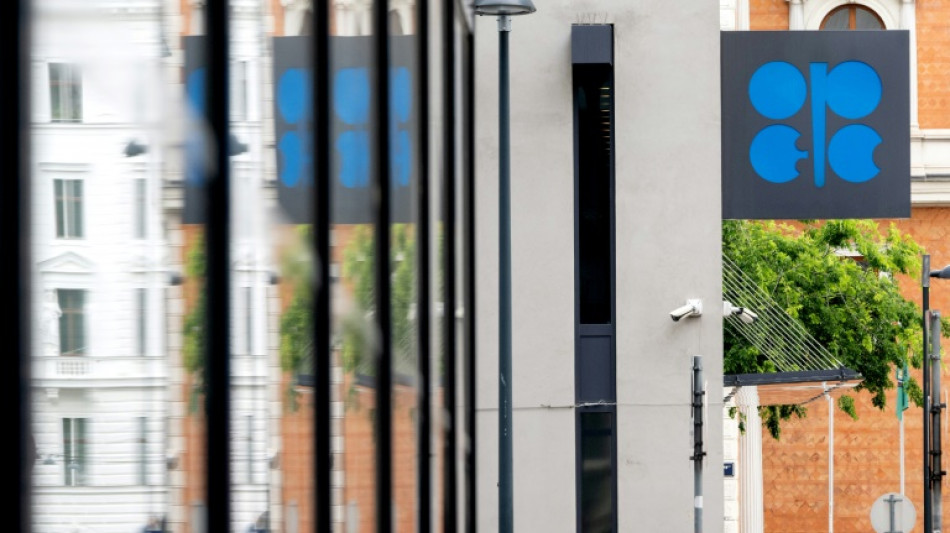
Eight OPEC+ countries raise production by 547,000 bpd / Photo: © AFP

Saudi Arabia, Russia and six key members of the OPEC+ alliance said Sunday they will increase production by 547,000 barrels a day in a move which analysts say aims to regain market share amid resilient crude prices.
Iraq, United Arab Emirates, Kuwait, Kazakhstan, Algeria and Oman, along with the Saudis and Russians -- together nicknamed the Voluntary Eight (V8) -- currently produce about 41-42 million barrels a day, so the increase is about 1.5 percent.
Analysts said there was unlikely to be a major impact on prices, with the Brent reference oil currently selling at about $70 a barrel.
"The eight participating countries will implement a production adjustment of 547,000 barrels per day in September 2025 from August 2025 required production level," said a statement released after a meeting where the hike was agreed.
The eight key producers, who started increasing production in April, affirmed their commitment to market stability on "current healthy oil market fundamentals," an OPEC statement read.
Oil prices have held up better than observers anticipated amid strong summer demand and a high geopolitical risk premium, notably owing to conflict between Iran and Israel.
"OPEC+ has passed the first test -- unwinding 2.2 million barrels per day (since April) without crashing prices or compromising unity," said Jorge Leon, analyst at Rystad Energy.
"But the next task will be even harder: deciding if and when to unwind the remaining 1.66 million barrels, all while navigating geopolitical tension and preserving cohesion," said Leon.
- 'Low oil inventories' -
The post-meeting statement said the decision came "in view of a steady global economic outlook and current healthy market fundamentals, as reflected in the low oil inventories."
The OPEC+ countries agreed in December to start a gradual return from last April of the 2.2 million barrels per day of previous production cuts.
The latest move, a year ahead of an initial 18-month schedule, completes the unwinding and also provides for a 300,000 barrels per day tranche granted specifically to the United Arab Emirates.
The statement said that "the phase-out of the additional voluntary production adjustments may be paused or reversed subject to evolving market conditions".
The eight added that they will hold monthly meetings for a regular review of market conditions.
For now, the return of other production cuts is to be discussed at the next OPEC+ ministerial meeting at the end of November, with all 22 members.
But OPEC said the V8 will first meet on September 7.
In a bid to boost prices, the wider OPEC+ group -- comprising the 12-nation Organization of the Petroleum Exporting Countries (OPEC) and its allies -- in recent years had agreed to three different tranches of output cuts, amounting to almost six million bpd in total.
- 'Avoid sharp drop' -
After a long period of producers seeking to combat price erosion by implementing production cuts to make oil scarcer, recent months have seen a shift in strategy.
Prior to the announcement, UBS analyst Giovanni Staunovo had suggested the quota increase was "largely priced in" on energy markets.
What happens over the next few months is less certain but ING's Warren Patterson said that the "base scenario" will see the V8 pause output hikes for the time being.
For Patterson, a significant surplus may well emerge from the fourth quarter of this year, which OPEC+ would have to manage carefully.
"The alliance is striving to find a balance between regaining market share and avoiding a sharp drop in oil prices," so as not to wipe out its profits, said Tamas Varga of PVM Oil Associates.
Market experts warn that forecasting is particularly challenging given the uncertainty emanating from US President Donald Trump's tariffs policy and its effects on global trade, as well as his 10-day deadline for Russia to end the war in Ukraine.
M.Chau--ThChM