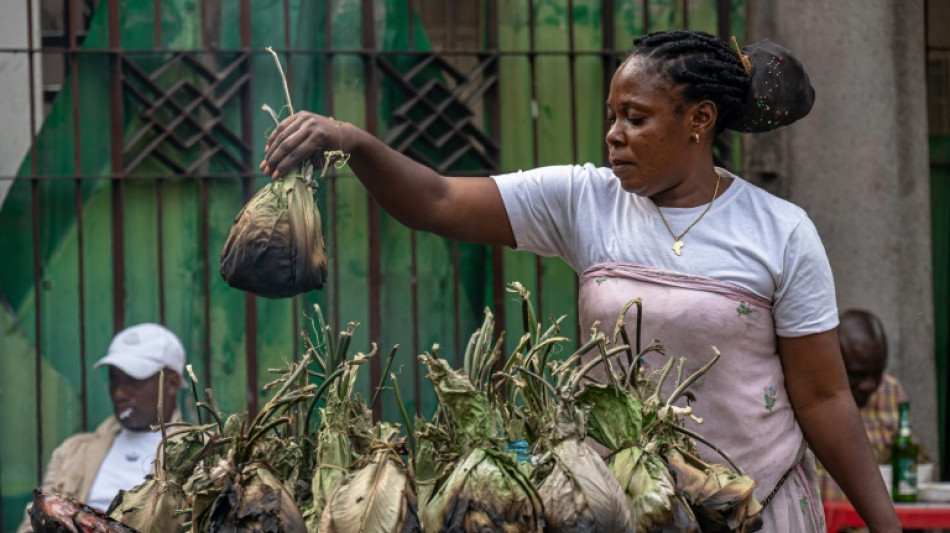
French dictionary gets bad rap over Congolese banana leaf dish / Photo: © AFP

Diners flock to the terrace of Mother Antho Aembe's restaurant in downtown Kinshasa to enjoy "liboke", blissfully unaware of the linguistic brouhaha surrounding the Democratic Republic of Congo's national dish.
Made by grilling fish from the mighty River Congo wrapped in a banana-leaf parcel with spices, tomatoes, peppers, onions, garlic and chillies, liboke enjoys cult status across the central African country.
But liboke's inclusion in one of France's top dictionaries has upset Congolese intellectuals, who say its compilers have failed to capture the full meaning of a word derived from the local Lingala language and closely associated with national identity.
The Petit Larousse dictionary -- an encyclopaedic tome considered a foremost reference on the French language -- announced in May it was including liboke in its 2026 edition.
Its definition: "a dish made from fish or meat, wrapped in banana leaves and cooked over charcoal."
Tucking into a plate on the terrace in the city centre, civil servant Patrick Bewa said it was a "source of pride" that liboke had made it into the leading French dictionary.
"We love it, it's really a typically African and Congolese meal," he said. "With the smoky flavour which takes on the aroma of the leaf, it's an inimitable taste. You have to taste it to believe it."
But some scholars argue that the definition was compiled in Paris by the Academie francaise (French Academy), the chief arbiter on matters pertaining to the French language, without doing justice to liboke's original meanings.
- 'United and undivided' -
Referring only to liboke as food is "very reductive", argued Moise Edimo Lumbidi, a cultural promoter and teacher of Lingala, one of scores of languages spoken in the DRC where French remains the official language.
Under dictator Mobutu Sese Seko, whose rise to power was helped by former colonial master Belgium and whose kleptocratic rule was backed by the United States as a bulwark against Cold War communism, liboke was even part of the national slogan.
"Tolingi Zaire liboke moko, lisanga moko," was a rallying cry, meaning: "We want a united and undivided Zaire", the former name for the DRC during Mobutu's 32 years in power.
"I'm not happy about restricting this precious word, so essential to our culture... liboke moko, it's above all that communion, that national unity," writer and former international cooperation minister Pepin Guillaume Manjolo told AFP.
"Limiting it to its culinary aspects may be all very well for the French, but for us it will not do."
The Petit Larousse should have drawn up the definition by consulting the literary academies of the DRC and its neighbour the Republic of Congo, as the region where the word originated, he said.
AFP contacted the publishers of the Petit Larousse dictionary for comment but did not receive an immediate response.
Edimo, the language teacher, explained that in Lingala, liboke means "a little group".
While liboke's inclusion in the dictionary is a good thing, Edimo said, Larousse's compilers should "deepen their research so as to give us the true etymology of the word".
That would be "a way for them to express their respect for our culture", he added.
At her restaurant in Kinshasa's upscale Gombe district, 41-year-old Mother Aembe was unaware of liboke's newfound literary status, but said she just hoped it would bring in more customers.
X.So--ThChM