The China Mail - Germany unveils debt-laden budget, relief measures

USD -
AED 3.672499
AFN 63.496767
ALL 82.510022
AMD 367.400305
ANG 1.790403
AOA 918.000408
ARS 1463.512787
AUD 1.427144
AWG 1.8025
AZN 1.699385
BAM 1.704772
BBD 2.014072
BDT 122.641098
BGN 1.69088
BHD 0.377135
BIF 2981.906689
BMD 1
BND 1.291046
BOB 6.904336
BRL 5.152498
BSD 1.000013
BTN 94.26975
BWP 13.589989
BYN 2.778541
BYR 19600
BZD 2.011105
CAD 1.418515
CDF 2280.00055
CHF 0.80791
CLF 0.022911
CLP 901.710474
CNY 6.769602
CNH 6.778505
COP 3447.81
CRC 453.643323
CUC 1
CUP 26.5
CVE 96.112443
CZK 21.110498
DJF 178.070899
DKK 6.524075
DOP 58.450197
DZD 133.483776
EGP 49.897696
ERN 15
ETB 158.279558
EUR 0.872798
FJD 2.24775
FKP 0.755711
GBP 0.756705
GEL 2.649915
GGP 0.755711
GHS 11.190238
GIP 0.755711
GMD 73.497256
GNF 8760.550479
GTQ 7.621704
GYD 209.00414
HKD 7.83925
HNL 26.750125
HRK 6.575299
HTG 130.624245
HUF 306.954971
IDR 17829
ILS 2.963399
IMP 0.755711
INR 94.480503
IQD 1308.869035
IRR 1374999.999824
ISK 125.689916
JEP 0.755711
JMD 158.007459
JOD 0.709001
JPY 161.634498
KES 129.41044
KGS 87.449978
KHR 4010.36396
KMF 429.500263
KPW 900.00035
KRW 1535.325028
KWD 0.30802
KYD 0.833293
KZT 488.011271
LAK 22084.385646
LBP 89547.276637
LKR 333.738992
LRD 181.996624
LSL 16.489878
LTL 2.95274
LVL 0.60489
LYD 6.377995
MAD 9.308956
MDL 17.659657
MGA 4210.122265
MKD 53.77498
MMK 2099.479867
MNT 3580.422334
MOP 8.066507
MRU 39.909271
MUR 47.810171
MVR 15.449759
MWK 1733.964363
MXN 17.33975
MYR 4.152498
MZN 63.910201
NAD 16.489878
NGN 1363.410186
NIO 36.797453
NOK 9.694399
NPR 150.832915
NZD 1.74473
OMR 0.384486
PAB 0.999172
PEN 3.381216
PGK 4.382892
PHP 61.106958
PKR 278.166512
PLN 3.71631
PYG 6140.706718
QAR 3.642275
RON 4.572196
RSD 102.441011
RUB 73.002274
RWF 1464.918977
SAR 3.753691
SBD 8.061424
SCR 14.800072
SDG 600.504229
SEK 9.59241
SGD 1.29241
SHP 0.746601
SLE 24.749882
SLL 20969.503664
SOS 571.503348
SRD 37.4025
STD 20697.981008
STN 21.37358
SVC 8.749967
SYP 110.532098
SZL 16.485429
THB 32.891502
TJS 9.266943
TMT 3.5
TND 2.952452
TOP 2.40776
TRY 46.461957
TTD 6.781036
TWD 31.660292
TZS 2628.635013
UAH 44.922859
UGX 3636.522118
UYU 39.947701
UZS 12039.224232
VES 606.63266
VND 26320
VUV 118.132932
WST 2.751795
XAF 572.250987
XAG 0.015028
XAU 0.000238
XCD 2.70255
XCG 1.802185
XDR 0.71169
XOF 572.245995
XPF 103.952931
YER 238.597365
ZAR 16.425799
ZMK 9001.19788
ZMW 17.924862
ZWL 321.999592
  • CMSC

    0.0500

    22.37

    +0.22%

  • JRI

    0.0500

    12.67

    +0.39%

  • RELX

    -0.8300

    31.18

    -2.66%

  • NGG

    -1.2400

    79.44

    -1.56%

  • BCC

    3.8500

    74.66

    +5.16%

  • RBGPF

    -0.5300

    60.61

    -0.87%

  • BCE

    0.0000

    23.28

    0%

  • RYCEF

    -0.0300

    18.4

    -0.16%

  • VOD

    -0.2300

    14.3

    -1.61%

  • RIO

    -2.5900

    100.08

    -2.59%

  • CMSD

    0.0000

    22.29

    0%

  • BP

    -1.0400

    39.1

    -2.66%

  • AZN

    -2.9600

    174.93

    -1.69%

  • BTI

    -0.5800

    58.91

    -0.98%

  • GSK

    -1.4800

    50.67

    -2.92%

Germany unveils debt-laden budget, relief measures
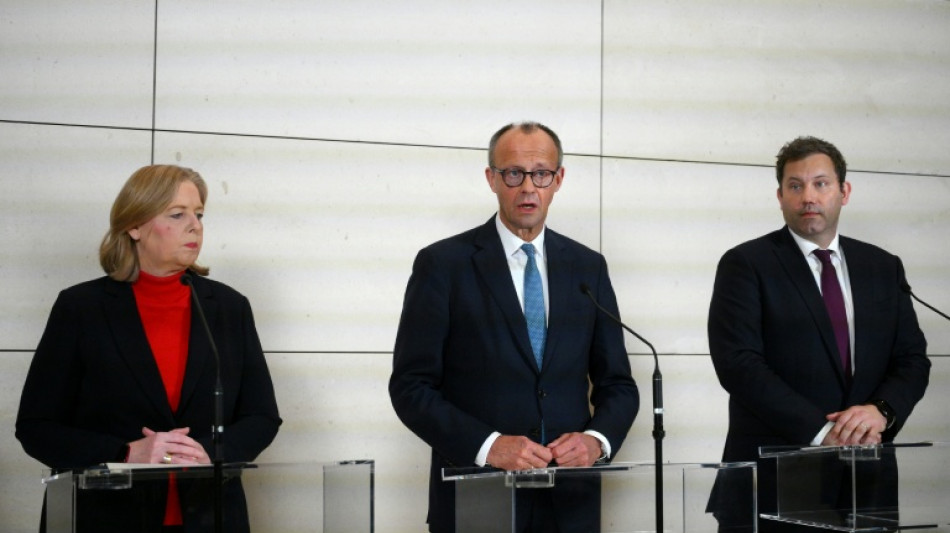
Germany unveils debt-laden budget, relief measures / Photo: © AFP

Germany unveils debt-laden budget, relief measures

The German parliament's budget committee has approved revised 2026 spending plans that include even higher debts than originally thought, lawmakers said Friday, as the government gears up for an investment splurge.

Text size:

Chancellor Friedrich Merz and his coalition partners also agreed further measures late Thursday aimed at helping Europe's struggling top economy, chief among them a reduction in industrial power prices.

"A strong Germany needs a strong economy and secure, well-paid jobs," said Merz, as he announced the policies.

Merz has made reviving the eurozone's traditional powerhouse a priority after two years of recession, relaxing strict debt rules to pave the way for a spending blitz on infrastructure and defence.

Late Thursday the budget committee approved the draft spending plans for next year, Sebastian Schaefer, the budget spokesperson for the Greens Party, told AFP.

Total expenditure of 524.5 billion euros ($610 billion) is now planned, with new borrowing expected to amount to just under 98 billion euros. The revised plans should now be passed by parliament in November.

In a draft approved at the end of July, net borrowing was estimated at 89.9 billion euros. In 2025, the figure is expected to be around 82 billion euros.

New borrowing is planned especially to help overhaul the long-underfunded armed forces, as Germany rearms to face any Russian threat.

The coalition's approach has proven divisive however in a country that has long prided itself on relatively low debt levels compared to other industrialised economies.

Some have questioned the wisdom of relying on borrowing to drive a short-term economic boost, saying that efforts are not being made to tackle painful structural reforms.

"The 2026 budget shows that the CDU/CSU (Merz's conservative bloc) and SPD have no plan for the future," said Schaefer, referring to the parties in the ruling coalition.

He accused them of "squandering" a special fund set up to overhaul infrastructure and for climate projects. Critics say some of the fund is being used to cover day-to-day outlays, rather than long-term investments.

Under the power price plans, the cost for key industries, such as chemical and steel production, is set to be reduced to five cents a kilowatt hour from 2026 to 2028.

This is expected to cost the state three to five billion euros, said Finance Minister Lars Klingbeil.

The coalition also agreed to reverse an increase in taxes on the aviation sector, which should bring the industry savings of about 350 million euros.

B.Chan--ThChM