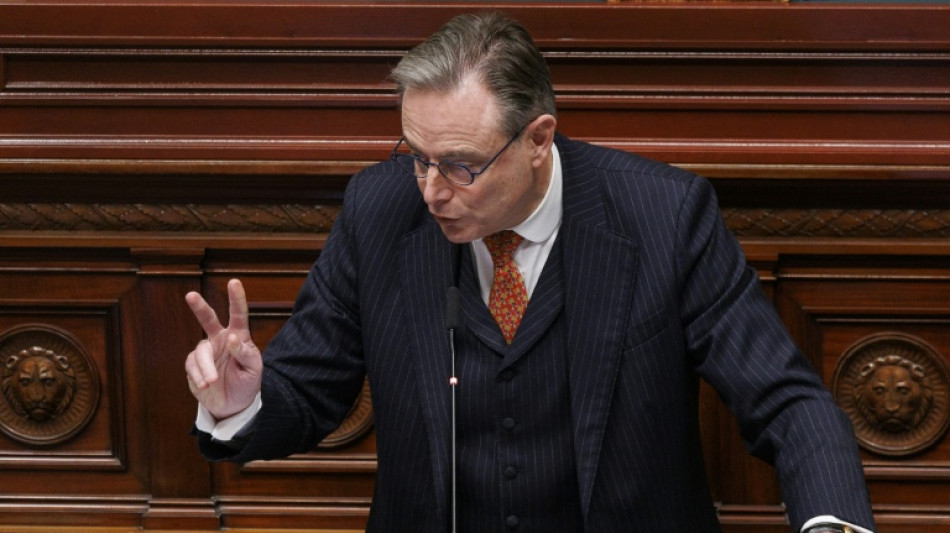
Belgian PM digs in against EU push to use Russian assets for Ukraine / Photo: © Belga/AFP

Belgium's Prime Minister Bart De Wever has called an EU plan to use frozen Russian assets to fund Ukraine "fundamentally wrong", throwing further doubt on a push to agree the move next month.
In a letter to European Commission head Ursula von der Leyen seen by AFP Friday, De Wever pushed back strongly on the initiative and urged against venturing "into unchartered legal and financial waters".
The EU executive and multiple member states, are pressing for the bloc to tap immobilised Russian central bank assets to provide Kyiv with a 140-billion-euro ($162 billion) loan to plug looming budget black holes.
Belgium is the key voice on the issue as it hosts international deposit organisation Euroclear, where the vast bulk of the assets are held.
De Wever has repeatedly said the plan could leave his country facing crippling legal and financial reprisals from Moscow -- and called for cast-iron guarantees from other EU countries that they will share the risk.
"I will never commit Belgium to sustain on its own the risks and exposures," he wrote in the four-page letter.
He said he would only agree to the scheme at a crunch EU leaders' summit on December 18 if binding guarantees "are delivered and signed by member states at the time of decision".
- 'Intense work' -
De Wever's letter comes as von der Leyen has promised to come up with legal texts soon laying out the exact proposed structure of the scheme.
EU officials have asserted that the risks for Belgium of a successful legal challenge are small -- an argument rebutted by the straight-talking De Wever.
"Let me use the analogy of a plane crash: aircraft are the safest way of transportation and the chances of a crash are low, but in the event of a crash the consequences are disastrous," he said.
German Chancellor Friedrich Merz said he was in contact with De Wever and was pressing for an agreement.
"I understand his concerns, he has good arguments but we also have good arguments about reaching our common goal," he said.
"We are looking for a joint solution with the Belgian state and also with Euroclear so that we can decide on this within the EU with the widest consensus possible."
Clamour to harness the Russian assets has grown in the EU after a US plan to stop the war in Ukraine that emerged last week suggested the assets should be unfrozen.
Proponents argue that if the bloc does not act now to use the money, then it risks losing control of it under a potential US-backed peace deal.
The proposed EU "reparations loan" envisages that Ukraine would only pay back the funds once Russia had coughed up for the damages inflicted by its invasion.
In the face of Belgian opposition to the plan, von der Leyen has laid out other options to keep financing Kyiv, including EU countries taking out joint borrowing.
But the commission has warned that those options would prove more costly for member states at a time when many are struggling with stretched national budgets.
An EU spokeswoman said that "intense work" was going on to try to hammer out a solution.
"What we are trying to do is to really make sure that the concerns that have been expressed, notably by Belgium and the prime minister, are addressed in a satisfactory manner," she said.
O.Yip--ThChM