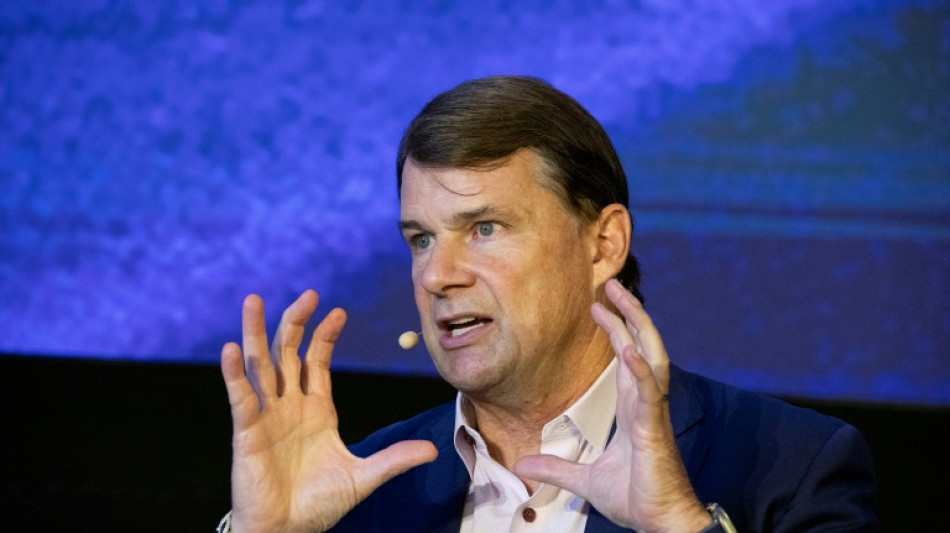
US car market expected to moderate in 2026 / Photo: © GETTY IMAGES NORTH AMERICA/AFP/File

Auto industry experts expect US car sales to moderate in 2026 after last year's churn of trade announcements and environmental policy changes spurred increased sales.
Analysts attribute some of 2025's sales gains to President Donald Trump's announcements early in the year of huge tariff increases.
Although the president ended up striking deals that moderated levies from the threatened level of 40 percent or more, initial headlines led to a noticeable spring surge in sales.
A similar uptick in electric vehicle sales occurred at the end of September after Trump signed legislation phasing out a tax credit. Again, consumers flocked to dealerships before the $7,500 EV tax credit went away.
Such a landscape was treacherous for car executives like Ford CEO Jim Farley, who complained in February 2025 that Trump's tenure was producing "a lot of cost and a lot of chaos."
But by the end of year, automakers still did okay. US auto sales for all 2025 came in at 16.3 million, up about two percent from 2024, according to Edmunds.com.
"A lot of the activity we had in 2025 was driven by the president's announcements," said Cox Automotive economist Charlie Chesbrough.
Ford on Tuesday announced final sales for the year of 2.2 million, up six percent from 2024 and the best year since 2019.
- Higher prices? -
But with the changing of the calendar, industry insiders expect a modest pullback in 2026 sales, pointing to tepid consumer confidence and a slowing job market, partly offset by more favorable factors like lower interest rates.
Cox expects "the market to be similar to (2025) but just a little bit slower," said Chesbrough, who described surveys of auto dealers as "very pessimistic."
Cox has projected 2026 sales to drop to 15.8 million, while Edmunds sees them coming in at 16.0 million.
The new car market is heavily impacted by the split-screen nature of the US economy, with wealthier households strengthened by stock market records, while working-class consumers struggle with increased prices.
Economists now speak of the US economy as "K-shaped" to reflect the opposite fortunes of these subsets, with new cars out of reach for lower-income shoppers.
Average transaction prices for new autos approached $50,000 for most of 2025, compared with under $35,000 less than a decade ago, according to Edmunds data.
One wildcard heading into 2026 is pricing.
Even with lower tariffs, automakers still face billions of dollars in added costs from the levies -- but with retail prices already so high, they are reluctant to pass them on to consumers.
Carmakers have opted to charge more for delivery costs, reduce incentives or strip away features that might once have been included, a step Chesbrough likens to "shrinkflation."
Ivan Drury, Edmunds' director of insights, described deep reluctance to raise retail prices further.
"The sticker shock is kind of flooring," said Drury, who notes that there are currently no new models under $20,000.
The landscape is particularly difficult for first-time buyers, consigning many to the used car market, Drury said.
While the cadence of tariff news has slowed in recent months, the Trump administration is set to negotiate a new version of the USMCA, a trade agreement with Canada and Mexico, later this year.
Given that Detroit automakers and other car companies have established much of their supply chains around the three countries, significant tariff changes could potentially impact prices.
But Drury believes car consumers will be less tuned-in to tariffs in 2026.
"At some point, it becomes a bit of a white noise," he said.
W.Tam--ThChM