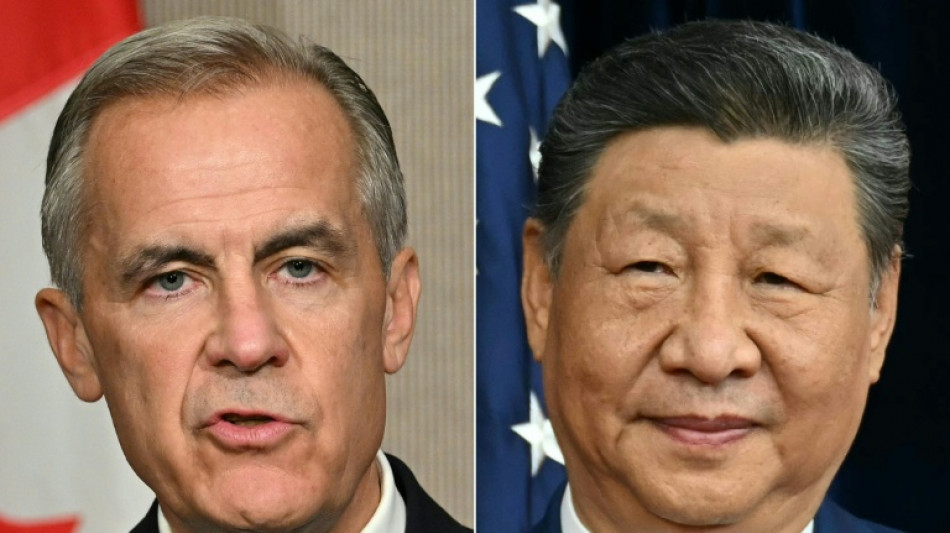
Turning point? Canada's tumultuous relationship with China / Photo: © AFP/File

Canadian Prime Minister Mark Carney will head to Beijing on Tuesday to meet with Chinese leader Xi Jinping, hoping for closer ties as he looks to reduce his country's dependence on the United States.
The trip will be the first by a Canadian leader in almost a decade, as the two sides seek to turn the page on a series of diplomatic spats.
Here is why the visit is significant and what it could mean for China-Canada relations:
- Big deal -
Carney will visit China from Tuesday to Saturday, and is scheduled to meet with Xi and Premier Li Qiang, among other government and business leaders.
It will be Carney's first official trip to China as prime minister, and the first visit by a Canadian leader to Beijing since Justin Trudeau's in December 2017.
Canada's relations with China have been among the worst of any Western nation. But Carney and Xi in late October held the first formal talks between the countries' leaders since 2017, with the Chinese president inviting the Canadian to visit.
Carney's visit will aim to "elevate engagement on trade, energy, agriculture, and international security", his office said in a statement on Wednesday.
- Testy relations -
Ties fell into a deep freeze in 2018 after the arrest of the daughter of Huawei's founder on a US warrant in Vancouver, and China's retaliatory detention of two Canadians on espionage charges.
Ottawa and Beijing have also imposed tit-for-tat tariffs on each other's products, including Canadian canola used to make cooking oil, animal feed and biodiesel.
Carney announced in July a 25 percent tariff on steel imports that contain steel melted and poured in China.
The following month, Beijing imposed a painful temporary customs duty of 75.8 percent on canola imports from Canada, which is among the world's top producers of the crop.
China has also been accused of interfering in Canadian elections in recent years.
The G7, which Canada is a member of, in late October announced new projects aimed at reducing China's dominance of critical mineral supply chains.
- 'Turning point' -
The first sign of warming ties came in late October with Xi and Carney's meeting on the sidelines of the Asia-Pacific Economic Cooperation (APEC) summit in October.
The Canadian premier called it a "turning point" in relations, and said he raised tricky topics such as the alleged Chinese interference in Canadian elections, saying it was "important to have that discussion" to get relations "back on track".
The leaders discussed "respective sensitivities regarding issues including agriculture and agri-food products, such as canola, as well as seafood and electric vehicles", according to a Canadian statement.
Meanwhile, Xi told Carney that China-Canada relations have "shown a recovery toward a trend of positive development" recently with joint efforts of both sides.
China was willing to work with Canada to bring relations "back to the right track", Xi added.
- Cosying up to China -
While Canadian foreign policy has for years been hawkish towards China, US President Donald Trump's mercurial trade policies and aggression towards allies could prompt a pivot.
The majority of US-Canada trade remains tariff-free, but Canada has been hit particularly hard by Trump's global tariffs on steel, aluminium, vehicles and lumber -- due to the interconnected nature of the neighbouring economies.
Trump also previously hiked tariffs on Canada by 10 percent over an anti-tariff ad campaign that featured late US president Ronald Reagan.
In October, Carney said Canada should double its non-US exports by 2035 to reduce reliance on the United States.
US-Canada trade was worth more than $900 billion in 2024, US government data showed.
Canada was also outraged by Trump's calls last year for it to become the 51st US state.
With Canada and China both heavily targeted by Trump's tariffs, Carney and Xi will likely try to dial down trade tensions between their two countries.
China is Canada's second-largest trade partner, Carney's office said, totalling C$118.7 billion ($85.5 billion) in two-way merchandise trade in 2024.
S.Wilson--ThChM