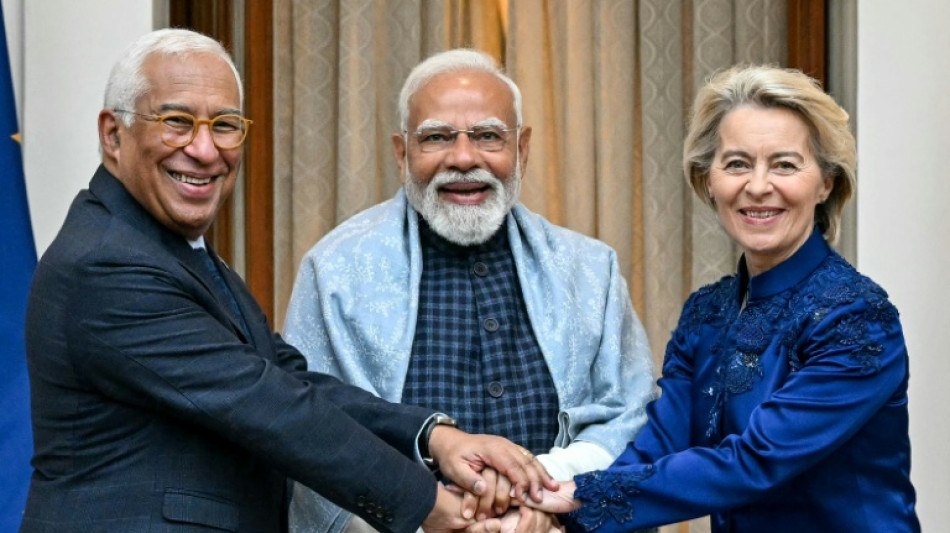
Greenland blues to Delhi red carpet: EU finds solace in India / Photo: © AFP

Presiding over the signing of a major trade deal alongside Indian Prime Minister Narendra Modi on Tuesday, EU chief Ursula von der Leyen broke into a large smile.
A diplomatic and economic coup, the EU-India pact comes as a welcome piece of good news for Brussels after a tumultuous few weeks dominated by US threats over Greenland.
Addressing a press conference in New Delhi, von der Leyen described it as a tale of "two giants who choose partnership" and "the best answer to global challenges".
In spite of its eye-tickling pollution, the Indian capital must have felt like a breath of fresh air for von der Leyen and European Council president Antonio Costa, who co-led the EU delegation.
As they flew away from Brussels over the weekend, the pair left behind a just-defused crisis in transatlantic relations and internal squabbling over another trade deal with South American nations.
In New Delhi, authorities rolled out the red carpet for the pair, who were feted as guests of honour at India's Republic Day parade.
Posters emblazoned with their faces adorned lampposts across the city.
Costa, whose family hails from Goa, proudly flashed his Indian identity card at a press conference where Modi celebrated him as "the Gandhi of Lisbon".
Meanwhile local media praised von der Leyen's burgundy and gold brocade outfit -- a nod to Indian fashion.
It was a far cry from the scorn and threats reserved for Europe by its traditional ally the United States at the World Economic Forum in Davos last week.
European officials had been hoping to make progress on Ukraine at the Swiss ski resort -- a goal drowned out by US President Donald Trump's push to wrest control of Greenland from EU member Denmark.
- 'Difficult job' -
Trump made an about-turn after talks with NATO chief Mark Rutte -- a change of heart EU officials were keen to credit to Europe's firm response -- and the climbdown took the sting out of an emergency summit called on the Greenland issue.
One year into Trump's second term, Costa said the European Union has "learned how to manage" the ups and downs, and not to "react to each message".
"We need to keep calm and continue to have a polite, respectful relationship," the council chief told AFP. "At the same time, we need to diversify our relationships".
But few in Europe believe the Greenland crisis was a one-off bump in the road, with the unpredictable US leader at the helm.
Maros Sefcovic, the EU's trade chief, told AFP he scours through newspaper headlines each morning in anticipation of "what else might happen".
"It's indeed a difficult job," he quipped.
Yet he said the same was true for most other countries, which in turn found renewed appeal in what Europe has to offer: partnership, predictability and stability.
India, for one, was left bruised by tariffs slapped on it by the White House over its purchase of Russian oil as New Delhi and Washington were negotiating a -- so-far-elusive -- trade deal.
"The last year has turbocharged the European trade policy," Sefcovic said.
Pushing to reduce its dependencies on the United States and China and lower the cost of US tariffs, the EU was negotiating or looking to open talks with an array of nations including the Philippines, Malaysia, the United Arab Emirates and Australia, he said.
- 'New opportunities' -
By cutting or eliminating tariffs on almost 97 percent of European exports, the deal struck in New Delhi will help ease access to India's 1.4-billion-people-strong market for cars, wine, pasta and other EU products.
But the signing also allowed Brussels to turn the page after a just-sealed pact with South American bloc Mercosur was cast into limbo by a legal challenge in the European parliament.
That setback added to rancorous divisions among member states over the deal's impact on European farmers, who remained deaf to the EU's arguments and staged months of tractor-mounted protests against the accord.
European officials hope the new India deal will also help bring the South Asian giant diplomatically closer to Europe.
Neutral on Ukraine, New Delhi has relied on Moscow for key military hardware for decades, but has tried to cut its dependence by diversifying imports and pushing its own domestic manufacturing base.
Modi said a security partnership struck alongside the trade deal would provide "new opportunities" for defence companies.
While denying a pivot away from Russia, foreign secretary Vikram Misri said India was interested in hosting the joint production of European military kit.
Monday's Republic Day parade featured Russian helicopters and planes, alongside dancers and motorcycle daredevils.
But, in perhaps a hint of things to come, it ended with a squad of French-made Rafale fighter jets zooming overhead.
D.Pan--ThChM