The China Mail - More baby milk recalls in France after new toxin rules

USD -
AED 3.672496
AFN 64.999678
ALL 81.588573
AMD 379.029852
ANG 1.79008
AOA 916.999541
ARS 1449.719304
AUD 1.43732
AWG 1.8025
AZN 1.698539
BAM 1.650151
BBD 2.016242
BDT 122.43245
BGN 1.67937
BHD 0.377017
BIF 2975.737965
BMD 1
BND 1.271584
BOB 6.942435
BRL 5.257403
BSD 1.001076
BTN 91.544186
BWP 13.176113
BYN 2.86646
BYR 19600
BZD 2.013297
CAD 1.36605
CDF 2265.000153
CHF 0.77988
CLF 0.021975
CLP 867.689828
CNY 6.951751
CNH 6.941175
COP 3626.78
CRC 496.70313
CUC 1
CUP 26.5
CVE 93.032968
CZK 20.57935
DJF 178.269032
DKK 6.322815
DOP 63.230368
DZD 129.880038
EGP 47.088601
ERN 15
ETB 156.05206
EUR 0.84653
FJD 2.228703
FKP 0.729754
GBP 0.732475
GEL 2.695024
GGP 0.729754
GHS 10.976819
GIP 0.729754
GMD 72.999728
GNF 8784.097333
GTQ 7.681242
GYD 209.445862
HKD 7.81015
HNL 26.425362
HRK 6.378901
HTG 131.200378
HUF 322.577992
IDR 16782.95
ILS 3.099235
IMP 0.729754
INR 91.49465
IQD 1311.39657
IRR 42125.000158
ISK 122.750189
JEP 0.729754
JMD 157.178897
JOD 0.708981
JPY 155.503498
KES 129.130131
KGS 87.449985
KHR 4030.628388
KMF 414.999802
KPW 900
KRW 1453.939756
KWD 0.30716
KYD 0.834223
KZT 505.528533
LAK 21528.492601
LBP 89647.267281
LKR 310.004134
LRD 185.702533
LSL 16.027252
LTL 2.95274
LVL 0.60489
LYD 6.324618
MAD 9.128815
MDL 16.948552
MGA 4464.150116
MKD 52.202968
MMK 2099.986463
MNT 3564.625242
MOP 8.053239
MRU 39.751102
MUR 45.649763
MVR 15.45956
MWK 1735.795886
MXN 17.358285
MYR 3.942022
MZN 63.760301
NAD 16.027252
NGN 1394.049808
NIO 36.836888
NOK 9.70597
NPR 146.471315
NZD 1.664765
OMR 0.384513
PAB 1.00108
PEN 3.37168
PGK 4.289481
PHP 58.869599
PKR 280.220805
PLN 3.572915
PYG 6656.120146
QAR 3.659474
RON 4.3137
RSD 99.381033
RUB 76.540627
RWF 1463.519585
SAR 3.750317
SBD 8.051613
SCR 14.998334
SDG 601.499594
SEK 8.968295
SGD 1.27239
SHP 0.750259
SLE 24.325041
SLL 20969.499267
SOS 572.132482
SRD 38.024985
STD 20697.981008
STN 20.671181
SVC 8.759629
SYP 11059.574895
SZL 16.019743
THB 31.584006
TJS 9.349825
TMT 3.5
TND 2.888144
TOP 2.40776
TRY 43.488803
TTD 6.777673
TWD 31.604503
TZS 2588.49008
UAH 43.112529
UGX 3575.692379
UYU 38.836508
UZS 12238.182624
VES 345.94141
VND 26020
VUV 119.156711
WST 2.710781
XAF 553.468475
XAG 0.01268
XAU 0.000212
XCD 2.70255
XCG 1.80413
XDR 0.687215
XOF 553.445126
XPF 100.622245
YER 238.324976
ZAR 16.07337
ZMK 9001.202915
ZMW 19.646044
ZWL 321.999592
  • RIO

    1.4670

    92.547

    +1.59%

  • BTI

    0.1000

    60.79

    +0.16%

  • SCS

    0.0200

    16.14

    +0.12%

  • CMSC

    -0.0380

    23.712

    -0.16%

  • CMSD

    -0.0100

    24.09

    -0.04%

  • BP

    -0.1450

    37.735

    -0.38%

  • RBGPF

    0.1000

    82.5

    +0.12%

  • BCE

    -0.0800

    25.765

    -0.31%

  • NGG

    -0.1800

    85.08

    -0.21%

  • RELX

    -0.1650

    35.64

    -0.46%

  • RYCEF

    0.7000

    16.7

    +4.19%

  • GSK

    0.9800

    52.59

    +1.86%

  • BCC

    1.5600

    82.39

    +1.89%

  • VOD

    0.2390

    14.889

    +1.61%

  • JRI

    0.0980

    13.175

    +0.74%

  • AZN

    1.7850

    192.225

    +0.93%

More baby milk recalls in France after new toxin rules
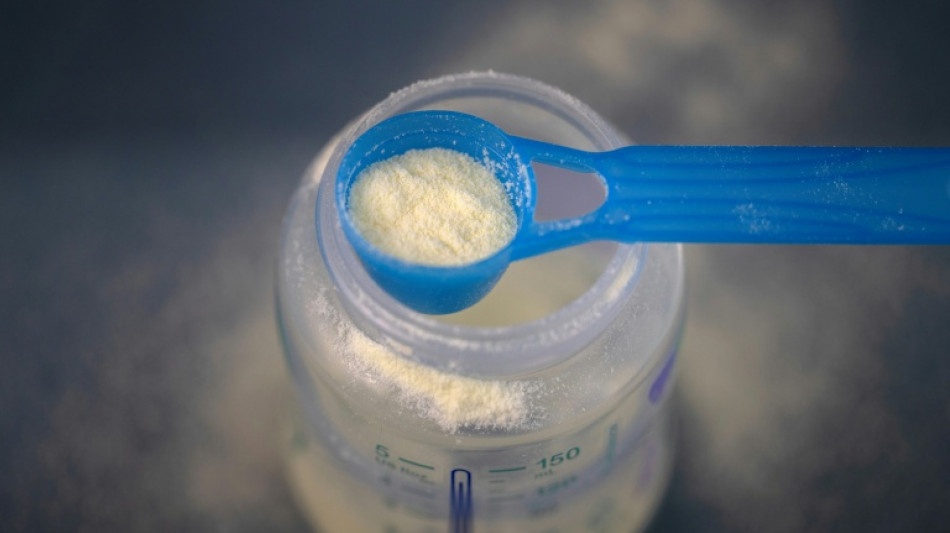
More baby milk recalls in France after new toxin rules / Photo: © AFP

More baby milk recalls in France after new toxin rules

Two infant formula manufacturers withdrew batches from the market on Monday after France imposed stricter limits on acceptable levels of a toxin that can cause nausea, vomiting and diarrhoea.

Text size:

French maker Popote said it was recalling two lots, while Vitagermine removed three different batches of Babybio formula from the shelves in the latest such recalls to rock the infant formula industry in recent weeks.

Several manufacturers, including European giants like Nestle, Danone, and Lactalis, have issued recalls of infant formula that could be contaminated with cereulide in more than 60 countries since December.

French authorities are investigating the deaths in December and January of two babies who were thought to have drunk possibly contaminated powdered milk. No link has been established so far between the formula and their symptoms.

The agriculture ministry on Friday set the new threshold at 0.014 micrograms of cereulide per kilogram of body weight, instead of 0.03 micrograms.

Vitagermine said its milk had complied with French rules until they changed last week, and it was removing the three batches on Monday to "better ensure the safety of infants".

Popote said it was removing two batches of first-stage infant formula "without waiting for the new European framework".

The European Food Safety Authority (EFSA) on Monday said its scientists had also suggested a maximum level for cereulide of 0.014 micrograms per kilogram of body weight.

This translated to 0.054 micrograms of cereulide per litre in infant formula, the Italy-based agency said.

"This advice is intended to help EU risk managers determine when products should be withdrawn from the market as a precautionary public health measure," it added.

- Cereulide health risk -

But European consumer association Foodwatch accused multinationals of focusing on thresholds as a "diversionary tactic".

"Cereulide should not be there at all in the first place," it said.

"It is illegal to market products that expose babies to health risks," it added, comparing cereulide to mouse droppings.

"There is no European standard on the presence of mouse droppings in infant formula. Nevertheless, it is prohibited," Foodwatch said.

The recall of potentially contaminated infant formula has heaped scrutiny on Chinese firm Cabio Biotech, the supplier of an ingredient used in infant formula which is suspected of being tainted.

Headquartered in the central Chinese city of Wuhan, Cabio Biotech is one of the world's largest producers of ARA, a fatty acid used primarily in baby formula and food products.

French company Nutribio told AFP it recalled some of its milk following an "alert" from Cabio Biotech.

French advocacy group Children's Health also named the company in a court filing, asking the government to order companies to pull all formula with ARA oil produced by Cabio Biotech.

Cabio Biotech has yet to publicly address allegations its ARA oil was contaminated, and has not responded to multiple requests for comment.

S.Davis--ThChM