'Metals of the future': copper and silver flow beneath Poland's surface / Photo: © AFP

Thousands of metres beneath the ground, amid suffocating heat, lies one of the keys to Poland's rumbling mining sector -- and the world economy.
Whitish ore, rich in copper and silver, is extracted from the country's depths and exported around the world to fuel technological and energy transitions.
"These are the metals of the future," Ariel Wojciuszkiewicz, a geologist at the Polkowice–Sieroszowice mine in the west of the country, tells AFP, noting that copper and silver are "indispensable for electronic equipment, electric cars, and renewable energy installations".
Driven by the rise of artificial intelligence, renewable energies, and global defence needs, demand for these metals is expected to keep increasing in the future, with copper even being referred to as "red gold" and a "barometer" for world economic development.
Poland, responsible for as much as half of Europe's supply, is one of the industry's key players.
Equipped with a helmet and an emergency breathing device, Wojciuszkiewicz leads AFP journalists through the Polkowice–Sieroszowice mine -- one of three sites operated by KGHM, the Polish metals giant, which also owns local smelters and companies in the Americas.
The 24-hour operation runs at a constant roar as machines grind rock at deafening volumes, its tunnels stretching for hundreds of kilometres beneath Poland's surface.
The world's second-largest silver producer, the KGHM group also supplies between 40 percent and 50 percent of the copper produced in Europe.
Last year, it ranked eighth worldwide in terms of copper extraction volume, behind global giants such as BHP Group, Glencore Plc and Rio Tinto, according to industry statistics.
Global copper demand, already high, is expected to climb by over 40 percent by 2040, according to a 2025 UN Report.
To meet this demand, "it might take 80 new mines and 250 billion dollars in investments by 2030," the organisation estimates.
The International Energy Agency (IEA), however, predicts that supply will lag 30 percent behind demand by as early as 2035.
- 1,200 degrees Celsius -
Dependence on copper is growing exponentially across the world economy's most innovative sectors.
"We don't realise how much we are surrounded by copper on all sides," Piotr Krzyzewski, KGHM vice president in charge of finance, explains to AFP.
"An electric car contains 80 kg of copper, compared with 20 kg in a conventional one," he notes, while "a wind turbine contains between four and ten tons of copper per megawatt."
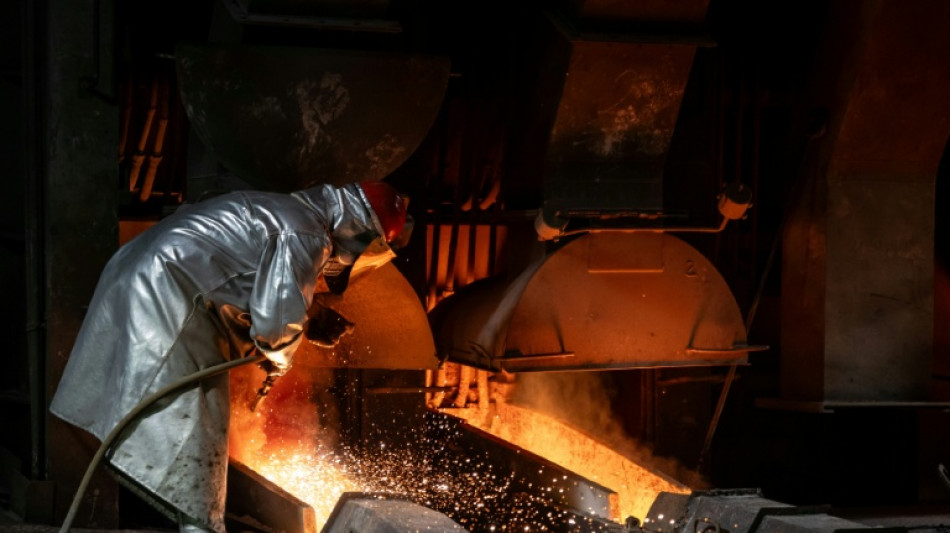
Farther away, at the Glogow smelter, two workers in protective suits, armed with long lances, open huge furnaces where the ore is melted.
They work diligently as sparks fly from metal heated to 1,200C.
Several processing stages later, 99.99 percent pure copper plates, each weighing more than a hundred kilos, are shipped all over the world.
Last year, the KGHM group as a whole generated more than 36 billion zlotys ($9.7 billion) in revenue. Copper production reached 710,000 tonnes and silver production 1,347 tonnes, according to the group's annual report, published at the end of March.
No less than half of the silver is used in industry, mainly for electronics, solar panels, and medical applications. The rest goes to jewellery or serves as a safety net and financial asset.
But it is copper, now an irreplaceable metal for the economy, that has become the object of global strategic contention.
"Copper is on the strategic list of critical metals in Europe, the United States, and China," Krzyzewski tells AFP.
The metal's impact on geopolitics is already being noted in real time.
In July, US President Donald Trump announced a 50 percent tariff on copper, eventually limiting the measure to products made with the metal.
To justify his decision, he invoked the need to "defend national security".
"Copper is the second most used material by the Department of Defense!" he said.
– Record prices –
In 2025, copper prices jumped 41.7 percent, before hitting a record high of $14,527.50 a ton in January of this year.
Even in the face of the war in the Middle East and the slowdown of the global economy, the price remains high at about 12,000 dollars per ton.
In this uncertain context, Poland's subsoil appears to be a major asset for the energy sovereignty of the Old Continent.
"It's no longer about the security of our country alone, but the security of all of Europe," Krzyzewski says, adding that KGHM's resources "are still estimated to last for at least 40 years," not counting new exploration and concessions.
But mining consumes enormous amounts of water, making it subject to the effects of global warming and drought.
M.Zhou--ThChM