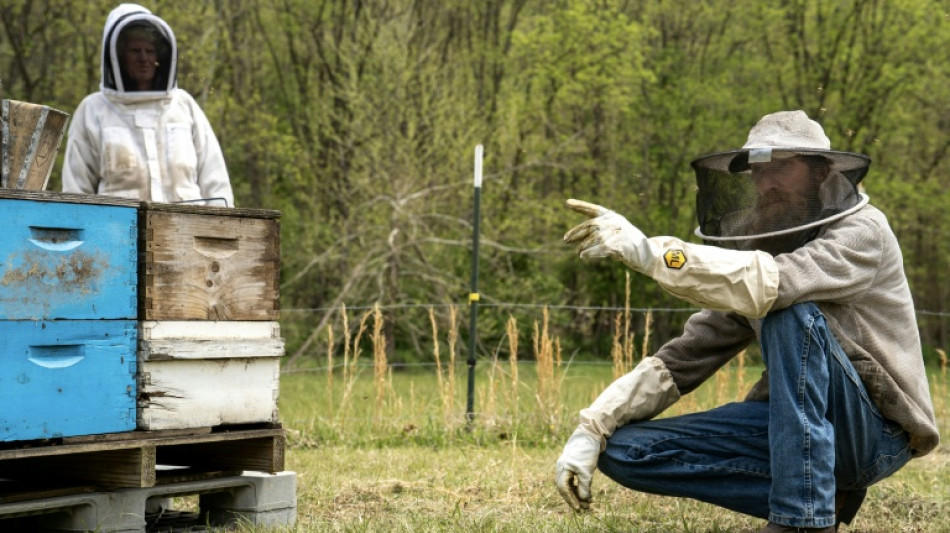
As bee population collapses, US apiarists fear research cuts / Photo: © AFP

In a lot behind a disused West Virginia gas station at the foot of the Appalachian Mountains, Roy Funkhouser is surrounded by about a dozen beekeepers and countless buzzing bees.
This club of apiarists -- ranging from hobbyists to full-time commercial bee farmers -- gathers regularly to learn new skills and discuss tricky problems, not least the parasitic varroa mites that plague their hives.
But the group -- and beekeepers across the country -- face a new challenge: The government's closure of a key research facility, home to the nation's oldest bee lab that has been at the vanguard of research into bee ills for over a century.
Funkhouser, a veteran commercial beekeeper, should have around 1,200 hives under his care. This year, he's sitting on less than 200.
"It's a real struggle," Funkhouser told AFP. "The parasites that we've got now, the mites and everything -- more viruses and more pesticide exposures, more chemical exposures -- everything is just more of a struggle today than what it was in the past."
- Catastrophic losses -
He's hardly alone.
America's beekeepers are in a bad way.
They lost more than half their bee colonies in the year leading up to April 2025, according to the latest estimates from Apiary Inspectors of America, marking the highest annual loss since the group began surveying beekeepers.
- Mites & Viruses -
"You know, I can sample for a mite count, but I can't sample for mitochondrial DNA," Funkhouser said. "We need the lab for that."
Funkhouser is referring to the aptly named "Varroa Destructor," a 1.5mm crab-looking creature that the US Department of Agriculture (USDA) calls "the most serious pest of honey bees inflicting more damage and higher economic costs than all other apicultural diseases."
The mites now wreak havoc on American bee colonies by feeding on the insects and spreading a wing-deforming virus.
The mites are also a threat to American crops.
Farmers pay Funkhouser to truck his bees across the country -- as far as the almond fields of California -- where they spend around two weeks pollinating crops.
"They'll get a percentage of almonds without [my bees] but not nearly the quantity that they're looking for," Funkhouser explained.
- Farm science -
In his mite battle, Funkhouser has found an ally in Zac Lamas, a researcher at the bee lab within the USDA's Beltsville Agricultural Research Center (BARC).
Lamas's "whole team come down one time, and we sampled everything," Funkhouser said. "They took bees back and growed them in the lab, they cultured all the pollen, the wax, and many, many things."
Lamas and his colleagues then formulate advice to share with beekeepers around the nation.
"It's not that we're working with one beekeeper. We might be working with several million dollars' worth of colonies, or several million dollars' worth of pollination services that won't exist because these colonies are at risk," Lamas told AFP between bare-armed lectures atop the hives.
But researchers like him may soon be out of job, as the USDA looks to save money by shutting BARC, eliminating labs and redistributing others to facilities across the country.
- Congressional cuts -
A USDA spokesperson told AFP that Congress had reduced agriculture research funding by more than $32 million "in certain areas," forcing the closure of the storied research center, leaving the fate of the nation's oldest bee lab uncertain.
Lamas argues this is short-sighted.
"The lab is 3.2 million (dollars) a year for 20 plus scientists, and all the work we do," he said. "We responded to a $600 million problem… The idea that we're redundant and expensive isn't a good way to generalize the value of this lab or the cost of this lab."
The USDA did not respond directly to AFP's questions about the fate of the bee research or where it might be relocated.
- Institutional knowledge -
Amid the uncertainty, Lamas has taken a job with a local university -- outside the lab.
But he fears the loss of institutional knowledge when the lab is fragmented.
"You have a dozen service-driven, -minded people, who all they want to do is provide benefits in the form of food security to the American public," he said. "When we have a problem, multiple people with overlapping skills can work on it."
Beekeepers are worried too.
"It's going to be a big loss," Funkhouser said. "We've got results from a lot of our testing and figured out a lot of the things that are going wrong."
"The unfortunate thing is, it seems like when you figure out one thing the next year, it's something else."
X.So--ThChM