US Fed chair Warsh vows reforms as central bank signals rate hikes on horizon / Photo: © AFP

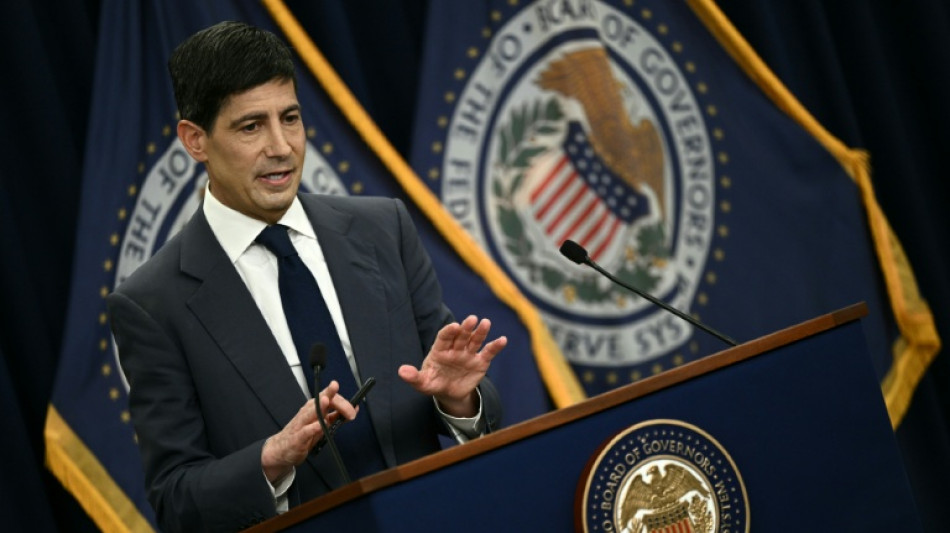
US Federal Reserve Chair Kevin Warsh on Wednesday vowed wide-ranging reforms at the central bank, as its rate-setting committee held rates steady but projected a rate hike by year-end to counter surging inflation.
The Fed decided to hold rates steady at 3.50 to 3.75 percent for the fourth consecutive meeting, with the vote being unanimous for the first time in a year.
Policymakers said inflation remained "elevated," partly due to supply shocks caused by skyrocketing energy prices triggered by US President Donald Trump's war on Iran.
Speaking to reporters after the meeting, Warsh vowed that the Fed would "deliver price stability" to Americans.
"Persistently high prices are a burden for the American people, but the recent past need not be prologue," he said, acknowledging that inflation has been well ahead of the Fed's two-percent target.
Trump has launched an unprecedented assault on the Fed's independence, opening a criminal probe into Warsh's predecessor and attempting to unseat another governor in his quest for lower interest rates.
Shortly after Wednesday's meeting, the Republican said he found it "hard to believe" the Fed would raise rates, but said he backed Warsh's decisions.
- Surging inflation -
US inflation came in at a three-year high in April, and Fed policymakers signalled they expected it to remain elevated through the end of the year.
In their Summary of Economic Projections (SEP), also released Wednesday, they raised their year-end projection for Personal Consumption Expenditures price index inflation from 2.7 percent to 3.6 percent.
They also raised their projected year-end interest rate, signalling that they expected one interest rate hike by the end of 2026.
The SEP was based on input from 18 of 19 policymakers, with Warsh withholding his forecast.
The new Fed chair has said he wants to reduce the amount the central bank communicates about its decisions.
During his briefing with reporters Warsh cut a polite figure determined not to say more than he intended, and to shift expectations on how much markets should expect to hear from the Fed chair.
"What we've given markets is a new chapter for the central bank -- some fresh thinking," he said, indicating he wanted financial markets to stop trying to interpret the Fed's reaction to data and to parse that data on their own.
- Wide-ranging reforms -
Warsh announced plans Wednesday to review five areas of Fed operations as he seeks to put his stamp on the US central bank.
He said he would name task forces to areas "central to the broad conduct of monetary policy": Fed communications, its balance sheet, its use of data sources, productivity/employment and the Fed's inflation frameworks.
The task forces were expected to deliver findings by the end of the year, he said.
Wednesday's statement was shorter than normal, and removed the forward guidance on the direction of the interest rate, which has been a constant in recent years.
Pao-Lin Tien, an economics professor at George Washington University, told AFP that moving towards more opaque monetary policymaking could mean inflation expectations are less anchored.
"Our fear would be that without the forward guidance, inflation expectations might become a little bit more volatile," she said.
A.Sun--ThChM