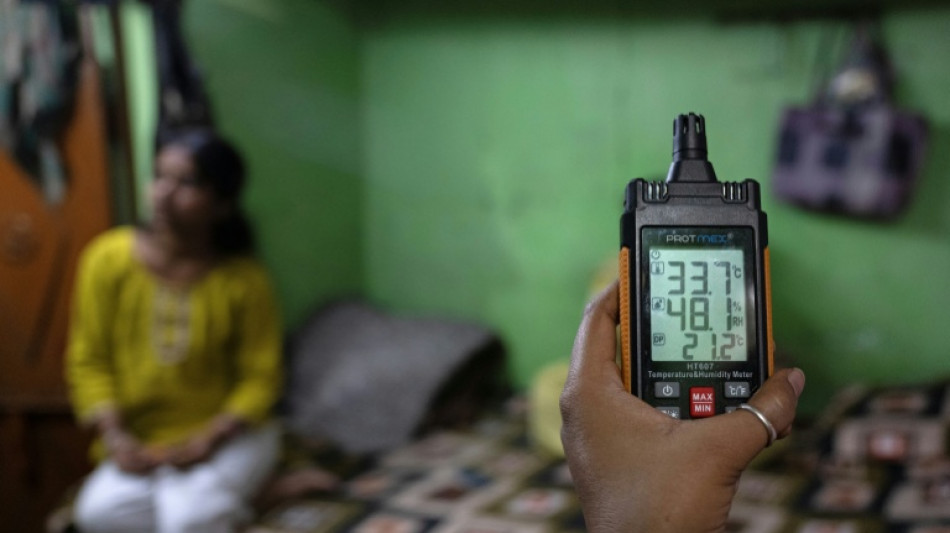
'Unbearable': tracking heat in one of New Delhi's poorest areas / Photo: © AFP

Durga Devi finds no relief after a day working in New Delhi's sweltering summer, because her poorly ventilated home radiates trapped heat, leaving her bedroom as hot as 45 degrees at night.
Campaigners are now documenting conditions in this densely packed area of India's capital, home to some of the country's poorest people, hoping to push policymakers to better protect vulnerable communities.
"I prefer staying outside after work, because inside the house there is no relief," said 45-year-old Devi, who lives in the cramped lanes of Delhi's Sundar Nagri district.
She spends eight hours a day working in a factory without a fan, only to return at dusk to stifling heat at home.
The one-room house -- like many in this part of the sprawling megacity of 30 million people -- has concrete walls, low roofs and poor ventilation, which combine to trap heat during the day and keep the space oppressively hot throughout the night.
Devi's son Abhishek has been keeping a heat diary and tracking temperatures inside the home and around the neighbourhood using a thermal camera, part of an initiative supported by Greenpeace India that includes 20 families in the area.
"I want to show how high the temperature goes here, and what it is like to live in this condition," said Abhishek, a 21-year-old student.
His findings reveal temperatures well above those recorded by official meteorological stations.
Devi said she had recorded temperatures as high as 45C on her bedroom wall at night. During the day, the concrete road outside registered a blistering 60C.
When AFP visited, the camera recorded the room temperature at 32C, while the kitchen wall was hotter, at 37C.
- 'No place to recover' -
"Heat doesn't end when the temperature outside falls," said Deepali Tonk, who has helped organise the project for Greenpeace India.
"For many families, the struggle continues inside homes that retain heat and offer no place to recover," she said.
"By documenting these experiences, we hope to support legal efforts to ensure vulnerable communities are better protected in these months."
Campaigners are gathering data and testimonies until July, and plan to file a legal case seeking stronger heat protections and a more effective action plan.
India has heat action plans that vary from state to state, and are often limited to measures such as heat alerts, changes in school and work timings, water distribution and temporary cooling spaces.
But they rarely offer long-term measures to address housing quality, urban heat retention, and protections for informal workers.
Officials would "come and count how many fans or rooms we have", said Arshi Qureshi, a 19-year-old student who has been measuring heat in the one-room home she shares with eight family members.
"But we are not just numbers. We are individuals living through this."
Summer heat in India, the world's most populous nation, can be brutal, and climate change is making extreme heat more common.
During a May 2024 heatwave, Delhi matched its previous record high of 49.2C, first recorded in 2022.
Night-time temperatures are also rising. Last month, the India Meteorological Department recorded a minimum temperature of 31.9C, the city's highest May night-time temperature in 14 years.
- 'We need change' -
The government releases limited statistics on heat-related deaths, with cases where heat contributes indirectly, such as heart attacks, often not counted.
In May, researchers at the University of California, Berkeley suggested India may be significantly undercounting heat-related deaths.
The researchers, drawing on data from 10 cities that tracked rises in mortality with temperature increase, estimated that a single day of extreme heat causes approximately 3,400 excess deaths nationally. A five-day heatwave causes nearly 30,000 deaths, they said.
"We have been very interested in quantifying the size of the problem, because what you cannot measure, you cannot manage," Ashok Gadgil, co-author of the research paper, told AFP.
The study illustrated the need for more localised action plans.
Annual monsoon rains are now sweeping north, with early storms tempering the blistering heat -- but also sending humidity shooting up.
Back in Sundar Nagri, vegetable seller Raja said his rooftop room has been unbearable since May.
"I couldn't concentrate at all," said the 21-year-old who is studying political science while preparing for government examinations.
To cool the air, he hangs a wet sack in front of a fan.
On the hottest days, his mother Madhuri Devi said she repeatedly vomited while cooking over the stove.
"We need change -- year after year, the summer is getting unbearable," said her son.
"We hope our experiences will help make a plan that could better protect us."
V.Fan--ThChM