Asia's vendors grapple with rising costs of ever-present plastics / Photo: © AFP

Food vendors across Asia who rely on plastics for everything from bags to cups and containers are grappling with their rising costs, the result of the energy crisis sparked by the Middle East war.
While the United States and Iran have reached a deal to halt the conflict, it will take time for markets to recover and supply flows to return to normal, with persistent concerns over traffic through the economically vital Strait of Hormuz.
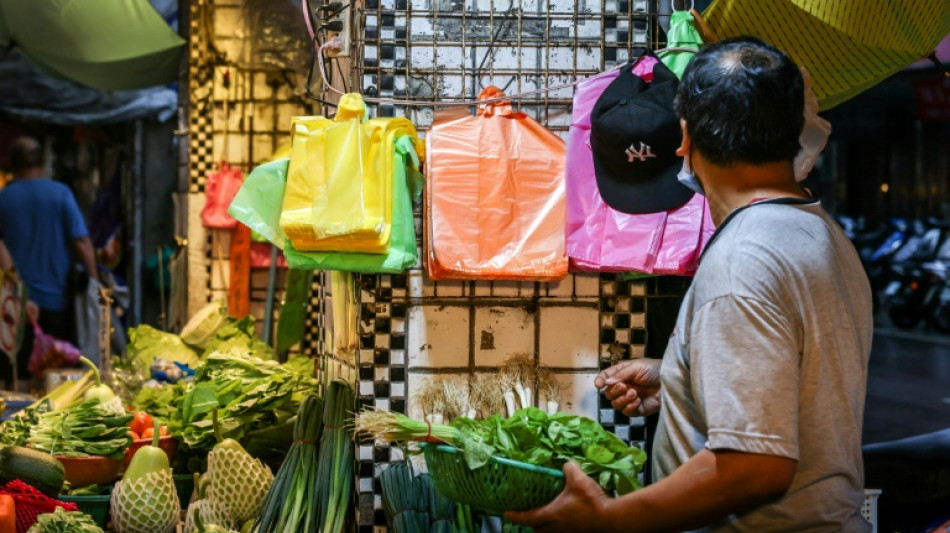
At Taipei's Songjiang market, chicken vendor Li Yu-ping, 52, said in early June that the price of plastic bags had jumped nearly 60 percent, while the cost of plastic trays had risen by a third.
"We use them everywhere," she said of the bags. "Our food containers are also plastic, all disposable."
Wary of hiking prices, "all of this has become a cost for the vendors", she said.
A key raw material for many of these plastic goods is ethylene, which is derived from naphtha, an oil by-product. Around 60 percent of the naphtha imported to Asia comes from the Gulf.
Faced with tight supply and soaring prices due to the monthslong closure of the Strait of Hormuz, petrochemical companies mainly in South Korea and Japan have scaled back production capacity, sending the cost of basic goods such as plastic bags surging.
In Bangkok, Nikorn Sai-inthara, a 60-year-old selling vegetables from a street cart, estimated his operating costs had risen by 30 percent.
"I rely on plastic bags for my work because I sell vegetables on the go to busy people and office workers," said Nikorn, who wraps individual portions in plastic and secures them with a rubber band.
"Ever since the fighting started in the Middle East, my profits have fallen, but I don't dare raise prices for my customers," he told AFP.
- 'No choice' -
Several vendors across the region told AFP they do not have a practical alternative to the plastic products they use on a daily basis.
"We have no choice. If you don't give customers plastic bags, they complain," said Chang Chiu-hsiang, a 78-year-old grocer in Taipei.
"I think you can't really avoid using them," added Li, the chicken vendor, noting however that some customers have started to use reusable bags.
Somsak Jaidee, 62, who sells rice porridge in bags secured with rubber bands at a Bangkok market, said that while "everything is more expensive... I have to endure it."
"I can't think of anything else that offers the same convenience for my customers as plastic bags."
A cautious reopening of the Strait of Hormuz since the US-Iran deal was signed last week has yet to fully impact naphtha prices, which have dipped only slightly.
And manufacturers continue to process naphtha purchased when prices were higher.
In early June, Taiwanese manufacturer Formosa Petrochemical reported cutting the utilisation rate of its ethylene steam cracker to 35 percent, down from 53 percent in March at the very start of the war.
"At this point, the situation is not entirely due to lack of feedstock. The bigger issue now is that the feedstock has become extremely expensive, and some of our customers simply can't bear the higher prices," Formosa's president, Lin Keh-yen, told AFP.
- Diversification -
In South Korea, supply tensions remained acute in early June.
"Normally, if we order 10,000 plastic bags, they arrive within about a week. Now suppliers are telling us that we may have to wait more than a month" with prices 30-percent higher, said a shop employee in Seoul.
A nearby dry cleaner said the price of plastic garment covers had more than doubled, while a cafe owner noted a 50-percent increase in the cost of plastic cups.
South Korea's plastics industry association said the Middle East war had forced manufacturers to hike prices, although "alternative" supply routes have helped stabilise the situation.
Fajar Budiyono, secretary-general of the Association of Olefin, Aromatic, Plastic and Chemical Industries in Indonesia, said a shift to suppliers in places like China and Africa has helped keep prices at bay.
In the Philippines, meanwhile, manufacturers said they had absorbed some of the additional costs.
"Our profits got squeezed. We could not simply raise prices as we would be swamped by imports," said Steve Tavera, a member of the Philippine Plastics Industry Association.
As a result, price hikes have so far been "conservative", he said.
burs-joy-tak-jug/lga/ami/abs
U.Feng--ThChM