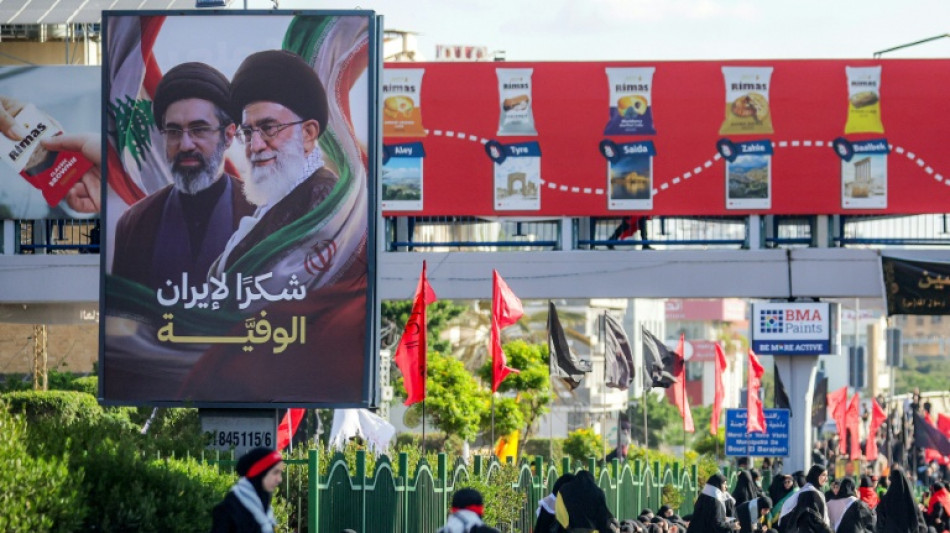
Iran warns challenge to Hormuz routes will spike Middle East tensions / Photo: © AFP

Iran's top diplomat warned Sunday that any attempt to bypass the Strait of Hormuz routes agreed with the United States would "increase tensions" in the Middle East, as the countries traded attacks and accusations of violating a fragile truce.
The exchanges underscored the fragility of a Pakistan-brokered agreement aimed at ending a war launched by the United States and Israel in February, which disrupted shipping through the strait and rattled global energy markets.
"Any attempt to adopt new or separate arrangements compared to what is underway by the Islamic Republic of Iran, will only lead to more complicated situations and delays in the reopening of the Strait of Hormuz, and will increase the tensions," Iranian Foreign Minister Abbas Araghchi said.
"I urge all parties... to adhere to the memorandum of understanding and not to allow this MoU to deviate from its course."
Iran's Revolutionary Guards said Sunday they were taking measures to control traffic in the strait -- through which in peacetime around a fifth of the world's oil and liquefied natural gas exports travel -- and that violating vessels would be dealt with more firmly than before.
The Guards said Thursday that Oman and the International Maritime Organization (IMO) announced a new corridor without consulting Tehran, and warned vessels against using it.
The only authorised passage by Tehran passes through a corridor running along Iran's coast.
Mohammad Mokhber, adviser to Iran's supreme leader, wrote on X that as long as Iran managed the strait the US' "hegemonic dreams in the region will not be realised".
In the memorandum of understanding reached this month -- aimed at putting a lasting end to the war -- Iran had agreed "safe passage of commercial vessels with no charge, for 60 days only, from the Persian Gulf to the Sea of Oman, and vice versa" in the strait.
Although a ceasefire took effect in April, sporadic violence has continued in the Gulf region, and on Sunday, Iran said it carried out retaliatory strikes against US bases in Kuwait and Bahrain in response to American attacks.
Bahrain denounced the "treacherous Iranian attacks", saying its air defences had intercepted missiles and drones.
Kuwait meanwhile condemned "Iran's heinous aggression... the latest of which was at dawn".
- Iran would 'no longer exist' -
The strikes came after US forces said they had struck "multiple" Iranian targets Saturday in another tit-for-tat response to attacks on shipping in the strait.
Experts said there would likely be more Hormuz incidents.
For Iran, "a drawn-out negotiation accompanied by controlled pressure in the strait can work to its advantage", said HA Hellyer, of London think tank the Royal United Services Institute.
The agreement signed by the US and Iran said both countries, and their respective allies, were "not to initiate any war or any military operation against each other and to refrain from the threat or use of force against each other".
But both countries have since traded accusations of violating their fragile ceasefire.
US President Donald Trump said Saturday that Iran would "no longer exist" if the US is "forced" to resume the war.
"United States aircraft just struck Iranian missile and drone storage locations, and coastal radar sites, for violating the Cease Fire Agreement, AGAIN!" Trump wrote on Truth Social.
US Central Command said the strikes were in response to an Iranian drone attack on the Panama-flagged oil tanker "Kiku".
Washington had carried out similar strikes on Friday.
- Israel strikes Lebanon -
Israel, meanwhile, launched strikes in Lebanon as Hezbollah's leader Naim Qassem rejected a deal to end that conflict, which has also threatened to derail the wider US-Iran peace effort.
Iran called them "a blatant violation" of the truce deal.
Hezbollah lawmaker Hassan Fadlallah warned on Sunday of "internal conflict" in Lebanon over the country's agreement with Israel, predicting the deal would not be implemented.
The agreement, which was signed in Washington on Friday and aims to pave the way to peace between the neighbours, includes plans to disarm Iran-backed militant group Hezbollah.
Lebanon was drawn into the Middle East war in early March, when Hezbollah launched rockets at Israel in support of Iran, and Israel responded with heavy airstrikes and a ground invasion.
Iranian foreign ministry spokesperson Esmaeil Baqaei said Sunday that Israel's withdrawal from Lebanon was "an essential condition for reaching a final and lasting agreement" that establishes security in the region.
But the Washington deal does not appear to provide for that.
On Sunday, Lebanese state media reported a new Israeli strike on the country's south, while the Israeli military said a soldier was killed in fighting in southern Lebanon.
burs-amj/jfx
Z.Huang--ThChM