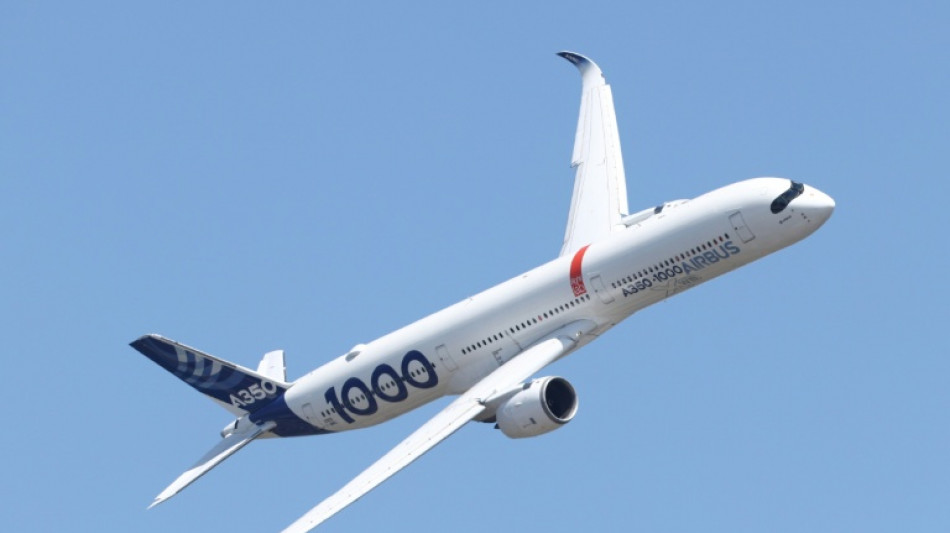
Airbus, Boeing fly in different directions at Farnborough / Photo: © AFP/File

Airbus and Boeing presented differing outlooks for their commercial aircraft in coming years, as the aviation sector gathered near London for this week's Farnborough airshow.
As well as taking on its US rival in the battle for orders, Europe's Airbus used the bienniel event to outline its successor to its flagship A320 single-aisle jet, which it hopes to enter service in the second half of the next decade.
Boeing, by contrast, believes that airlines are looking for an improved narrow-body 737 MAX rather than a new aircraft.
"We have been preparing (our move) for a long time," Airbus chief executive Guillaume Faury said at the airshow.
"In early 2018, we began examining what needed to be done and how to structure the company to prepare it for the next generation."
- New wings -
Airbus unveiled at Farnborough its "wing of tomorrow" -- a longer, lighter and folding wing structure designed to reduce fuel consumption by up to 30 percent. Test flights are to begin this year.
Boeing is adopting a more cautious approach, insisting that three conditions must be met before launching a new aircraft: finances, technology readiness and a mature market.
"From a financial perspective, it is driven by production rates," Stephanie Pope, head of Boeing Commercial Airplanes, said at Farnborough.
She noted that "about 70 percent" of Boeing's cashflow comes from the 737, adding it is "essential" that the group grows production to 47 planes per month from 38 currently.
It is "very important in our recovery", Pope added.
Boeing hinted this week that a tough financial situation at the group was not the primary obstacle to launching a new programme.
On the technology front, the anticipated certification of the 737 MAX 7 and 737 MAX 10 this year -- following years of delays -- should help to free up significant engineering resources, Pope said.
For Boeing chief executive Kelly Ortberg, a new aircraft is not the priority for airlines, insisting that they are looking for better performance from existing fleets and, crucially, more reliable and durable engines.
"The message I'm constantly hearing is: 'Forget about something new. Let's get what we've got performing better'," he said in an interview with "Aviation Week" ahead of Farnborough.
- Engine-makers -
Caught between Airbus optimism and Boeing's caution, engine manufacturers are advancing several technologies to meet the needs of both companies.
CFM International, a joint venture between France's Safran and the US-based GE Aerospace, is closely monitoring the debate.
Its Leap engines power all Boeing 737 MAX aircraft and nearly 60 percent of Airbus A320neo planes, while its "open fan" engine currently in development is expected to reduce fuel consumption by up to 20 percent. Fans in current jet engines are enclosed.
Referred to as "Rise", the new advanced engine has undergone hundreds of hours of ground tests, ahead of airborne testing expected before the end of the decade, CFM announced at Farnborough.
Should Airbus opt for this type of engine while Boeing selects a more conventional architecture, CFM believes it can cater for both giants of the air.
J.Thompson--ThChM