US economic growth slows in second quarter, missing expectations / Photo: © AFP

The United States saw slowing growth in the second quarter, the Commerce Department said Thursday, with the fallout from President Donald Trump's Iran war weighing on the world's largest economy.
GDP grew at a sluggish annualized rate of 1.5 percent in the second quarter, the Bureau of Economic Analysis said, missing analyst expectations of around 2.0 percent.
It had grown by 2.1 percent in the previous quarter, BEA data showed.
"Compared to the first quarter, the deceleration in real GDP in the second quarter reflected a downturn in government spending and decelerations in investment and exports that were partly offset by an acceleration in consumer spending," the BEA said in a statement.
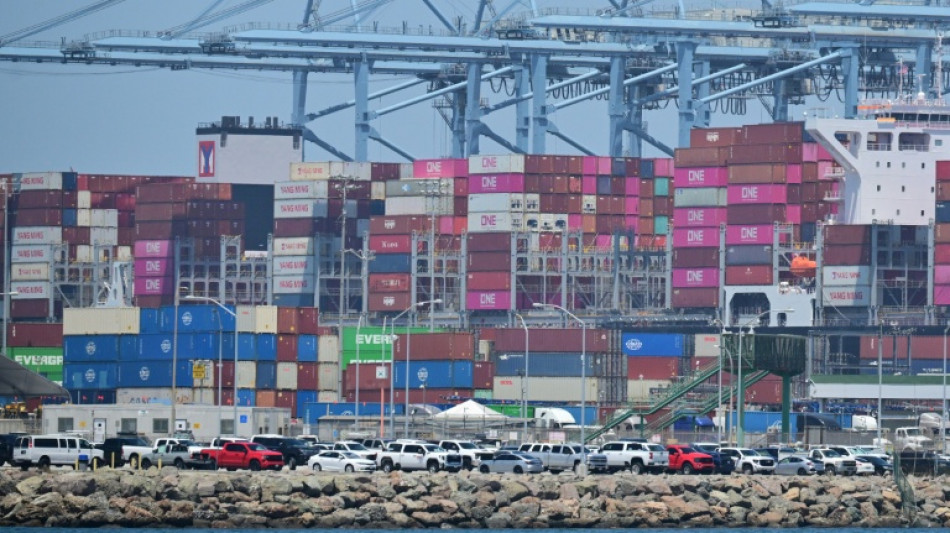
The bureau also cited an increase in imports -- which are a subtraction from GDP -- as a factor in Thursday's data.
The US economy has been facing headwinds from a number of factors, but has displayed robust growth in recent quarters despite turmoil from a turbulent tariff policy and the fallout of the Iran war, which has seen energy and fertilizer prices skyrocket.
Economic growth has been buoyed by investments in the AI boom, but consumption has been hit by years of high prices, compounded by the effects of the war.
The state of the US economy and how it is impacting households across the country is a key issue in November midterm elections, which will see the Democratic Party attempting to wrest control of Congress from Trump's Republicans.
- Inflation high but slowing -
On Thursday, BEA data showed that Personal Consumption Expenditures (PCE) inflation had slowed to 3.7 percent in June, from 4.1 percent the month before.
The indicator is the US Federal Reserve's preferred gauge of inflation, as it takes into account a broader swathe of spending than the Consumer Price Index (CPI) data.
The Fed has a long-term two-percent target for PCE inflation, but prices have surged in recent months and have remained above target for more than five years, since the pandemic.
On Wednesday, the Fed chose to keep interest rates steady despite those push factors, but three policymakers dissented, calling for an immediate rate hike.
Core PCE inflation, which strips out volatile food and energy prices, came in at 3.3 percent.
PCE inflation is expected to pick up again in July on the back of Trump renewing the military offensive on Iran, which has driven energy prices back up.
- 'Resilience' -
Chris Zaccarelli of Northlight Asset Management said the lower inflation figure may give the Fed room to continue holding rates, but the GDP figures were of greater concern.
"The weaker-than-expected GDP numbers this morning could be cause for concern that the economy is slowing too quickly," he said.
Michael Pearce, chief US economist at Oxford Economics, said the GDP figure was not entirely negative, as it showed non-AI investment had posted its biggest increase in three years.
"We expect that recovery to broaden in the coming quarters, driven by tax cuts and lean inventories," he said.
"The subdued 1.5 percent annualized rise in GDP in Q2 underplays the economy's strength as it reflects a drag from rising imports and falling inventories that won't be sustained for long."
Kathy Bostjancic, chief economist at Nationwide, offered a similar assessment of Thursday's sluggish figure.
"The softish headline Q2 GDP reading masks strength in the core private domestic sector that expanded by a vibrant 3.9 percent," she said.
"This underscores the resiliency of the economy in the face of the energy price shock emanating from the war in the Middle East."
Z.Huang--ThChM