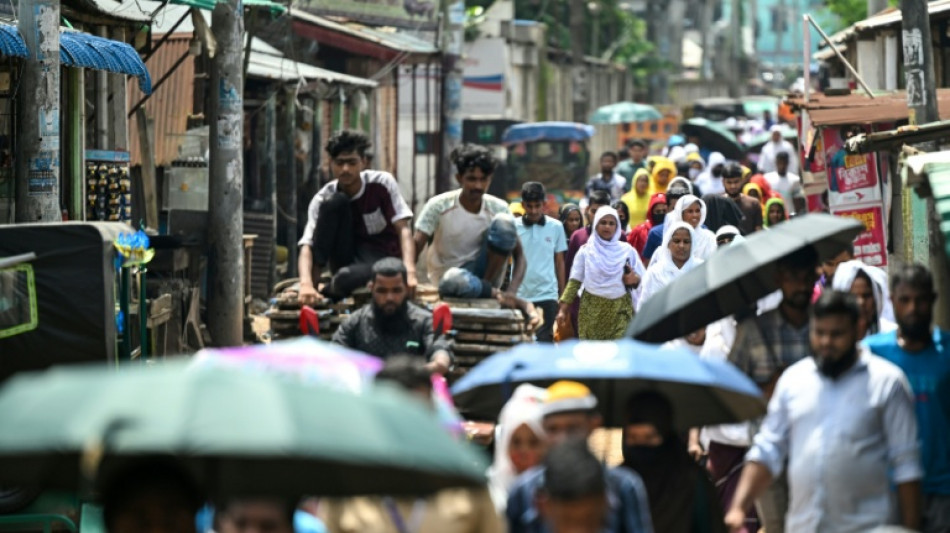
Factories shed workers in Bangladesh garment sector / Photo: © AFP

Garment worker Mosammat Aklima found out in a text message that she had become one of thousands laid off in the latest wave of cuts to hit Bangladesh's once-booming export industry.
The news appearing on her mobile that July evening confirmed the end of her eight years' employment at Lithe Garments factory, a major manufacturer in the country's industrial heartland.
She was among 3,000 people laid off in one go, a sign of the industry's struggle with slowing exports, weak customer demand and stiff competition from rivals India and Vietnam.
"I am three months pregnant now. It is not possible to find a new job," said Aklima, 27.
"I will now dip into my savings, borrow some money. I don't know what's next," she told AFP in the garment hub of Gazipur.
Aklima earned $250 a month, roughly matching the income of her husband, who works at another garment factory.
With her redundancy, their son and elderly parents must now rely on a single wage.
The layoffs are part of a wider downturn in an industry that accounts for around 80 percent of Bangladesh's export earnings.
About 400 of the roughly 4,000 apparel factories in the country have shut over the past two years, eliminating tens of thousands of jobs, according to the Bangladesh Garment Manufacturers and Exporters Association.
Some of them had to shut down because they could not survive with exports declining in the "highly competitive" global market, BGMEA president Mahmudul Hasan Babu told AFP.
- Trade deals -
The closures have fuelled concern over the future of a sector that employs more than 4.5 million people, most of them women.
While US tariffs are similar for apparel exporters across Asia, analysts say Bangladesh faces a greater challenge in Europe, its largest market, where India and Vietnam have gained ground through free-trade agreements.
The pressure could intensify as Bangladesh is set to lose the duty-free preferential market access it enjoys in Europe and other countries because its status as a least-developed country is scheduled to expire in 2029.
"If Bangladesh fails to strike free-trade agreements after the end of the preferential trade regime, the country may risk losing competitiveness," said Dhaka University professor Selim Raihan.
European Union apparel imports fell during the first five months of the year, with those from Bangladesh recording the sharpest decline among major suppliers, Eurostat data shows.
Experts point to weak consumer demand linked to conflicts in Ukraine and the Middle East, but also blame structural weaknesses in the South Asian nation of 170 million people.
The industry remains focused on low-margin products such as T-shirts and jeans, while rivals have moved into higher-value segments made with synthetic fibre.
Bangladesh, which earned about $39 billion from garment exports in 2025, relies heavily on imported cotton and other fibres, raising production costs.
- Basic products -
"We have expanded without planning and without consolidating the infrastructure," said Mohiuddin Rubel, founder and chief executive of Apparel Voice, a research and advocacy group.
"We got stuck with basic products," he said, adding that Bangladesh had not fully tapped opportunities in military uniforms and medical apparel.
Research also remains limited, while automation is reshaping production lines elsewhere.
A recent World Bank study found that most garment factories in Bangladesh still rely on semi-automated labour-intensive processes, while rivals such as Vietnam are moving rapidly towards advanced manufacturing.
At the same time, labour advocates worry that technological advances can have an impact on employment numbers.
"We have not seen any integrated government policy to manage this transition in manufacturing," said Syed Sultan Uddin Ahmed, executive director of the Bangladesh Institute of Labour Studies.
Government adviser Rashed Al Mahmud Titumir said authorities were focusing on training to help workers adapt to changing industrial needs.
For workers, however, long-term plans offer little immediate comfort.
Begum, who did not give her first name, told AFP she had been turned away by many factories in Gazipur despite having experience in sewing and hemming.
She had to go back to her native village in the country's north to bring back rice and other essentials to feed her family.
"I don't know what will come next."
P.Deng--ThChM