As Opel turns to Chinese partners, its hometown frets about the future / Photo: © AFP

As Germany's Opel slashes its engineering ranks and partners with China's Leapmotor, anxiety is running high in Ruesselsheim, the city it has long dominated.
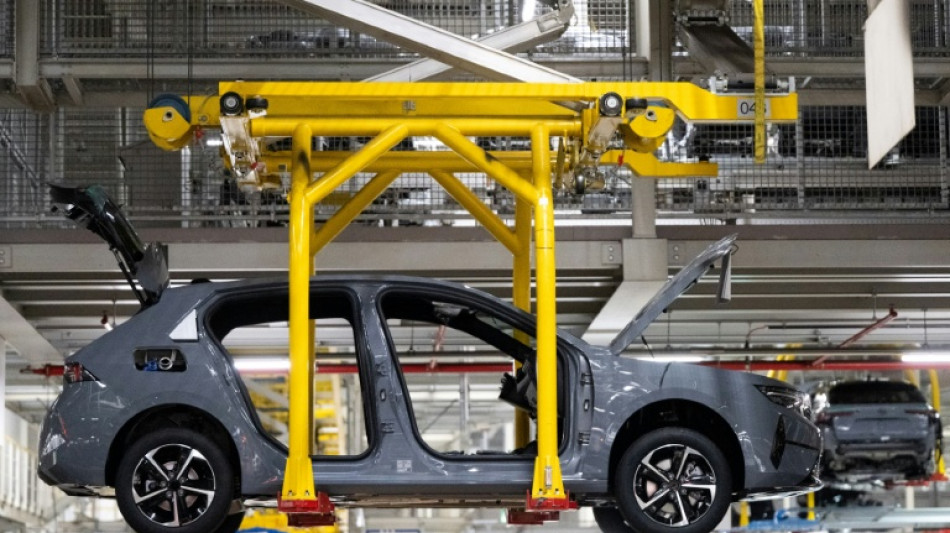
Struggling like many other European automakers, Opel is expanding its partnership with Leapmotor to build a new SUV, tapping the Hangzhou-based company's expertise on electric vehicles and low-cost production -- while leaving Opel's local engineers to perform more old-fashioned vehicle design work.
Stellantis, Opel's multinational parent company, said in April that it would cut 650 engineering jobs -- from a total workforce of 1,650 -- at its Ruesselsheim development centre, amid a wave of job cuts across the German auto industry.
Those developments have unleashed concerns in this Rhine River city, where Opel was once the mighty engine of prosperity. For their part, the mass-market carmaker's executives say they are trying to adapt to the "reality" of stiff global competition.
- A new reality -
For Daniel Bremm, a local representative of the IG Metall union, the main risk is technological downgrading, the possibility that the engineering centre would be reduced to a mere "adaptation hub" for vehicles designed elsewhere within the Stellantis group or in China.
"In France and Italy, they are hiring, whereas in Germany, we are only cutting jobs," Bremm lamented, saying that governments in Paris and Rome seemed to be lobbying the parent company more aggressively.
"The arrival of Chinese manufacturers in Europe is a reality," Opel boss Florian Huettl told AFP. He noted that Chinese carmakers had captured nine percent of the EU market over the first five months of 2026 -- a figure that rose to 10.5 percent in June.
Huettl said the Leapmotor partnership would combine German industrial know-how with the Chinese company's software expertise "to create the best of both worlds".
The Ruesselsheim teams would in turn refocus on their core competencies -- vehicle parts such as chassis, seats, lighting, steering and driver-assistance systems.
- A changed European market -
German automakers are ramping up cost-cutting measures in response to a sluggish European market, overcapacity in the EV sector, and the rising strength of Chinese rivals.
Volkswagen, Mercedes-Benz, BMW and Porsche have all announced cost-reduction programmes.
For Opel, these measures are part of a long-term trend.
Founded in 1862 by Adam Opel, the company produced sewing machines and later bicycles, before venturing into car manufacturing in 1899 at its Ruesselsheim site.
Long a symbol of German industrial might, the brand dominated the West German market and sold well across Europe in the 1970s thanks to successful and affordable models like the Kadett and the Rekord.
It subsequently went into gradual decline under the ownership of the American group General Motors, which long restricted its international expansion to avoid competition with other GM subsidiaries.
- Fewer than 7,000 employees -
Opel was acquired in 2017 by France's Peugeot Group, which in turn merged with Fiat-Chrysler in 2021 to form Stellantis.
The workforce at Ruesselsheim has shrunk from a 1970s peak of around 42,000 employees to approximately 6,800 by the end of 2025.
Opel is no longer even the town's largest employer.
The city's mayor, Patrick Burghardt, noted in an interview with AFP that that position is now held by the nearby Frankfurt airport.
These latest job cuts "naturally have an impact" on the city, Burghardt said.
Although he understood Opel's need to remain competitive globally, he worried that a strategy of cutting German engineering expertise could eventually "come back to haunt them in the long run".
None of the employees contacted by AFP wished to comment on the site's future.
- Economic diversification -
Concerns have been compounded by the decision to manufacture the upcoming SUV -- developed in partnership with Leapmotor -- in Zaragoza, Spain, rather than in Ruesselsheim.
There was, however, a bit of good news this summer when Stellantis decided to allocate production of the next-generation Opel Astra and DS4 to Ruesselsheim, securing the plant's operations beyond 2029.
This decision is part of a one-billion-euro ($1.2 billion) investment plan for Germany running through 2030, which includes the construction of a new Ruesselsheim headquarters known as the "grEEn-campus".
That came as a relief to Opel's workers and the city, though anxieties remain high as the broader auto industry remains under pressure and questions remain about the future shape of the Chinese partnership.
The municipality is not waiting to find out, instead seeking to accelerate its economic diversification, hoping to find new areas of growth beyond the Opel plants.
Opel has committed to releasing 140,000 square meters (1.5 million square feet) of industrial land, which the city plans to transform into a technology hub dedicated to green hydrogen.
"We have two hearts beating in our chests," Burghardt, the mayor, told AFP.
Job cuts are difficult for families, he said, but the new project offers "a unique opportunity" for the city to "position itself in a much better way" for the decades ahead.
A.Sun--ThChM