The China Mail - NASA satellite rescue mission fails

USD -
AED 3.672502
AFN 64.000029
ALL 81.501894
AMD 360.300301
ANG 1.789785
AOA 917.999928
ARS 1538.507797
AUD 1.422738
AWG 1.8025
AZN 1.677898
BAM 1.755348
BBD 2.014118
BDT 124.150744
BGN 1.747831
BHD 0.37735
BIF 3000
BMD 1
BND 1.281553
BOB 11.995315
BRL 5.385503
BSD 1.000013
BTN 95.207367
BWP 13.822349
BYN 2.947868
BYR 19600
BZD 2.01121
CAD 1.397321
CDF 2315.000297
CHF 0.822255
CLF 0.025025
CLP 988.119786
CNY 6.661102
CNH 6.65463
COP 3178.94
CRC 454.76167
CUC 1
CUP 24.000287
CVE 99.197463
CZK 21.753898
DJF 177.719676
DKK 6.68102
DOP 60.650375
DZD 135.26301
EGP 56.002289
ERN 15
ETB 161.149916
EUR 0.89395
FJD 2.24075
FKP 0.747647
GBP 0.746635
GEL 2.599154
GGP 0.747647
GHS 11.649517
GIP 0.747647
GMD 74.000066
GNF 8799.999657
GTQ 7.645879
GYD 209.614159
HKD 7.844085
HNL 27.000156
HRK 6.76901
HTG 131.054259
HUF 327.0915
IDR 18170
ILS 3.11488
IMP 0.747647
INR 95.267006
IQD 1514
IRR 1868414.999662
ISK 121.419633
JEP 0.747647
JMD 158.760361
JOD 0.708966
JPY 157.59796
KES 129.989677
KGS 87.448023
KHR 4072.99998
KMF 440.999894
KPW 899.999961
KRW 1335.301894
KWD 0.31104
KYD 0.833326
KZT 453.3167
LAK 22534.99989
LBP 89549.999695
LKR 332.450795
LRD 170.449866
LSL 16.629789
LTL 2.95274
LVL 0.60489
LYD 6.424992
MAD 9.833505
MDL 18.045072
MGA 4595.000356
MKD 55.021155
MMK 2099.909661
MNT 3597.883233
MOP 8.082337
MRU 40.240109
MUR 47.279726
MVR 15.450451
MWK 1736.000155
MXN 18.88925
MYR 4.054099
MZN 63.90998
NAD 16.629887
NGN 1346.859954
NIO 36.809505
NOK 9.22898
NPR 152.332146
NZD 1.77407
OMR 0.384488
PAB 1.000013
PEN 3.459795
PGK 4.49025
PHP 63.708502
PKR 276.602571
PLN 3.9231
PYG 5858.938516
QAR 3.645503
RON 4.771902
RSD 105.072008
RUB 81.248966
RWF 1475
SAR 3.7541
SBD 8.058206
SCR 13.983075
SDG 601.499746
SEK 9.826885
SGD 1.277835
SHP 0.748335
SLE 22.897847
SLL 20969.504398
SOS 571.497754
SRD 37.644498
STD 20697.981008
STN 22.3
SVC 8.749697
SYP 13001.999685
SZL 16.630013
THB 33.712025
TJS 9.190174
TMT 3.5
TND 3.0207
TOP 2.40776
TRY 49.930696
TTD 6.779691
TWD 32.613982
TZS 2649.713013
UAH 45.55389
UGX 4360.137679
UYU 40.22581
UZS 11995.00019
VES 887.479801
VND 25791
VUV 119.217464
WST 2.773901
XAF 586.392655
XAG 0.019619
XAU 0.000250628137
XCD 2.70255
XCG 1.802288
XDR 0.707052
XOF 586.392655
XPF 107.305413
YER 236.167524
ZAR 16.623855
ZMK 9001.207781
ZMW 20.200416
ZWL 321.999592
SSP 5745.199062
MXV 2.128922
  • RYCEF

    0.4000

    19.71

    +2.03%

  • CMSC

    0.0000

    20.4

    0%

  • BTI

    0.4200

    56.05

    +0.75%

  • BP

    0.2800

    44.43

    +0.63%

  • RBGPF

    1.6000

    67

    +2.39%

  • RIO

    -0.1500

    94.41

    -0.16%

  • AZN

    -0.4300

    166.15

    -0.26%

  • GSK

    0.4600

    49.7

    +0.93%

  • BCE

    -0.4100

    20.56

    -1.99%

  • NGG

    -0.2500

    75.24

    -0.33%

  • VOD

    -0.0400

    16.58

    -0.24%

  • RELX

    -0.4500

    33.07

    -1.36%

  • BCC

    -0.5500

    76.59

    -0.72%

  • CMSD

    -0.0300

    20.27

    -0.15%

  • JRI

    -0.2500

    10.77

    -2.32%

NASA satellite rescue mission fails
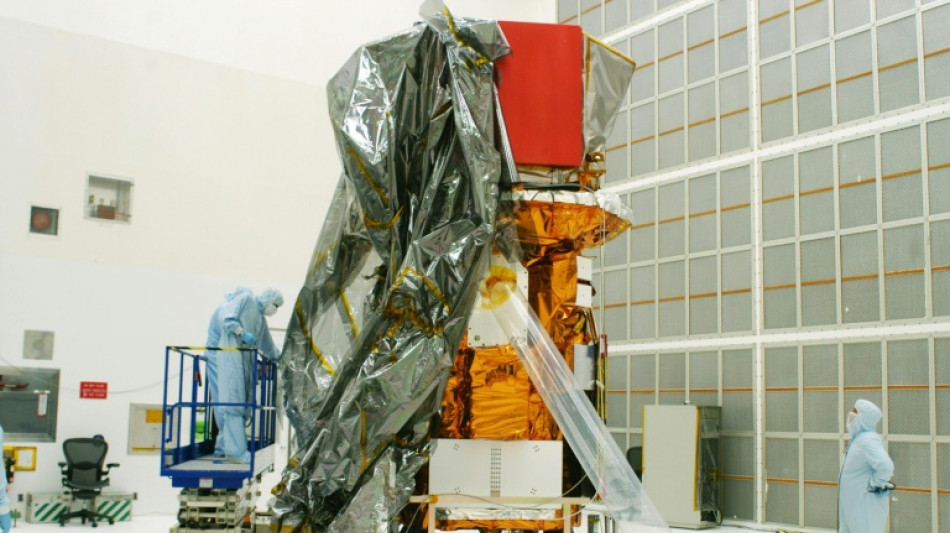
NASA satellite rescue mission fails / Photo: © NASA/AFP

NASA satellite rescue mission fails

A complicated mission to save a NASA satellite from burning up in the atmosphere has failed, the US space agency said Wednesday, as the rescue spacecraft could not be controlled.

Text size:

The Swift space telescope, which studies the most powerful explosions in the universe, will now likely plunge back to earth and disintegrate along the way later this year.

The unprecedented $30 million dollar mission attempted to send a robot to grab the telescope and move it farther into orbit.

"This is not the outcome we were working toward, but it does not change why this mission was worth attempting," NASA Administrator Jared Isaacman said.

Planners had hoped the mission would pave the way for giving other satellites a second life.

"The team moved with extraordinary speed to give Swift a chance to carry out more science while advancing capabilities America will need for satellite servicing in the future," Isaacman added.

Developed by American startup Katalyst, the unmanned spacecraft was launched on July 3 by a small rocket named Pegasus, which was itself launched from an airplane.

However, on July 28 the company said the spacecraft had been in an out-of-control spin for 72 hours with multiple problems including a loss of communications.

In announcing the mission failure on Wednesday, Katalyst cited "ongoing attitude control issues" as the reason it and NASA were calling it off.

NASA said that the spacecraft would still attempt to reach the Swift telescope with the hope of giving scientists and engineers lessons for similar future missions.

The agency launched Swift in 2004 to study gamma-ray bursts.

O.Tse--ThChM