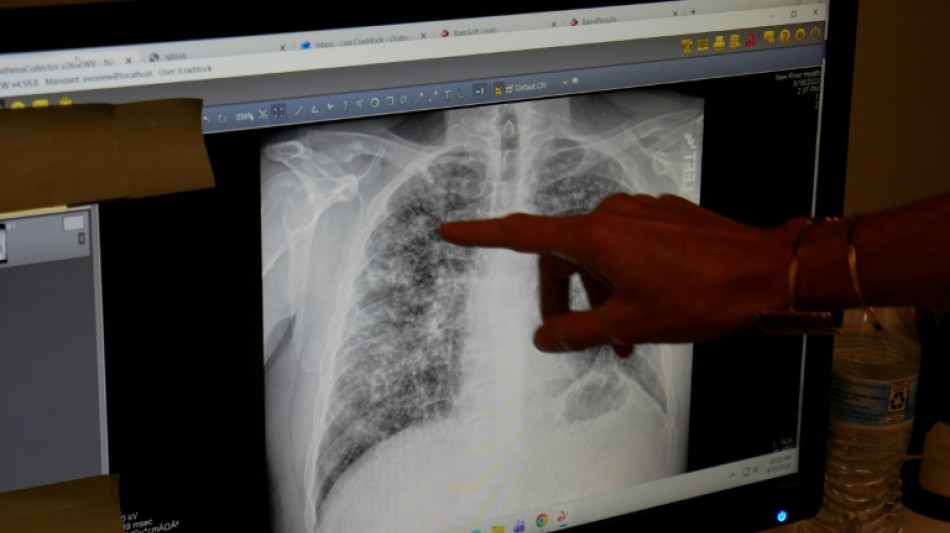
In US mining hub, black lung rates soar / Photo: © AFP

John used to love to go fishing with his son. But at age 45, after 20 years working in the coal mines of West Virginia, physical activity has become nearly impossible.
"I can't do nothing," said the man who, despite his sturdy build, had trouble speaking.
"I can't breathe, and it's changed everything."
John, who asked to be identified by a pseudonym because he is part of a lawsuit against his former employer, has been diagnosed with coal workers' pneumoconiosis, commonly called black lung disease.
When coal dust is repeatedly inhaled over time, it causes scarring in the lungs that makes it difficult to breathe.
There is no treatment to reverse the damage. The complications can eventually be fatal, when not enough oxygen reaches the bloodstream.
Appalachia -- a region defined by the Appalachian Mountains that includes all of West Virginia and parts of a dozen other states -- is a major mining hub in the United States.
With about 30,000 coal miners working there, John is not alone in his suffering.
The National Institute for Occupational Safety and Health (NIOSH) this month published a study revealing that one out of three miners in the area with more than 25 years in the industry have black lung disease.
"To see that it's the worst that it's ever been since I've been here, and all the way back to the 1970s, is quite alarming," said NIOSH epidemiologist Scott Laney, the study's co-author.
"I was saddened, but I cannot say that I was surprised."
- 'Your son's disease' -
Disease prevalence rates in the region have risen for the past 20 years or more, after a period when they had dropped off thanks to regulations limiting miners' exposure to coal dust.
Why? The answer is silica, a material that is 20 times more toxic than coal.
Once companies had extracted all the easy-to-reach coal, miners were forced to bore deeper into the rock, which sent fine silica dust into the air.
This increased exposure explains why more and more miners are getting sick more quickly, and more seriously, than before, Laney explained.
In a specialized clinic in the city of Oak Hill, the youngest black lung patient was just 30 when he was diagnosed with progressive massive fibrosis, the most severe form of black lung disease.
"This is not Grandpa's disease anymore. This is your husband's disease. This is your son's disease," said Emery, the director of the Breathing Center and Black Lung Clinic at New River Health.
Emery said some of her 40-something patients are now on the list for double lung transplants, their only real hope of survival.
"You can treat the symptoms... but there's no cure for black lung."
- 'Totally preventable' -
Faced with a crisis, the government's Mine Safety and Health Administration (MSHA) in 2024 adopted a rule lowering the silica exposure limit to a level scientists believe is safer.
But mining associations filed suit, claiming that the standards set by the government to measure compliance are too stringent.
A federal appeals court suspended the rule. It has never been implemented, and MSHA has shelved it indefinitely.
The National Mining Association, the main lobbying group for mining firms in the United States, told AFP it "absolutely supports" the new lower permissible silica exposure limit.
"Where we differ with the MSHA silica rule is how to get there," said association spokeswoman Ashley Burke.
Burke insisted that new black lung cases do not reflect current mining conditions, because of the delay in the onset of symptoms.
Improvements over the last two decades had "exponentially" lowered dust levels, she said.
A study by the Appalachian Citizens' Law Center, a non-governmental organization that advocates for miners, showed that in mines tested by MSHA in 2025, one out of five had dangerous levels of silica dust.
In about 10 of them, the dust level was twice as high as the limit proposed in the not yet implemented MSHA rule.
"The companies know how to work around the dust inspectors," said Gary Hairston, a former miner and the president of the National Black Lung Association.
"They ain't worried about the coal miners. We're just a number to them," added Hairston, who is a black lung patient himself.
"All they worry about is the coal they produce."
For Debbie Wills, who has spent nearly 40 years working with black lung patients at Valley Health Systems, the situation is all the more dire because the disease is "totally preventable."
"Nobody has to have it. But if you don't use your engineering controls and run your mine properly, they will get it," Wills said.
V.Liu--ThChM