The China Mail - Merino crossbreeding plan tests Himachal Pradesh wool ambitions

USD -
AED 3.673042
AFN 65.000368
ALL 79.715041
AMD 364.320403
ANG 1.789783
AOA 917.000367
ARS 1499.143585
AUD 1.395504
AWG 1.8
AZN 1.70397
BAM 1.679281
BBD 2.014502
BDT 123.298316
BGN 1.696366
BHD 0.37703
BIF 2992
BMD 1
BND 1.271197
BOB 11.727937
BRL 5.193604
BSD 1.00021
BTN 95.349267
BWP 13.402252
BYN 3.016542
BYR 19600
BZD 2.011669
CAD 1.39105
CDF 2273.000362
CHF 0.809457
CLF 0.023655
CLP 931.010396
CNY 6.72675
CNH 6.731305
COP 3211.02
CRC 451.378305
CUC 1
CUP 26.5
CVE 95.503894
CZK 20.838504
DJF 177.720393
DKK 6.453404
DOP 58.750393
DZD 133.39204
EGP 49.798455
ERN 15
ETB 160.503874
EUR 0.863104
FJD 2.198804
FKP 0.735368
GBP 0.738825
GEL 2.603861
GGP 0.735368
GHS 11.19504
GIP 0.735368
GMD 74.000355
GNF 8780.000355
GTQ 7.634879
GYD 209.263688
HKD 7.84235
HNL 26.870388
HRK 6.505404
HTG 130.854201
HUF 315.250388
IDR 17757.4
ILS 2.976204
IMP 0.735368
INR 95.43455
IQD 1310.5
IRR 1374575.000352
ISK 121.390386
JEP 0.735368
JMD 158.543444
JOD 0.70904
JPY 160.07504
KES 129.440385
KGS 87.450384
KHR 4045.503796
KMF 425.00035
KPW 900.000294
KRW 1377.570383
KWD 0.30892
KYD 0.833552
KZT 463.527826
LAK 22425.000349
LBP 89550.000349
LKR 328.019886
LRD 180.250382
LSL 15.990381
LTL 2.95274
LVL 0.60489
LYD 6.340381
MAD 9.289039
MDL 17.293533
MGA 4329.000347
MKD 52.82251
MMK 2099.772007
MNT 3598.777615
MOP 8.07707
MRU 40.110379
MUR 46.840378
MVR 15.460378
MWK 1736.000345
MXN 17.034504
MYR 4.025904
MZN 63.910377
NAD 15.990377
NGN 1341.580377
NIO 36.720377
NOK 9.375804
NPR 152.558483
NZD 1.691475
OMR 0.381078
PAB 1.00021
PEN 3.351504
PGK 4.42225
PHP 62.270375
PKR 277.550374
PLN 3.74735
PYG 5927.077117
QAR 3.645038
RON 4.539504
RSD 101.324183
RUB 86.149411
RWF 1469
SAR 3.789762
SBD 8.000184
SCR 13.880372
SDG 601.503676
SEK 9.57835
SGD 1.274504
SHP 0.740866
SLE 24.625038
SLL 20969.499227
SOS 571.503662
SRD 37.74037
STD 20697.981008
STN 21.375
SVC 8.75176
SYP 13001.999906
SZL 15.990369
THB 33.150369
TJS 9.25201
TMT 3.51
TND 2.913038
TOP 2.40776
TRY 48.240368
TTD 6.788276
TWD 31.638704
TZS 2644.998038
UAH 44.565558
UGX 3771.073837
UYU 40.278022
UZS 11825.000334
VES 790.677104
VND 26085
VUV 118.040776
WST 2.709953
XAF 563.222427
XAG 0.015062
XAU 0.000224
XCD 2.70255
XCG 1.80268
XDR 0.707052
XOF 563.000332
XPF 103.503591
YER 236.525037
ZAR 16.17251
ZMK 9001.203584
ZMW 18.929211
ZWL 321.999592
  • CMSC

    -0.0200

    21.29

    -0.09%

  • CMSD

    0.0000

    21.18

    0%

  • JRI

    -0.0500

    12.35

    -0.4%

  • AZN

    -1.8200

    162.7

    -1.12%

  • VOD

    0.1600

    16.04

    +1%

  • BCE

    0.0600

    23.46

    +0.26%

  • BCC

    -0.0200

    78.75

    -0.03%

  • RBGPF

    0.0800

    70.77

    +0.11%

  • GSK

    0.5500

    50.82

    +1.08%

  • RIO

    -1.4800

    103.3

    -1.43%

  • BP

    -0.1900

    42.15

    -0.45%

  • BTI

    -0.1500

    56.13

    -0.27%

  • RELX

    0.2400

    36.54

    +0.66%

  • RYCEF

    -0.2500

    20.5

    -1.22%

  • NGG

    -0.0800

    79.35

    -0.1%

Merino crossbreeding plan tests Himachal Pradesh wool ambitions


Merino crossbreeding plan tests Himachal Pradesh wool ambitions

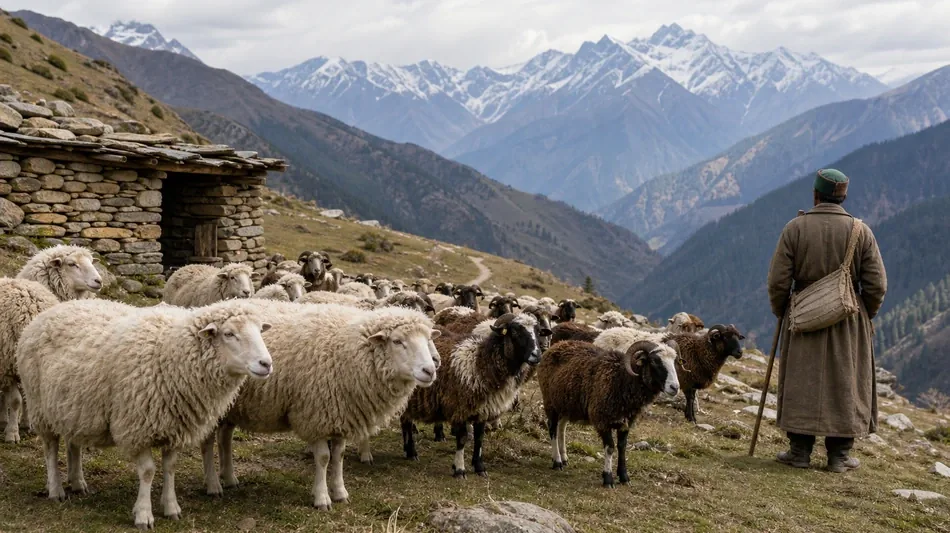
Himachal Pradesh is distributing Merino-Gaddi crossbred sheep to raise fine-wool output, while pastoralists and researchers warn that local breeds and migratory systems need protection.

Text size:

Himachal Pradesh is expanding a wool-development programme launched in 2021 under the National Livelihood Mission with a budget of Rs 6 crore. The state wants to increase annual wool output from about 1,500 tonnes to 3,000 tonnes by 2027 by introducing Australian Merino genetics into indigenous flocks.

The government brought 240 Merino sheep, comprising 40 males and 200 females, to its breeding farm at Nagwain in Mandi in 2021. Artificial insemination involving Merino and Gaddi sheep has since produced 800 healthy lambs. Fifty-two animals, including 20 males and 32 females, were recently sent to Bharmour, a historic centre of Gaddi pastoral life, for eventual introduction to farmers and herders.

Merinos can yield 4.3 to 4.5kg of fine wool per animal annually. The programme seeks to reduce fibre diameter from roughly 27 microns in Pahari sheep to 21 or 22 microns, producing softer apparel-grade wool. Crossbred wool sells for about Rs 40 to Rs 70 a kilogram, compared with Rs 12 to Rs 15 for wool that many pastoralists sell to private traders. The Himachal Pradesh Wool Federation pays about 20% more for white crossbred wool than for coarse wool.

Adaptation remains uncertain. Gaddi flocks move seasonally across elevations from 200 metres to 3,400 metres and can cover 10 to 15km a day on rugged terrain. Herders said dense, soft wool could retain water during the monsoon, increasing the risk of skin infections and pneumonia, and could be damaged by thorny shrubs. They also questioned whether softer Merino-type hooves could withstand mountain routes as effectively as indigenous animals.

Pastoralists are interested in breeds that may improve income, but weak market access, limited institutional capacity and the absence of strong producer federations also depress returns from indigenous wool. Traditional Gaddi fibre is water resistant and supports products including carpets, unali coats and pattu cloth, linking the breed to local ecological knowledge and culture.

The programme’s animals will require continuous monitoring under pastoral conditions rather than only at the Nagwain farm. The report argues that Merino crossing should remain below 50%, while the quality of local Gaddi rams should also be improved so fine-wool development does not displace the indigenous breed and its associated livelihoods.

V.Liu--ThChM