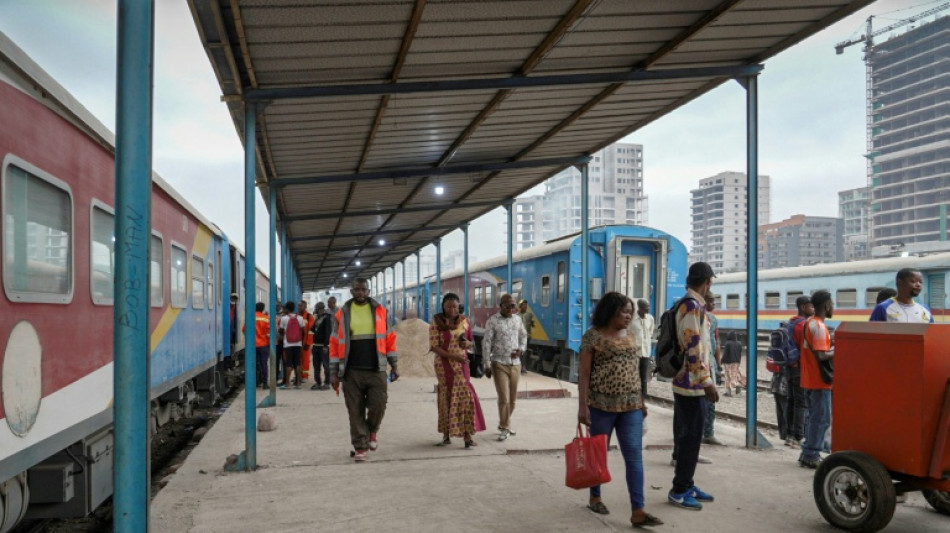
Kinshasa urban train back on track after years to beat gridlock / Photo: © AFP

At dawn, dozens of passengers crowded along dusty tracks to board the only urban rail link serving downtown Kinshasa, the Democratic Republic of Congo's congested capital.
Recently brought back into service after nearly 15 years out of operation, the sky-blue train sporting the national colours makes the daily round trip between the outskirts of the airport and the centre of the megacity of nearly 17 million inhabitants.
At Masina station, a suburb about 10 kilometres (six miles) from the city centre, people have to elbow their way through to find a spot in the packed carriages.
Those who miss their stop -- which last barely a few moments -- have to jump on while the train is moving.
The basic one-way ticket costs 2,000 Congolese francs (around $0.87), rising to 4,000 francs in second class and 5,000 in first class.
Carriages are packed to bursting and the heat inside quickly becomes stifling due to a lack of air conditioning.
Those lucky enough to have a seat can see the busy avenues and vast shantytowns that have sprung up along the tracks in recent years as they go by.
Others end up missing the legendary yellow minibuses that clog the city streets.
"We're paying the same price, but here there's nowhere to sit," grumbled Clovis Musa, who lives in Masina and works at the central market, standing in a second-class carriage filled with noise and chatter.
Nevertheless, the Kinshasa rail service offers an escape for residents of outlying neighbourhoods who are otherwise forced to spend several hours a day in monster traffic jams.
"I haven't taken a car in four years; I do all my trips back and forth by motorbike," Britey Mafuka, a trader who spends around $380 a month on transport, said.
"I was starting to look for a house near the city, but when they brought the train back, I dropped the whole idea," he added.
- Quick but 'expensive' -
Mass transit systems are considered vital for the future of African megacities, which are seeing rapid population growth and often chaotic urbanisation.
Kinshasa, Lagos in Nigeria and Tanzania's Dar es Salaam are projected to be the most populous cities in the world by 2100.
Nigeria's biggest city inaugurated a long-awaited urban train in 2023.
The Senegalese capital, Dakar, did the same in 2021, and three years later, established a bus network on dedicated lanes to alleviate the congestion in the city centre.
But in Kinshasa, which sits on the banks of the mighty Congo River, such infrastructure has remained at the planning stage.
The railway network, built in the aftermath of independence from Belgium in 1960, was gradually abandoned by the National Transport Office (ONATRA) due to a lack of funds to maintain the tracks.
President Felix Tshisekedi officially restarted the Kinshasa urban train service after nearly 15 years at the end of June.
Its resurrection is part of the MetroKin project, a 300-kilometre rail network supported by Africa Finance Corporation, a pan-African organisation that helps fund and develop infrastructure, the president's office said.
The revamped city link means it takes around an hour and 15 minutes to travel into the city centre from the area around the airport.
By road "it's practically impossible", Chadrack Walele, the line manager, said.
Between 4,000 and 5,000 passengers are transported per train, he said.
"If these passengers were now to go by road it would cost us an enormous amount of time and cause traffic jams," he said.
The train currently does one daily round trip but that will soon rise to two, he added.
On arrival at Kinshasa's central train station, thousands of passengers poured out onto the tracks -- with mixed opinions.
"We're glad they restarted the train because it's the fastest way to travel," Gabriel Mfutila said.
But "we are poor, we are trying to survive -- how are we going to feed our children and pay for transportation that's so expensive?" he said, on the platform before disappearing into the city's crowds.
Q.Moore--ThChM