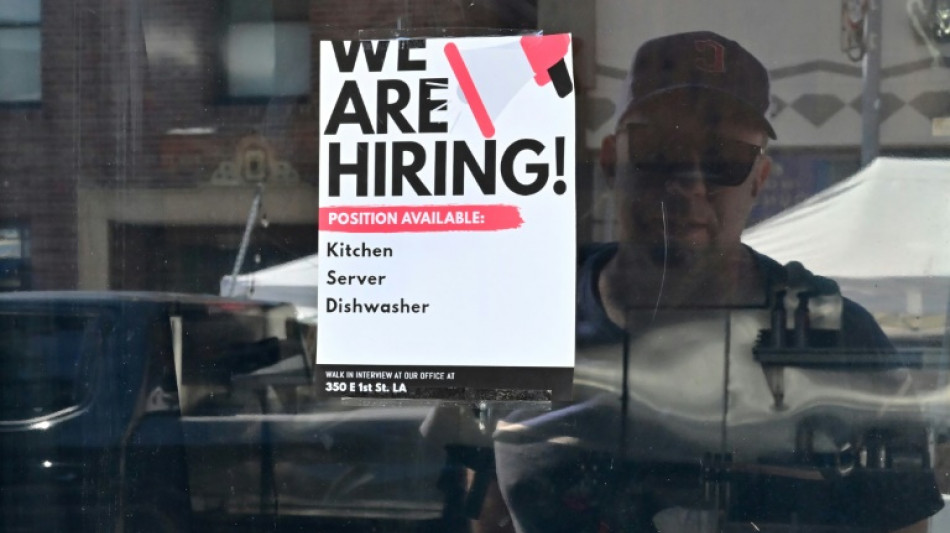
Slowdown or not? US job market walking a tight rope / Photo: © AFP

The number of "Help Wanted" signs may have decreased across the United States in August, but the job situation still remains tense, official figures are expected to show Friday.
According to consensus, the unemployment rate for August should fall somewhere around 3.5 percent when official data is released at 8:30 am (1230 GMT).
If the estimate turns out to be true, it would be the same rate as July when unemployment first returned to its pre-pandemic levels, which had been the lowest in 50 years.
Job creation, on the other hand, is expected to have slowed sharply, falling to 300,000 -- almost half July's number.
Data for private sector jobs created in August already disappointed: American employers ratcheted back their hiring in the month to 132,000, according to data published Wednesday by payroll firm ADP, a far cry from the 315,000 jobs that had been expected.
"We think that these numbers suggest a shift to a more moderate pace of hiring," Nela Richardson, chief economist for ADP, said in a conference call.
Firms of all sizes are trying "to read what has become a complex economic picture" due to high inflation and a lack of workers at a moment when employers are looking to hire on a large scale.
Neither an economic slowdown, fears of recession nor action taken by the Federal Reserve to curb soaring inflation have deflated the hot job market.
In July, the labor market demonstrated particular dynamism when it returned to its pre-pandemic level.
The unemployment rate fell to a historically low 3.5 percent as the 22 million jobs lost due to Covid-19 returned.
By the end of the month, there were more than 11 million job openings, or two for every job seeker. Just over four million Americans quit their jobs in July, and the same held true for June.
- 'Some pain' -
Meanwhile, weekly jobless claims -- which provide insight into layoffs -- fell almost every week in August and remain at historically low levels.
"Labor market conditions remain tight despite fairly weak economic growth," said Nancy Vanden Houten, chief economist for Oxford Economics, in a note released Thursday.
US GDP contracted in the first two quarters of 2022, which falls under the classic definition of a recession.
But because of its glaringly robust job market, the US economy doesn't quite seem to fall under the recession label for the moment.
The August jobs report data is expected to strengthen the Federal Reserve's commitment to raising interest rates.
The Fed's rate-hiking fight against high inflation will likely result in an employment slowdown and even a rise in the unemployment rate.
Federal Reserve chair Jerome Powell hammered home this point last week at a conference in Jackson Hole, Wyoming, warning of "some pain to households and businesses," as well as a "softer labor market."
With companies having faced a labor shortage for more than a year, many are offering higher wages, which is in turn driving up prices.
Amid the soaring inflation, the Fed has been gradually raising its key rate, making credit more expensive and thus slowing consumption as well as pressure on prices.
It is expected to raise rates again at its next meeting on September 20 and 21. To determine the extent of the rate hike, it will take Friday's employment figures into serious consideration.
A slowdown in the labor market could indicate that the Fed's rate hikes are finally bearing fruit, whereas a tight labor market would lead the Fed to act more forcefully.
Inflation, at its highest in 40 years, slowed to 8.5 percent over the previous year in July, according to the CPI index.
A.Sun--ThChM