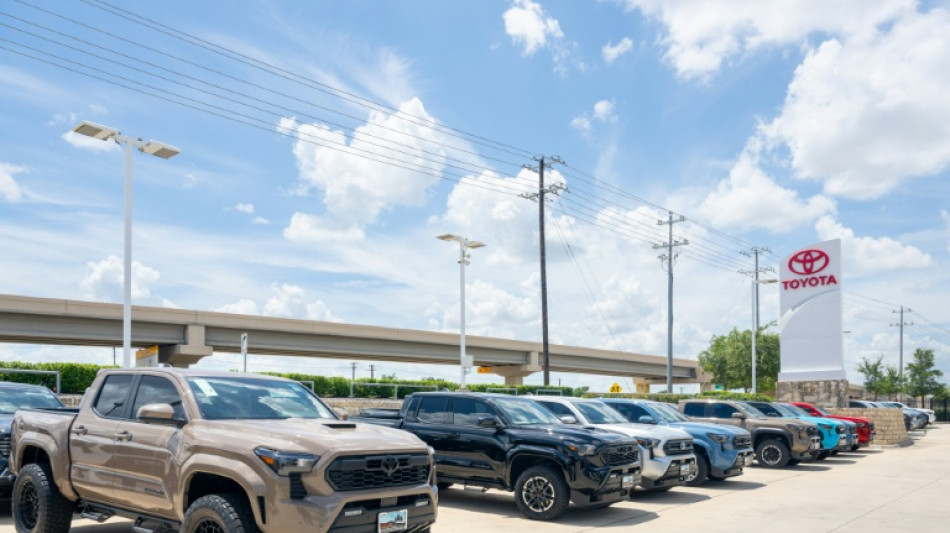
Trump tariffs a mixed bag for US auto industry / Photo: © GETTY IMAGES NORTH AMERICA/AFP/File

President Donald Trump has claimed a "roaring comeback" in American auto manufacturing following aggressive trade policy, but analysts view the cumulative impact as more of a mixed bag.
Since Trump returned to the White House, General Motors, Toyota, Ford and other carmakers have announced plans to expand US plants or shift production from overseas to make use of underutilized factories, as the industry navigated measures such as a 25-percent levy on imported autos.
But as the president's allies in the Republican party look ahead to mid-term elections in November, the gains to the US carmaker profile look more incremental than decisive, and are accompanied by a drag in spending in some cases due to trade uncertainty.
"It's a partial win," Stephanie Brinley, an automotive analyst at Mobility Global, said of the lift from Trump's tariffs to the US auto industry.
Auto industry experts view the unsettled nature of Trump's trade measures as a hindrance to bigger wins. This defect has most recently surfaced in the dust-up between the United States and Canada that has clouded the prospects of the North American trade agreement, known as the USMCA.
In August, a top Honda executive said the company was operating near full capacity at its North American facilities and wanted to build a new plant, but might pivot if the fog around USMCA persists.
Moreover, the disruptions from tariffs and Trump's reversals of US policies favoring electric vehicles have weighed on the US auto supplier sector, which provides parts and technology and employs some 930,000 people in the United States.
There has been "a noticeable slowdown" in investment by suppliers due to policy uncertainty, including on tariffs, said Tyler Harp, an industry economist at the Center for Automotive Research (CAR).
Investment by suppliers plunged from more than $8 billion in the first quarter of 2025 to around $600 million in the two subsequent quarters before recovering somewhat, according to CAR data.
"Suppliers are more exposed to tariffs," Harp said. "They're not in a position to absorb them as well as automakers."
- Investing in automation -
After falling for much of 2025, US auto employment has been on an upswing for most of 2026. In September, the sector had just under 1.8 million workers, according to the US Bureau of Labor Statistics.
That's almost one percent more than the level in January 2025 when Trump took office, but more than two percent below the peak level from the last decade, in July 2024 when Joe Biden was president, according to the BLS.
US auto production has also been broadly stable, but isn't expected to rise until around 2030, when GM's $4 billion investments in Michigan, Kansas and Tennessee come into force, along with Toyota's $3.6 billion plan to move Tacoma pickup production to Texas from Mexico.
Global Mobility projects that US car production will be 10 million vehicles in 2026, about the same as last year, but rise to around 11.3 million in 2030, according to Brinley.
"There is definitely an increase in there and it is partially related to tariffs," she said, noting that in some cases automakers are reconfiguring plants or making use of underutilized capacity.
A brand-new plant such as the one floated by Honda must be used for decades.
"Plants aren't put in the ground with the expectation of lasting a presidential cycle," Brinley said. "The tariffs have an impact, but it's just not the only input."
Suppliers have ranked changes in government trade policy as the industry's "greatest threat" over the next 12 months, according to surveys from MEMA, the Vehicle Suppliers Association.
In the most recent report, nearly 80 percent of companies ranked trade policy changes among the four top threats, alongside weakness in the US economy, an external or "black swan" event, and poor vehicle sales.
The industry has recovered only about half of tariff-policy-related costs, a "sustained margin drag that is likely to weigh on supplier financials," according to a commentary from Deloitte accompanying the survey.
The industry is following a "discipline-over-growth playbook" while shifting more investment to automation and robotics, Deloitte said.
O.Tse--ThChM