50 million people stuck in 'modern slavery': UN / Photo: © AFP/File

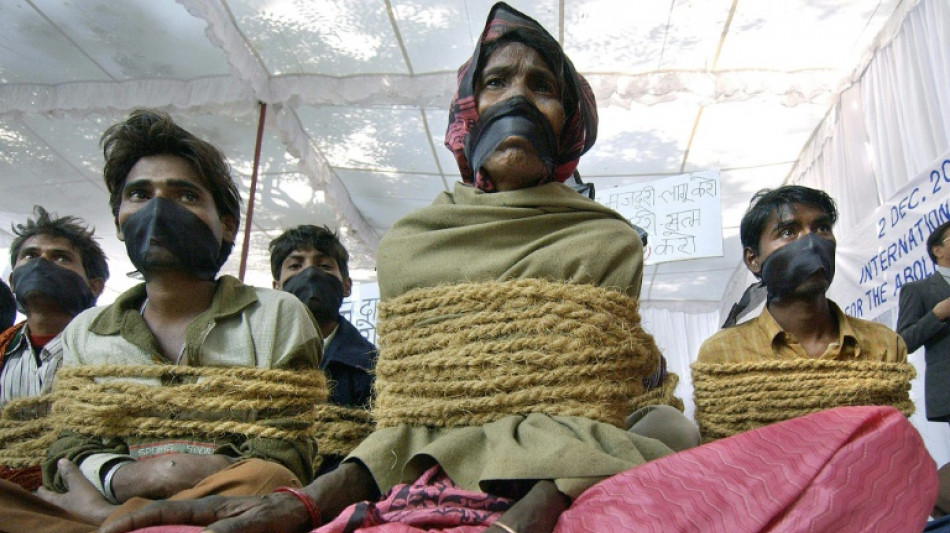
Fifty million people around the world are trapped in forced labour or forced marriage, the UN said Monday, warning that their ranks had swelled dramatically in recent years.
The United Nations had set a goal to eradicate all forms of modern slavery by 2030, but the number of people caught up in forced labour or forced marriage ballooned by 10 million between 2016 and 2021, according to a new report.
The study by the UN's agencies for labour and migration along with the Walk Free Foundation found that at the end of last year, 28 million people were in forced labour and 22 million living in a marriage they had been forced into.
That means nearly one out of every 150 people in the world are caught up in modern forms of slavery, the report said.
The Covid-19 pandemic, which worsened conditions and swelled debt levels for many workers, has heightened the risk, the report found.
Coupled with the effects of climate change and armed conflicts, it has contributed to "unprecedented disruption to employment and education, increases in extreme poverty and forced and unsafe migration", compounding the threat, it said.
"It is shocking that the situation of modern slavery is not improving," Guy Ryder, head of the International Labour Organization (ILO), said in a statement.
"Nothing can justify the persistence of this fundamental abuse of human rights."
- 'Life sentence' -
It is a long-term problem, the report cautioned, with estimates indicating entrapment in forced labour can last years while forced marriage is often "a life sentence".
Women and children are by far the most vulnerable.
Children account for one out of five people in forced labour, with more than half of them stuck in commercial sexual exploitation, the report said.
Migrant workers are more than three times likely to be in forced labour than non-migrant adult workers, it showed.
"This report underscores the urgency of ensuring that all migration is safe, orderly, and regular," Antonio Vitorino, head of the International Organization for Migration (IOM), said in the statement.
Modern slavery is present in basically every country, with more than half of cases of forced labour and a quarter of forced marriages in upper-middle income or high-income countries.
"It would be a mistake to believe that forced labour is solely the problem of poor countries," Ryder told AFP.
The report found that the number of people -- mainly women and girls -- stuck in forced marriages had risen by a full 6.6 million since the last global estimates in 2016.
- China in focus -
The number of people in forced labour swelled by 2.7 million over the same period.
The increase was driven entirely by more forced labour in the private economy, including forced commercial sexual exploitation.
But the report also said that 14 percent of those in forced labour were doing jobs imposed by state authorities, voicing concern about abuse of compulsory prison labour in many countries, including the United States.
It also pointed to grave concerns raised by the UN rights office about "credible accounts of forced labour under exceptionally harsh conditions" in North Korea.
And it highlighted the situation in China, where several UN agencies have warned of possible forced labour, including in the Xinjiang region, where Beijing stands accused of detaining more than one million Uyghurs and other Muslim minorities.
Beijing has vehemently rejected such charges, claiming it is running vocational training centres to help root out extremism.
A report published by former UN rights chief Michelle Bachelet on August 31 said more information was needed, but that labour schemes in the region appeared to be discriminatory and to "involve elements of coercion."
Monday's report welcomed China last month having ratified the ILO Forced Labour Convention.
This means "they will start to report on the situation of the Uyghurs, and that will give us new opportunities to have access and to go deeper into the situation in that regard," Ryder told AFP.
He acknowledged that the discussion about labour rights in Xinjiang was "not an easy conversation, ... but obviously it's a very important one.”
P.Ho--ThChM