The China Mail - French aristocrat's golden dental secret revealed 400 years on

USD -
AED 3.672498
AFN 63.999985
ALL 82.659231
AMD 377.229775
ANG 1.790083
AOA 916.99991
ARS 1387.053699
AUD 1.440103
AWG 1.80125
AZN 1.701218
BAM 1.685671
BBD 2.013678
BDT 122.977207
BGN 1.709309
BHD 0.377574
BIF 2970.646923
BMD 1
BND 1.28264
BOB 6.908351
BRL 5.152402
BSD 0.999815
BTN 92.79256
BWP 13.597831
BYN 2.973319
BYR 19600
BZD 2.010774
CAD 1.388995
CDF 2285.000168
CHF 0.793125
CLF 0.023301
CLP 920.105187
CNY 6.88655
CNH 6.87481
COP 3691.62
CRC 464.839659
CUC 1
CUP 26.5
CVE 95.035143
CZK 21.106012
DJF 178.039804
DKK 6.431875
DOP 60.153163
DZD 132.640887
EGP 53.664798
ERN 15
ETB 156.112361
EUR 0.86079
FJD 2.257401
FKP 0.758501
GBP 0.750315
GEL 2.690039
GGP 0.758501
GHS 10.998199
GIP 0.758501
GMD 74.000198
GNF 8767.90016
GTQ 7.648319
GYD 209.250209
HKD 7.837345
HNL 26.559099
HRK 6.482601
HTG 131.237691
HUF 329.353497
IDR 16901
ILS 3.13645
IMP 0.758501
INR 93.22495
IQD 1309.682341
IRR 1315874.999864
ISK 124.13027
JEP 0.758501
JMD 158.120413
JOD 0.708982
JPY 158.483497
KES 130.095212
KGS 87.450324
KHR 4000.224102
KMF 428.497333
KPW 899.943346
KRW 1509.580251
KWD 0.30933
KYD 0.833229
KZT 475.292069
LAK 22034.321965
LBP 89532.404175
LKR 315.172096
LRD 183.46212
LSL 16.791309
LTL 2.95274
LVL 0.60489
LYD 6.377046
MAD 9.33924
MDL 17.611846
MGA 4230.341582
MKD 53.066601
MMK 2100.405998
MNT 3572.722217
MOP 8.072575
MRU 39.88606
MUR 46.789534
MVR 15.470118
MWK 1733.674081
MXN 17.823085
MYR 4.026999
MZN 63.950035
NAD 16.792032
NGN 1381.320063
NIO 36.794904
NOK 9.685435
NPR 148.468563
NZD 1.733505
OMR 0.384494
PAB 0.999836
PEN 3.478666
PGK 4.323975
PHP 60.189936
PKR 278.954626
PLN 3.684325
PYG 6493.344193
QAR 3.645288
RON 4.386597
RSD 101.031989
RUB 80.450357
RWF 1463.214918
SAR 3.753694
SBD 8.042037
SCR 13.854038
SDG 600.999989
SEK 9.376755
SGD 1.28184
SHP 0.750259
SLE 24.550261
SLL 20969.510825
SOS 571.374393
SRD 37.364014
STD 20697.981008
STN 21.117322
SVC 8.748077
SYP 110.747305
SZL 16.786116
THB 32.493036
TJS 9.560589
TMT 3.51
TND 2.934847
TOP 2.40776
TRY 44.483897
TTD 6.785987
TWD 31.968987
TZS 2590.000133
UAH 43.749677
UGX 3724.309718
UYU 40.637618
UZS 12144.744043
VES 473.27785
VND 26335
VUV 120.24399
WST 2.777713
XAF 565.390002
XAG 0.01323
XAU 0.00021
XCD 2.70255
XCG 1.801759
XDR 0.710952
XOF 565.351019
XPF 102.791293
YER 238.649905
ZAR 16.768951
ZMK 9001.20415
ZMW 19.270981
ZWL 321.999592
  • RYCEF

    0.4000

    15.45

    +2.59%

  • RBGPF

    -13.5000

    69

    -19.57%

  • CMSC

    0.2000

    22.1

    +0.9%

  • BCC

    -0.2150

    75.635

    -0.28%

  • GSK

    1.1650

    56.355

    +2.07%

  • RIO

    1.7750

    95.065

    +1.87%

  • AZN

    3.3200

    200.54

    +1.66%

  • VOD

    0.1100

    15.13

    +0.73%

  • NGG

    2.1400

    86.74

    +2.47%

  • BCE

    0.1450

    25.385

    +0.57%

  • CMSD

    0.1900

    22.29

    +0.85%

  • BTI

    -0.6600

    57.81

    -1.14%

  • JRI

    0.1300

    12.43

    +1.05%

  • RELX

    0.3150

    33.465

    +0.94%

  • BP

    -1.1900

    45.81

    -2.6%

French aristocrat's golden dental secret revealed 400 years on
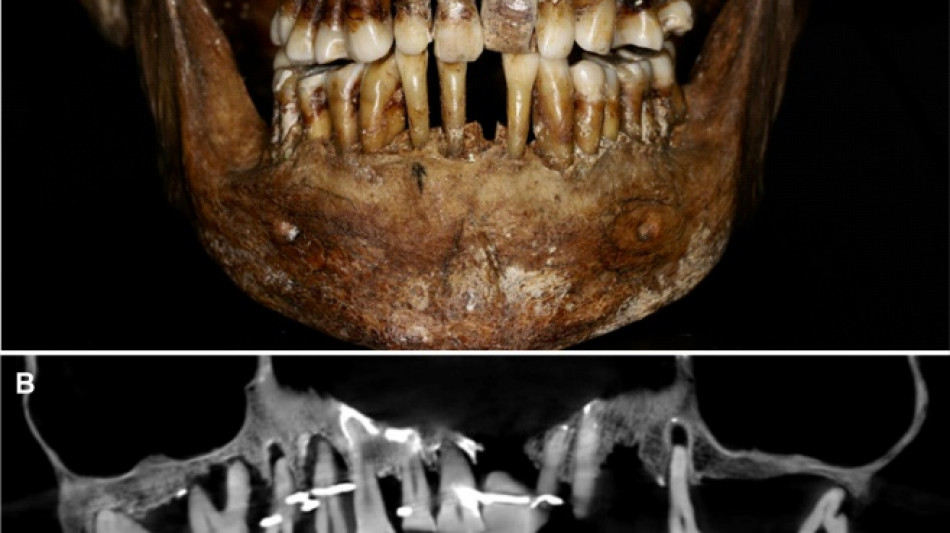
French aristocrat's golden dental secret revealed 400 years on / Photo: © INRAP/Rozenn Colleter/AFP/File

French aristocrat's golden dental secret revealed 400 years on

Scientists have discovered the long-buried secret of a 17th-century French aristocrat 400 years after her death: she was using gold wire to keep her teeth from falling out.

Text size:

The body of Anne d'Alegre, who died in 1619, was discovered during an archaeological excavation at the Chateau de Laval in northwestern France in 1988.

Embalmed in a lead coffin, her skeleton -- and teeth -- were remarkably well preserved.

At the time the archaeologists noticed that she had a dental prosthetic, but they did not have advanced scanning tools to find out more.

Thirty-five years later, a team of archaeologists and dentists have identified that d'Alegre suffered from periodontal disease that was loosening her teeth, according to a study published in the Journal of Archaeological Science: Reports this week.

A "Cone Beam" scan, which uses X-rays to build three-dimensional images, showed that gold wire had been used to hold together and tighten several of her teeth.

She also had an artificial tooth made of ivory from an elephant -- not hippopotamus, which was popular at the time.

But this ornate dental work only "made the situation worse", said Rozenn Colleter, an archaeologist at the French National Institute for Preventive Archaeological Research and lead author of the study.

The gold wires would have needed repeated tightening over the years, further destabilising the neighbouring teeth, the researchers said.

D'Alegre likely went through the pain for more than just medical reasons. There was huge pressure on aristocratic women at a time when appearance was seen as related to value and rank in society.

Ambroise Pare, a contemporary of D'Alegre's who was the doctor for several French kings and designed similar dental prosthetics, claimed that "if a patient is toothless, his speech becomes depraved", Colleter told AFP.

A nice smile was particularly important for d'Alegre, a "controversial" twice-widowed socialite "who did not have a good reputation," Colleter added.

- War and widowhood -

D'Alegre lived through a troubled time in French history.

She was a Huguenot, Protestants who fought against Catholics in the French Wars of Religion in the late 1500s.

By the age of 21, she was already widowed once and had a young son, Guy XX de Laval.

When the country plunged into the Eighth War of Religion, D'Alegre and her son were forced to hide from Catholic forces while their property was seized by the king.

Her son then converted to Catholicism and went to fight in Hungary, dying in battle at the age of 20.

After being widowed a second time, D'Alegre died of an illness aged 54.

D'Alegre's teeth "shows that she went through a lot of stress," Colleter said.

The researcher said she hopes that the research "goes a little way towards rehabilitating her".

Severe periodontal diseases are estimated to affect nearly a fifth of the world's adults, according to the World Health Organization.

R.Lin--ThChM