The China Mail - Balkan nations offer lessons on handling cow virus sowing turmoil

USD -
AED 3.672499
AFN 63.504804
ALL 83.192586
AMD 375.730804
ANG 1.790083
AOA 917.000196
ARS 1383.990646
AUD 1.456399
AWG 1.8
AZN 1.6996
BAM 1.693993
BBD 2.007535
BDT 122.298731
BGN 1.709309
BHD 0.376597
BIF 2960.807241
BMD 1
BND 1.28353
BOB 6.91265
BRL 5.2553
BSD 0.996752
BTN 94.473171
BWP 13.741284
BYN 2.966957
BYR 19600
BZD 2.004591
CAD 1.388345
CDF 2282.502159
CHF 0.79771
CLF 0.023433
CLP 925.259905
CNY 6.91185
CNH 6.92027
COP 3662.985579
CRC 462.864319
CUC 1
CUP 26.5
CVE 95.504742
CZK 21.315799
DJF 177.489065
DKK 6.495495
DOP 59.330475
DZD 133.010264
EGP 52.827466
ERN 15
ETB 154.083756
EUR 0.86938
FJD 2.257404
FKP 0.752712
GBP 0.754148
GEL 2.679935
GGP 0.752712
GHS 10.921138
GIP 0.752712
GMD 73.501257
GNF 8739.335672
GTQ 7.62808
GYD 208.64406
HKD 7.83333
HNL 26.46399
HRK 6.545201
HTG 130.656966
HUF 338.426497
IDR 16990.8
ILS 3.13762
IMP 0.752712
INR 94.850203
IQD 1305.703521
IRR 1313249.999868
ISK 124.760264
JEP 0.752712
JMD 156.892296
JOD 0.708989
JPY 160.221002
KES 129.470356
KGS 87.449549
KHR 3992.031527
KMF 428.000372
KPW 900.00296
KRW 1507.999985
KWD 0.30791
KYD 0.830627
KZT 481.867394
LAK 21678.576069
LBP 89256.247023
LKR 313.975142
LRD 182.893768
LSL 17.115586
LTL 2.95274
LVL 0.60489
LYD 6.362652
MAD 9.315751
MDL 17.507254
MGA 4153.999394
MKD 53.388766
MMK 2098.832611
MNT 3571.142668
MOP 8.042181
MRU 39.797324
MUR 46.770219
MVR 15.450249
MWK 1728.292408
MXN 18.073499
MYR 3.92401
MZN 63.950302
NAD 17.115586
NGN 1383.460211
NIO 36.680958
NOK 9.74797
NPR 151.156728
NZD 1.739885
OMR 0.38408
PAB 0.996752
PEN 3.472089
PGK 4.307306
PHP 60.549644
PKR 278.184401
PLN 3.721535
PYG 6516.824737
QAR 3.634057
RON 4.427302
RSD 101.684639
RUB 81.581921
RWF 1455.545451
SAR 3.752751
SBD 8.042037
SCR 15.03876
SDG 601.000431
SEK 9.458405
SGD 1.28808
SHP 0.750259
SLE 24.549666
SLL 20969.510825
SOS 569.659175
SRD 37.600987
STD 20697.981008
STN 21.220389
SVC 8.721147
SYP 110.527654
SZL 17.114027
THB 32.494989
TJS 9.523624
TMT 3.5
TND 2.938634
TOP 2.40776
TRY 44.445008
TTD 6.772336
TWD 32.044396
TZS 2571.564679
UAH 43.689489
UGX 3713.134988
UYU 40.344723
UZS 12155.385215
VES 467.928355
VND 26337.5
VUV 119.385423
WST 2.775484
XAF 568.149495
XAG 0.014291
XAU 0.000222
XCD 2.70255
XCG 1.796371
XDR 0.706596
XOF 568.149495
XPF 103.295656
YER 238.596498
ZAR 17.111955
ZMK 9001.19943
ZMW 18.763154
ZWL 321.999592
  • RIO

    0.8500

    86.64

    +0.98%

  • RBGPF

    -13.5000

    69

    -19.57%

  • CMSC

    -0.0500

    22.77

    -0.22%

  • NGG

    -0.4800

    81.92

    -0.59%

  • RELX

    -0.1000

    31.97

    -0.31%

  • BTI

    0.3749

    57.8

    +0.65%

  • BCE

    -0.2200

    25.25

    -0.87%

  • BCC

    0.1400

    74.43

    +0.19%

  • CMSD

    -0.0900

    22.66

    -0.4%

  • GSK

    -0.1000

    53.84

    -0.19%

  • RYCEF

    -0.5900

    14.65

    -4.03%

  • JRI

    -0.2700

    11.8

    -2.29%

  • VOD

    -0.1400

    14.49

    -0.97%

  • AZN

    5.0200

    188.42

    +2.66%

  • BP

    0.5100

    46.68

    +1.09%

Balkan nations offer lessons on handling cow virus sowing turmoil
Balkan nations offer lessons on handling cow virus sowing turmoil / Photo: © AFP

Balkan nations offer lessons on handling cow virus sowing turmoil

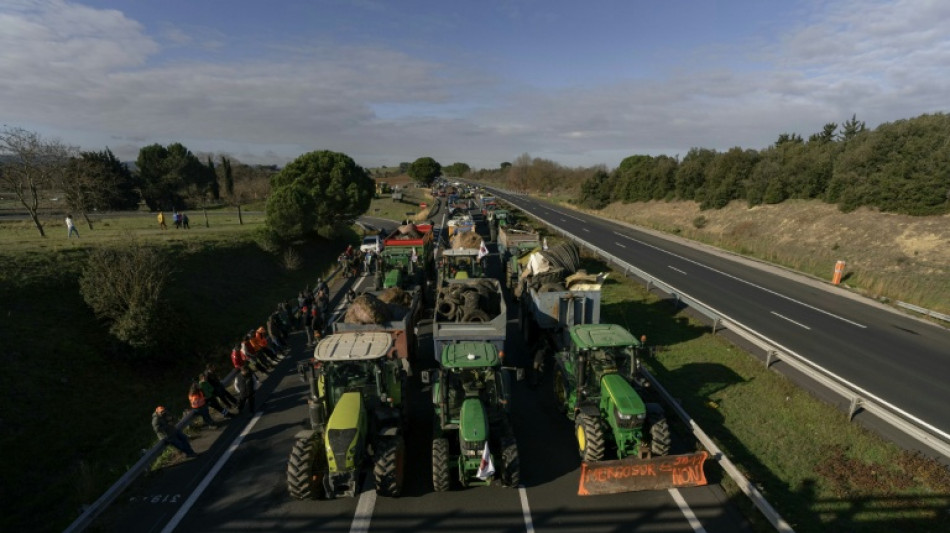
An outbreak of a highly contagious cattle disease has left France, the world's top exporter of live animals, struggling since June to prevent devastating impacts on its industry, amid growing protests by farmers.

Text size:

But in 2016 several Balkan nations curtailed major epidemics of the same disease through swift action, mass vaccination and culls in about three months.

With no cases reported since 2018, Tamas Petrovic, head of virology at the Scientific Veterinary Institute in the Serbian city of Novi Sad, said the Balkans' response could offer lessons for this new outbreak.

- Early alert -

When lumpy skin disease (LSD), or nodular dermatitis, was detected in nearby Greece and Bulgaria, Serbia was placed on alert and formed a task force to monitor its spread, said Petrovic, who was involved in the response.

Although the viral disease poses no risk to humans, it severely affects milk production and fertility and can be fatal in cattle.

As the prolonged incubation of the disease made it difficult to track and contain, officials quickly turned to vaccination, the researcher said.

But with no registered vaccine in Europe at the time, imports were ordered from South Africa.

Within a week of its arrival in Serbia, the vaccine was tested, and the first cattle vaccinations began.

- Mass vaccination -

Mass vaccination was carried out in phases, with one million doses eventually administered across the country.

By first targeting large swaths of livestock in infected districts and then broadening out in three phases, the outbreak was quickly controlled, he said.

"We stopped the disease within two to three months after it entered the country," Petrovic said.

By 2018 the European Food Safety Authority (EFSA) said that more than 70 per cent of the Balkan region's cattle were vaccinated.

- Culls -

But vaccination alone did not stop the disease -- several culls were needed across the region.

"If the disease appears, the euthanasia of the entire herd is mandatory," Petrovic said.

But rapid action meant fewer than 1,000 cattle were slaughtered in Serbia, out of a total herd of close to 900,000, Petrovic said.

Insect controls across the entire region also helped prevent the spread of diseases through mosquitoes, ticks and flies.

- 'A good example' -

Petrovic said the Balkans proved to be "more than a good example" in controlling the disease.

Croatia's preventive vaccination, after EU approval, meant LSD was never reported in the country, despite outbreaks nearby in Serbia and Montenegro.

Its vaccination programme effectively stopped the disease from entering the bloc at the time, he said.

Bosnia and Herzegovina also carried out vaccination and booster campaigns between 2016 and 2018.

As of 2019, the EFSA said that the disease had not been detected in the region, and preventive vaccination programmes continued in high-risk areas.

The main lesson from that crisis was that experts must take the lead, Petrovic said.

"The state and politicians acted in line with the experts and followed what needed to be done -- and they did it," he insisted.

K.Leung--ThChM