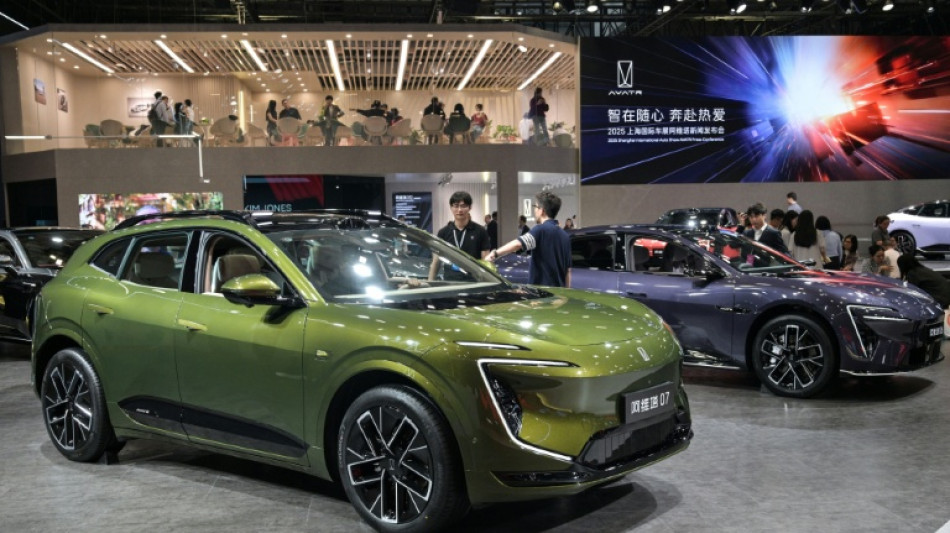
China to ban hidden car door handles, setting new safety standards / Photo: © AFP/File

China will ban hidden door handles on cars from next year over safety concerns, phasing out the minimalist design popularised by Tesla.
The new rules could prompt carmakers globally to rethink vehicle-door designs as China increasingly positions itself as a standards-setter in the rapidly expanding international EV market, according to analysts.
The rules, announced by the Ministry of Industry and Information Technology on Monday will take effect from January 1, 2027, and require door handles to have both interior and exterior mechanical releases.
Chinese car models already approved for launch will have an additional two years to achieve compliance, the ministry said.
The new regulations will apply to all vehicles but will mostly impact EVs, which are commonly designed with hidden handles, and will "improve the level of automotive safety design", the ministry added.
Safety concerns have risen in China recently over sleek, aerodynamic car doors that reduce drag but are prone to losing operability in the event of a crash.
One high-profile incident occurred in October, when rescuers were shown failing to open the doors of a burning Xiaomi electric vehicle in the southwestern city of Chengdu.
The driver, reported to be under the influence of alcohol, died in the crash.
Electronic or "flush" door handles were introduced with Tesla's 2012 launch of the Model S, later becoming popular with Chinese EV brands prioritising high-tech features.
Folding into the body of the car, such door handles provide a slight boost to efficiency by reducing drag while the vehicle is in motion.
Banning the handles is part of a pattern in which "China is increasingly acting as a rule-setter rather than a rule-taker in EV and intelligent vehicle regulation," Bill Russo, founder of Shanghai-based consultancy Automobility, told AFP.
He pointed to areas including battery safety standards and remote updating as other examples of this.
Russo said he expects the new door regulations to be "echoed" abroad, particularly in Europe, "as Chinese vehicles and platforms increasingly set the baseline for global EV design".
The new rules stipulate that all doors except the tailgate "shall be equipped with a mechanical release exterior door handle".
Other rules will improve the visibility of interior handles, including by requiring permanent graphic markings, the ministry said.
China is the world's largest EV market, and its dozens of brands have growing operations abroad.
Statistics published last month showed that Chinese firm BYD last year sold more EVs than Tesla, overtaking the US industry pioneer in the annual category for the first time.
China's status as the world's largest passenger vehicle market means the country is "informally" setting global standards, Tu Le, founder of Sino Auto Insights, told AFP.
The new rules on door handles mean that "for companies like Tesla, Kia and other legacy automakers that sell their vehicles in multiple regions, they'll need to decide whether to make the change to the China product only or implement it globally," Le said.
"It's likely a pain for quite a few automakers since some of them have global designs that will need to be reconciled," he added.
P.Deng--ThChM