Health workers battle with few resources on DR Congo's Ebola front line / Photo: © AFP

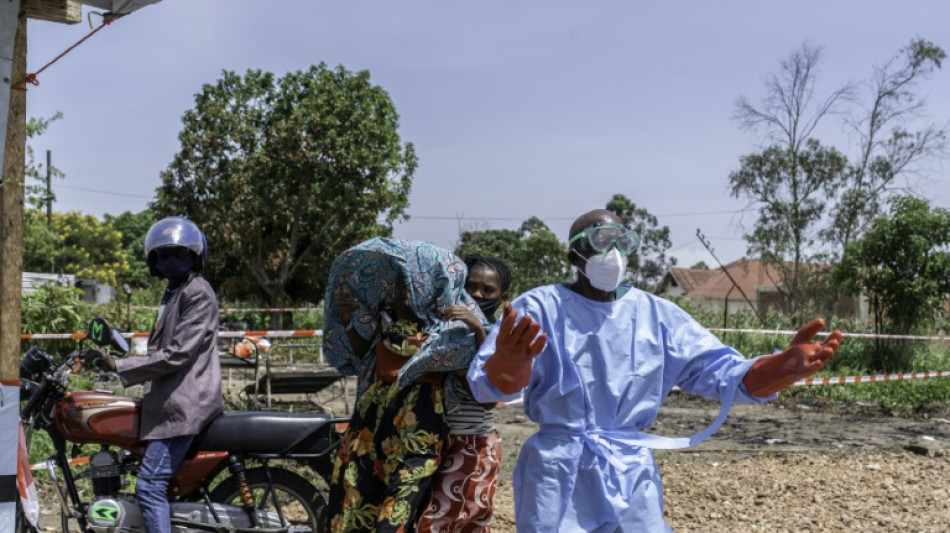
Squeezed onto the back of a motorcycle, clearly exhausted and symptomatic, a young woman arrived at Rwampara hospital, where overwhelmed health workers have found themselves on the front line of a deadly Ebola outbreak.
The town in the violence-hit east of the Democratic Republic of Congo is one of the centres of a recent flare-up in cases of the highly contagious disease, which can cause severe bleeding and organ failure.
Since the current outbreak was detected on May 14, more than 220 suspected deaths and 900 suspected cases have been identified, according to official figures, in what the World Health Organization has declared an international emergency.
Experts suspect the virus was circulating under the radar for some time and that the true extent of the health crisis has yet to be seen.
The young woman arriving at the hospital in Rwampara, a town in northeastern Ituri province, had spent the journey wedged between her sister and the driver of the motorbike.
A health worker immediately took the woman's temperature, which was 39.7C, and noted the first symptoms even before she had got off the motorcycle: bleeding from the nose, a common symptom of Ebola, which causes a haemorrhagic fever.
"She gave birth a month ago and two weeks after giving birth she began to fall ill," her sister said, without giving her name.
State services have largely been absent for years in Ituri province, the epicentre of the current outbreak, where armed groups have roamed for years and regularly commit massacres.
When the first signs of the illness appear, families are often at a loss over what to do, especially in rural areas.
"We thought it was malaria. Then she was given tablets and medicinal plants but there was no change," her sister said.
The motorcycle driver who brought the two women to the hospital wore a surgical mask but no gloves or protective clothing.
Hospital health worker Dieudonne Sezabo rushed to spray him and the vehicle with chlorine in an attempt to prevent contamination.
Ebola spreads through direct contact with bodily fluids.
Behind the current outbreak is the less common Bundibugyo strain, for which there are no approved vaccines or treatments and which has a fatality rate of up to 50 percent.
With no ambulances available, "people make do with motorbikes", said Sezabo.
Unable to walk on her own, the young woman was helped by her sister -- who wore gloves but had bare arms -- into the entrance of the hospital, where staff dressed in full protective suits led her to the isolation ward.
The health response has been slow to get off the ground in Ituri, which relies mostly on the international airport in Bunia, the regional capital about 12 kilometres (7.5 miles) from Rwampara, for deliveries of medical aid.
The Congolese government on Saturday announced a ban on all flights to Bunia, apart from those with special authorisation.
- 'Convince them to return' -
While they await crucial deliveries of equipment, staff at the hospital have been forced to move patients with everyday illnesses in order to open a temporary isolation centre.
Two isolation tents set up by the NGO Alima in the first days of the response were set on fire by an angry crowd demanding the body of one of their friends, who had died of Ebola.
The riot was broken up when soldiers fired warning shots.
"Our concern is that several patients who were in isolation returned to the community after the isolation centre fire," said doctor Isaac Mukengi, Rwampara Hospital's medical director.
"We regularly send teams into the field to trace patients, convince them to return to the treatment centre so they can continue receiving care and limit the spread of the epidemic," he added.
It is the 17th Ebola outbreak in the DRC, one of the poorest countries in the world, and without a vaccine, efforts to contain the spread rely on adhering to preventive measures and quickly detecting cases.
"For good practices and rules on isolation, safe burials and contact tracing to be followed, a great deal of trust in the health authorities is required," said Pierre Boisselet, head of the country's Ebuteli research institute.
"The current situation of conflict and fragmented authority does not, at first glance, seem very favourable," he added.
Healthcare workers do their best to allow patients' families to visit them under the supervision of medical staff in order to reduce tensions and encourage the sick to go to the hospital.
"From a moral standpoint, it is important to establish this communication between patients and their family members," said Ganou Lamissa, logistics coordinator for the NGO Alima.
"This reassures not only the patients, but also the relatives, who can know under what conditions the patients are being cared for," he added.
U.Feng--ThChM