The China Mail - Africa faces child surgery crisis as key anaesthesia runs out

USD -
AED 3.672501
AFN 65.5106
ALL 80.498871
AMD 364.974259
ANG 1.789783
AOA 918.000006
ARS 1491.737504
AUD 1.416869
AWG 1.80125
AZN 1.702138
BAM 1.695131
BBD 2.013772
BDT 122.727568
BGN 1.696366
BHD 0.377013
BIF 2989.30472
BMD 1
BND 1.279707
BOB 11.723256
BRL 5.201099
BSD 0.999822
BTN 95.377802
BWP 13.458947
BYN 3.007007
BYR 19600
BZD 2.01086
CAD 1.39252
CDF 2272.999644
CHF 0.813998
CLF 0.023234
CLP 914.439687
CNY 6.743205
CNH 6.74562
COP 3125.46
CRC 448.949346
CUC 1
CUP 26.5
CVE 95.568479
CZK 20.994974
DJF 178.045684
DKK 6.48067
DOP 58.519421
DZD 132.927061
EGP 50.175331
ERN 15
ETB 161.731835
EUR 0.86693
FJD 2.21345
FKP 0.740201
GBP 0.741185
GEL 2.609626
GGP 0.740201
GHS 11.128686
GIP 0.740201
GMD 73.498647
GNF 8783.265513
GTQ 7.627971
GYD 209.1829
HKD 7.846925
HNL 26.804356
HRK 6.531968
HTG 130.780532
HUF 315.109458
IDR 17827.8
ILS 2.962965
IMP 0.740201
INR 95.40325
IQD 1309.815818
IRR 1374587.504424
ISK 123.269917
JEP 0.740201
JMD 158.180975
JOD 0.709028
JPY 159.389504
KES 129.298579
KGS 87.450534
KHR 4046.698677
KMF 426.99993
KPW 900.000294
KRW 1413.230295
KWD 0.30881
KYD 0.833243
KZT 465.286595
LAK 22558.404583
LBP 89534.106716
LKR 333.288554
LRD 181.477003
LSL 16.129242
LTL 2.952739
LVL 0.60489
LYD 6.368494
MAD 9.261251
MDL 17.356486
MGA 4306.620269
MKD 53.324955
MMK 2099.846019
MNT 3597.969266
MOP 8.081473
MRU 40.066389
MUR 47.15013
MVR 15.450265
MWK 1733.741837
MXN 17.03355
MYR 4.086023
MZN 63.909905
NAD 16.129242
NGN 1361.339462
NIO 36.792109
NOK 9.50485
NPR 152.601176
NZD 1.706194
OMR 0.3845
PAB 0.999848
PEN 3.372981
PGK 4.424529
PHP 61.396002
PKR 277.775008
PLN 3.738401
PYG 5967.212831
QAR 3.6435
RON 4.5406
RSD 101.693022
RUB 83.076856
RWF 1469
SAR 3.753929
SBD 8.064941
SCR 13.734821
SDG 600.549391
SEK 9.56117
SGD 1.280205
SHP 0.740866
SLE 24.49841
SLL 20969.499227
SOS 571.49877
SRD 37.722498
STD 20697.981008
STN 21.425
SVC 8.748445
SYP 13001.999906
SZL 16.133575
THB 33.229027
TJS 9.23879
TMT 3.51
TND 2.93499
TOP 2.40776
TRY 47.869295
TTD 6.780175
TWD 31.998498
TZS 2645.502997
UAH 44.693081
UGX 3712.16225
UYU 40.060498
UZS 11943.661972
VES 770.1091
VND 26073.5
VUV 118.594628
WST 2.730779
XAF 568.516344
XAG 0.015647
XAU 0.000231
XCD 2.70255
XCG 1.801951
XDR 0.707052
XOF 568.516344
XPF 103.367281
YER 237.150564
ZAR 16.20051
ZMK 9001.194384
ZMW 18.797263
ZWL 321.999592
  • BCE

    0.1900

    23.32

    +0.81%

  • JRI

    -0.0300

    12.68

    -0.24%

  • RBGPF

    -0.8200

    71.34

    -1.15%

  • GSK

    0.1500

    50.45

    +0.3%

  • BCC

    -0.1200

    84.13

    -0.14%

  • RELX

    0.1200

    34.67

    +0.35%

  • CMSC

    0.0250

    21.475

    +0.12%

  • RIO

    -3.0200

    98.2

    -3.08%

  • AZN

    -1.2600

    157.24

    -0.8%

  • CMSD

    0.0000

    21.59

    0%

  • NGG

    0.5200

    81.2

    +0.64%

  • BTI

    1.5100

    57.35

    +2.63%

  • BP

    -0.1000

    42.83

    -0.23%

  • RYCEF

    -0.3900

    20.71

    -1.88%

  • VOD

    0.1300

    16.22

    +0.8%

Africa faces child surgery crisis as key anaesthesia runs out
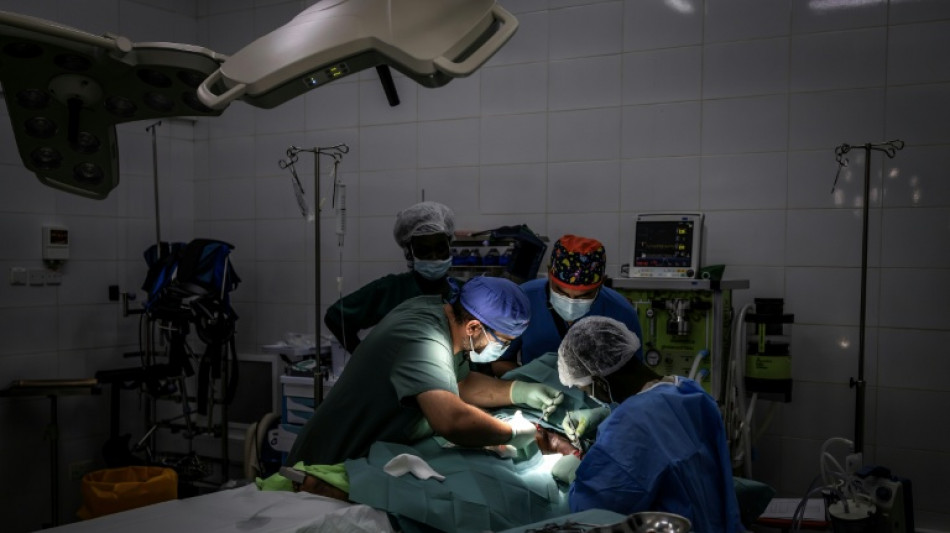
Africa faces child surgery crisis as key anaesthesia runs out / Photo: © AFP

Africa faces child surgery crisis as key anaesthesia runs out

African hospitals face huge new costs as they scramble to replace the main anaesthetic for child operations that is set to run out in 2027, a charity has warned.

Text size:

Halothane is still widely used across sub-Saharan Africa to put children to sleep for operations, primarily because it can be seven to 10 times cheaper than the newer alternative, sevoflurane.

But the last halothane manufacturer shut down its production line in India in 2023, and stocks are rapidly running out across Africa.

"We don't know exactly when, but I don't think we will have any halothane left by the end of 2027," said Elizabeth Igaga, an anaesthesiologist in Uganda.

Igaga is senior director for programme safety at Smile Train, a charity that carries out more than 100,000 surgeries each year for cleft lips and palates, 90 percent of them for children.

"This halothane situation is a big deal for us. We are committed to them having safe surgery," she said.

While high-end hospitals have already switched to sevoflurane, they represent a tiny fraction of health facilities in sub-Saharan Africa.

The transition has exposed years of under-funding in anaesthesia systems on the continent, with many discovering that machines need to be replaced at a cost of tens of thousands of dollars each.

The announcement that halothane was no longer being produced "set off nationwide panic" in Zambia, said Sompwe Mwansa, president of the country's Society of Anaesthetists.

"We're playing catch-up on equipment needs and training needs," she told AFP.

"It's really been quite a challenging transition period for us, especially for centres that are away from sort of the urban centres."

Across much of Africa, anaesthetics are administered by health workers who are not doctors and will require fresh training for new drugs to avoid expensive wastage, Mwansa added.

The World Federation of Societies of Anaesthesiologists called in 2024 for African governments to urgently budget for the transition.

"Unfortunately, that call has not received the response that the timeline requires," Smile Train said in a statement.

Ugandan and Zambian authorities have responded positively, according to the doctors who spoke to AFP.

But the transition adds millions of dollars to already stretched health budgets, compounded by massive cuts to aid subsidies from Western countries over the past 18 months.

"It may very realistically lead to a reduction in our surgical capacity," said Mwansa.

"Already anaesthesia was a hidden corner of the budget... with many competing interests. It's very concerning," she added.

Adding to concerns, Africa is host to the world's youngest population -- the UN predicts that by 2050, one in four children globally will reside in Africa -- while infant mortality rates remain stubbornly high.

Smile Train is helping with the transition, but cannot do everything and wants African governments to take ownership of the problem.

"We are happy to support, but we also need them to take responsibility," said Igaga.

X.Gu--ThChM