The China Mail - One million Afghan children suffer 'life-threatening' malnutrition: UN

USD -
AED 3.6725
AFN 65.566306
ALL 79.122067
AMD 364.59623
ANG 1.789783
AOA 918.000164
ARS 1511.058271
AUD 1.397458
AWG 1.795
AZN 1.702758
BAM 1.677495
BBD 2.014693
BDT 123.090515
BGN 1.696366
BHD 0.37714
BIF 2986.400889
BMD 1
BND 1.270966
BOB 11.517992
BRL 5.148796
BSD 1.000274
BTN 95.393377
BWP 13.392857
BYN 3.017793
BYR 19600
BZD 2.01181
CAD 1.383906
CDF 2277.487991
CHF 0.802705
CLF 0.023164
CLP 911.690268
CNY 6.72215
CNH 6.71781
COP 3075.18
CRC 453.82029
CUC 1
CUP 26.5
CVE 94.574601
CZK 20.635104
DJF 178.123901
DKK 6.40519
DOP 58.5806
DZD 133.027649
EGP 50.417103
ERN 15
ETB 161.449677
EUR 0.85683
FJD 2.216398
FKP 0.733696
GBP 0.733425
GEL 2.604994
GGP 0.733696
GHS 11.153711
GIP 0.733696
GMD 74.00006
GNF 8788.880741
GTQ 7.631774
GYD 209.274999
HKD 7.838685
HNL 26.829572
HRK 6.457005
HTG 130.858596
HUF 309.361973
IDR 17684.2
ILS 2.979104
IMP 0.733696
INR 95.29665
IQD 1310.387121
IRR 1374575.000076
ISK 120.999744
JEP 0.733696
JMD 158.760791
JOD 0.709023
JPY 159.265502
KES 129.409764
KGS 87.450431
KHR 4048.270479
KMF 422.999859
KPW 900.000294
KRW 1384.670395
KWD 0.30861
KYD 0.833591
KZT 458.031701
LAK 22451.036311
LBP 89575.740942
LKR 328.555867
LRD 181.547619
LSL 15.999966
LTL 2.95274
LVL 0.60489
LYD 6.333278
MAD 9.243239
MDL 17.285062
MGA 4280.758031
MKD 52.766556
MMK 2099.770766
MNT 3596.537388
MOP 8.075854
MRU 40.109273
MUR 46.770139
MVR 15.460226
MWK 1734.49521
MXN 16.946825
MYR 4.0419
MZN 63.905021
NAD 15.999966
NGN 1347.795805
NIO 36.813236
NOK 9.313095
NPR 152.635123
NZD 1.67517
OMR 0.384473
PAB 1.00033
PEN 3.357178
PGK 4.435181
PHP 61.701012
PKR 277.510657
PLN 3.68626
PYG 5996.200377
QAR 3.646438
RON 4.503902
RSD 100.558004
RUB 83.753968
RWF 1474.457939
SAR 3.758291
SBD 8.019375
SCR 13.697586
SDG 601.498853
SEK 9.470875
SGD 1.269885
SHP 0.740866
SLE 24.649928
SLL 20969.499227
SOS 571.671184
SRD 37.921979
STD 20697.981008
STN 21.01417
SVC 8.752857
SYP 13001.999906
SZL 15.998593
THB 32.729062
TJS 9.222509
TMT 3.51
TND 2.914731
TOP 2.40776
TRY 48.098701
TTD 6.795725
TWD 31.8829
TZS 2649.998035
UAH 44.691549
UGX 3731.055245
UYU 40.209625
UZS 11780.699723
VES 783.68245
VND 26112
VUV 118.301391
WST 2.715944
XAF 562.604101
XAG 0.014683
XAU 0.000216
XCD 2.70255
XCG 1.802836
XDR 0.707052
XOF 562.616165
XPF 102.290954
YER 237.100992
ZAR 15.9594
ZMK 9001.206186
ZMW 19.050274
ZWL 321.999592
  • RBGPF

    2.5700

    71.13

    +3.61%

  • CMSC

    0.1320

    21.36

    +0.62%

  • RIO

    1.1000

    105.9

    +1.04%

  • BTI

    -0.4100

    56.3

    -0.73%

  • GSK

    0.1350

    51.915

    +0.26%

  • RYCEF

    0.1900

    20.44

    +0.93%

  • BCE

    -0.2700

    23.58

    -1.15%

  • RELX

    -0.5100

    35.88

    -1.42%

  • BCC

    -1.0700

    81.17

    -1.32%

  • NGG

    0.5350

    80.955

    +0.66%

  • AZN

    2.8500

    169.56

    +1.68%

  • VOD

    0.0850

    16.065

    +0.53%

  • CMSD

    0.1250

    21.185

    +0.59%

  • BP

    -0.6300

    43.11

    -1.46%

  • JRI

    0.0480

    12.418

    +0.39%

One million Afghan children suffer 'life-threatening' malnutrition: UN
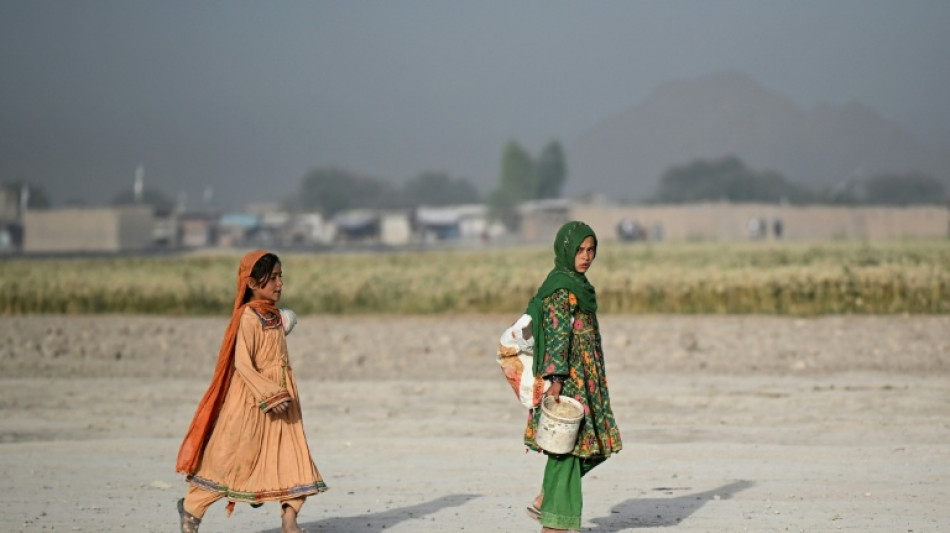
One million Afghan children suffer 'life-threatening' malnutrition: UN / Photo: © AFP

One million Afghan children suffer 'life-threatening' malnutrition: UN

One million children in Afghanistan are suffering from life-threatening malnutrition in a worsening crisis sweeping the country, the United Nations warned Tuesday.

Text size:

Across Afghanistan, 3.7 million children suffer from wasting, meaning they are acutely malnourished, the UN children's agency UNICEF said.

Among them are "one million children who are suffering from life-threatening severe acute malnutrition" -- the worst form, said UNICEF's Afghanistan country representative Tajudeen Oyewale.

"If there is no treatment, and we are not able to act fast, that one million number are at risk of dying," he told reporters in Geneva, speaking from Kabul.

Afghanistan has endured repeated hunger emergencies in recent decades as it has struggled through civil war and other crises. An economic collapse followed the Taliban government's return to power after US-led forces withdrew in 2021.

"Malnutrition plays a central role" in the growing numbers of deaths of very young children, Oyewale said.

Nearly 40 percent of children admitted to hospitals with severe wasting and medical complications were babies under six months old, he said.

Meanwhile children under two years old make up more than 80 percent of severe acute malnutrition cases in Afghanistan.

He described a "worsening nutrition crisis" across the country, with more than half a million children admitted to hospital so far this year for high-risk moderate and severe wasting.

In July 2025, around 6,000 severe acute malnutrition cases were admitted; in July this year, the numbers went above 8,000 -- a third higher.

"In parts of southern Afghanistan, some hospitals are now seeing three or four severely malnourished children for every available bed," he warned.

- 'Vicious cycle' -

Oyewale said an "increasingly alarming picture" was developing, with families cutting back on nutritious food and meals becoming smaller.

Children's first food beyond breast milk may be little more than bread with tea, or watered-down yoghurt, "and for a growing child, this is simply not enough".

He said children could get trapped in a "vicious cycle": being poorly nourished, developing severe diarrhoea or respiratory infections, and then in turn becoming more malnourished.

These problems are compounded by Afghanistan's other troubles, such as successive years of drought, flash floods, regional instability and cross-border trade disruptions.

The return of six million Afghans from abroad since 2023 -- more than half of whom are children -- is also exacerbating the pressures on stretched resources.

While treatment for malnutrition can save lives, if survivors return home to the same conditions, "we frequently see those kind of children relapse and come back".

Oyewale said that while the needs were increasing, services for children were being slashed due to international aid cuts.

He said more than 100 sites treating children for severe wasting had closed since 2025.

UNICEF's nutrition programme in Afghanistan is estimated at $180 million this year but is only 22 percent funded.

"We should not wait until a child is dangerously thin and lying in a hospital bed before we act," Oyewale said.

T.Wu--ThChM