The China Mail - Study Finds Psilocybin Makes Brain Activity More Responsive to Immediate Experience

USD -
AED 3.673042
AFN 65.000368
ALL 81.855041
AMD 360.540403
ANG 1.790403
AOA 918.000367
ARS 1546.131265
AUD 1.476887
AWG 1.8
AZN 1.70397
BAM 1.769883
BBD 2.014669
BDT 124.411223
BGN 1.77347
BHD 0.37715
BIF 3005
BMD 1
BND 1.287984
BOB 11.678099
BRL 5.666304
BSD 1.000231
BTN 94.214794
BWP 13.981141
BYN 2.99667
BYR 19600
BZD 2.011773
CAD 1.42715
CDF 2315.000362
CHF 0.838719
CLF 0.025287
CLP 995.220396
CNY 6.67175
CNH 6.67522
COP 3319.97
CRC 448.217041
CUC 1
CUP 24.005936
CVE 100.150394
CZK 22.139304
DJF 177.720393
DKK 6.782304
DOP 60.703884
DZD 137.227489
EGP 53.502064
ERN 15
ETB 161.050392
EUR 0.90715
FJD 2.25325
FKP 0.756884
GBP 0.75683
GEL 2.590391
GGP 0.756884
GHS 11.72504
GIP 0.756884
GMD 74.000355
GNF 8857.503848
GTQ 7.646644
GYD 209.264655
HKD 7.84565
HNL 26.950388
HRK 6.831965
HTG 131.169348
HUF 331.003504
IDR 18235.4
ILS 3.216704
IMP 0.756884
INR 94.25795
IQD 1514
IRR 1913737.503816
ISK 123.930386
JEP 0.756884
JMD 158.047862
JOD 0.70904
JPY 159.72504
KES 130.050385
KGS 87.435504
KHR 4080.00035
KMF 447.00035
KPW 900.00035
KRW 1336.565039
KWD 0.31147
KYD 0.833529
KZT 445.849094
LAK 22530.000349
LBP 89550.000349
LKR 332.687818
LRD 170.000348
LSL 16.930381
LTL 2.95274
LVL 0.60489
LYD 6.445039
MAD 9.961704
MDL 18.169149
MGA 4590.000347
MKD 55.830725
MMK 2099.848767
MNT 3604.365716
MOP 8.083632
MRU 40.603743
MUR 47.620378
MVR 15.403739
MWK 1736.000345
MXN 18.536504
MYR 4.086104
MZN 63.903729
NAD 16.930377
NGN 1343.570377
NIO 36.803722
NOK 9.57248
NPR 150.739077
NZD 1.809628
OMR 0.385141
PAB 1.000231
PEN 3.403039
PGK 4.511504
PHP 63.960375
PKR 276.603701
PLN 3.996535
PYG 6207.891986
QAR 3.64425
RON 4.851904
RSD 106.559038
RUB 82.829047
RWF 1476
SAR 3.77446
SBD 8.097697
SCR 13.945304
SDG 601.503676
SEK 10.075038
SGD 1.287204
SHP 0.752984
SLE 23.050371
SLL 20969.503664
SOS 572.503662
SRD 37.49037
STD 20697.981008
STN 22.2
SVC 8.752585
SYP 13002.000337
SZL 16.930369
THB 33.875038
TJS 9.227282
TMT 3.5
TND 3.008504
TOP 2.40776
TRY 50.342104
TTD 6.789769
TWD 32.891404
TZS 2648.920367
UAH 45.477786
UGX 4131.053487
UYU 40.541335
UZS 12039.000334
VES 912.87925
VND 25725.5
VUV 120.638016
WST 2.81058
XAF 595.051667
XAG 0.020459
XAU 0.00025782798
XCD 2.70255
XCG 1.802699
XDR 0.707052
XOF 595.051667
XPF 108.325037
YER 236.550363
ZAR 16.976255
ZMK 9001.203584
ZMW 20.450473
ZWL 321.999592
SSP 5946.454122
MXV 2.081672
  • RYCEF

    0.4000

    19.71

    +2.03%

  • CMSC

    0.0000

    20.4

    0%

  • BTI

    0.4200

    56.05

    +0.75%

  • BP

    0.2800

    44.43

    +0.63%

  • RBGPF

    1.6000

    67

    +2.39%

  • RIO

    -0.1500

    94.41

    -0.16%

  • AZN

    -0.4300

    166.15

    -0.26%

  • GSK

    0.4600

    49.7

    +0.93%

  • BCE

    -0.4100

    20.56

    -1.99%

  • NGG

    -0.2500

    75.24

    -0.33%

  • VOD

    -0.0400

    16.58

    -0.24%

  • RELX

    -0.4500

    33.07

    -1.36%

  • BCC

    -0.5500

    76.59

    -0.72%

  • CMSD

    -0.0300

    20.27

    -0.15%

  • JRI

    -0.2500

    10.77

    -2.32%

Study Finds Psilocybin Makes Brain Activity More Responsive to Immediate Experience

Study Finds Psilocybin Makes Brain Activity More Responsive to Immediate Experience

A neuroimaging study found that psilocybin loosened conventional brain-network boundaries while strengthening patterns linked to what participants were doing at the time.

Text size:

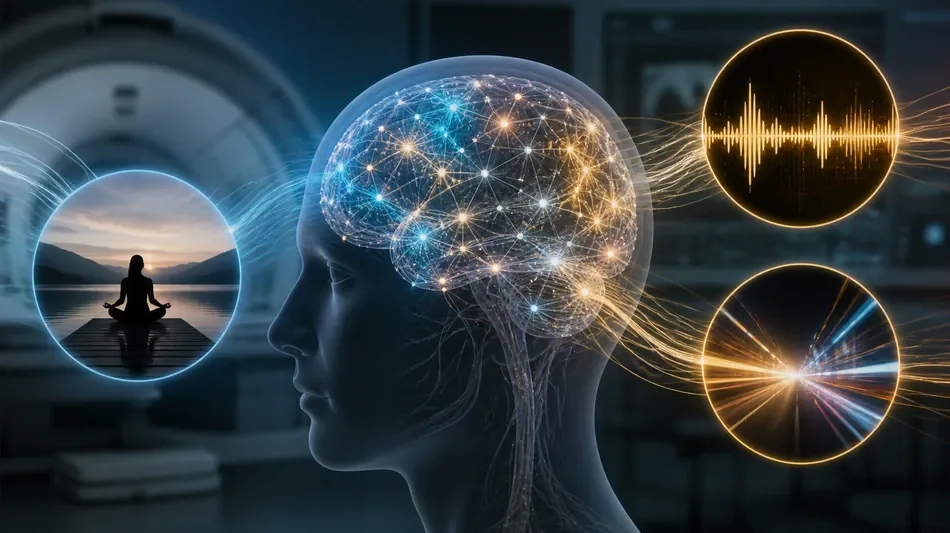
A large neuroimaging study of psilocybin has found an organized pattern within the increased variability commonly associated with psychedelic drugs. The research, published in Nature, indicates that the substance can reduce distinctions between established brain networks while making neural responses to immediate activities more recognizable.

Researchers monitored changes across 332 brain regions using functional magnetic resonance imaging and electroencephalography. The study involved 62 people who had not previously used psychedelics. Each participant took a 19-milligram oral capsule of psilocybin and then meditated, listened to music or watched a film.

Artificial-intelligence analysis identified different neural patterns associated with each activity. The patterns became clearer as the reported intensity of the psychedelic experience increased. The result suggests that greater unpredictability in overall brain signaling does not necessarily mean a person’s immediate environment has less influence. Instead, the activity underway appeared to leave a more distinct neurological signature.

Self-reports were consistent with the biological measurements. Participants whose brain activity showed the clearest activity-specific patterns also tended to describe stronger immersion and a greater sense of unity with their surroundings. Some reported that the boundary between themselves and the environment felt less distinct.

Lead author Devon Stoliker of Monash University’s School of Psychological Sciences in Melbourne said networks involved in processing internal and external experience became less separate under psilocybin but reorganized into patterns reflecting what participants were experiencing.

The findings add detail to the broad description of psychedelics as making the brain chaotic and may help explain reports of oneness during psilocybin experiences. They may also be relevant to psychedelic-assisted treatment, where the circumstances of a session are considered important.

Senior author Adeel Razi, a Monash professor, said context should not be treated as background to the drug’s effects. The results support careful attention to the setting and to what a person does and experiences during a therapeutic session. The study does not establish a treatment outcome, but it provides evidence that the immediate environment is reflected in brain organization during the drug’s effects.

C.Mak--ThChM