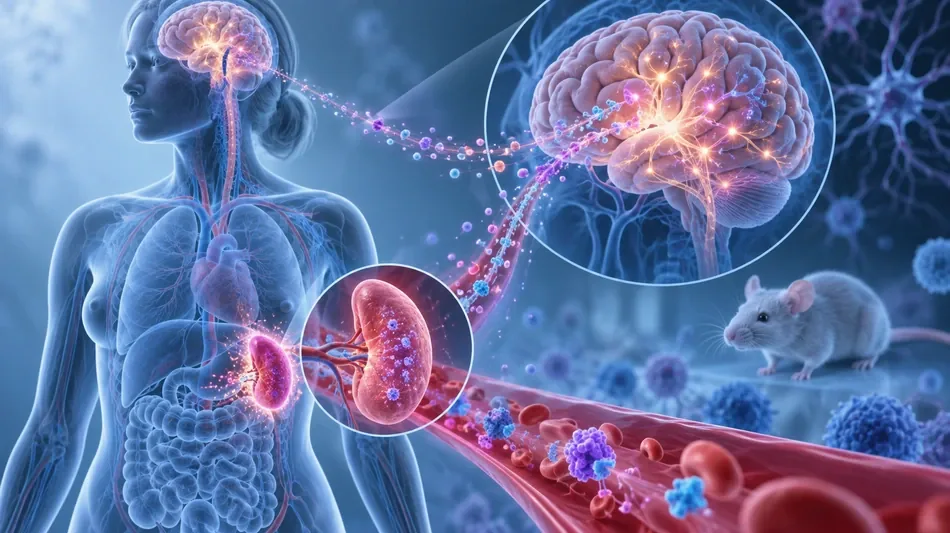
Study Identifies Spleen-to-Brain Pathway Linked to Female Cognitive Aging

Researchers in China have identified a molecular pathway through which the spleen may influence brain aging, offering a possible explanation for why women become more vulnerable than men to cognitive decline from midlife.
A team of Chinese scientists has identified a spleen-to-brain signaling pathway that may help explain sex differences in cognitive aging. The research, published on Sept. 18 in the peer-reviewed journal Neuron, was led by Ma Huan, vice dean of the School of Brain Science and Brain Medicine at Zhejiang University.
Women generally live longer than men but become more susceptible to cognitive impairment beginning in midlife. Previous explanations have focused largely on estrogen. The new work points instead to a mechanism involving the spleen and an X-chromosome gene that becomes more active in aging females.
The researchers first analyzed gene-expression information from 11 major organs in an existing database. From about age 40, markers of cellular senescence rose sharply in women’s brains and spleens and exceeded levels in men of the same age. Senescent cells have stopped dividing and begun to function abnormally. The team observed a comparable pattern in naturally aging mice and in donated human brain tissue.
The findings led the group to investigate whether a signal originating elsewhere in the body could promote brain aging. Their search focused on miR-10a-5p, a microRNA that regulates gene expression. Its concentration increased in the spleens and brains of middle-aged female mice, but not in age-matched males.
The scientists then traced the regulator to RBMX, a protein encoded by a gene on the X chromosome. RBMX binds to miR-10a-5p, stabilizing it and allowing it to accumulate. In the experiments, the process occurred only in females, which carry two X chromosomes.
When the team injected mice with a compound designed to block miR-10a-5p, levels of the microRNA fell in the brain. Removing the animals’ spleens produced a similar decline, indicating that the organ is an important source. The blocking compound does not efficiently cross the blood-brain barrier, so the results also suggest that reducing miR-10a-5p elsewhere in the body can alter its concentration in the brain.
Inside brain neurons, miR-10a-5p suppresses a protein known as γCaMKII. That protein is involved in regulating calcium inside mitochondria, the structures that supply cells with energy. In middle-aged female mice, falling γCaMKII levels weakened calcium signaling and reduced energy production, pushing neurons toward senescence. Restoring γCaMKII in mice with reduced levels reversed those changes.
Qu Jing, the study’s first author, said cognitive aging has often been treated as a process limited to the brain. The results instead indicate that age-related changes in peripheral tissue may begin shaping brain health earlier than previously assumed.
The pathway could have implications for both diagnosis and treatment, although further research is required before either use becomes possible. Because some miR-10a-5p in the brain appears to originate elsewhere in the body, measuring it in blood may eventually help assess brain-aging risk before cognitive symptoms emerge.
The experiments also raise the possibility of reducing cognitive decline without designing a medicine capable of crossing the blood-brain barrier. If lowering the microRNA in the rest of the body is sufficient to affect the brain, researchers may have an additional therapeutic route to investigate.
Qu said the findings identify midlife as a potentially important period for maintaining long-term brain health rather than merely waiting for age-related decline. Because the mechanism links the immune system and the brain, the work also suggests that preserving healthy immune function may matter for cognitive health. The current findings are based substantially on animal experiments and biological samples and do not by themselves establish a clinical test or treatment for people.
T.Luo--ThChM