The China Mail - Robot plant grows, wilts on fate of UN nature talks

USD -
AED 3.6725
AFN 65.499729
ALL 82.012423
AMD 377.773158
ANG 1.79008
AOA 917.000037
ARS 1442.275002
AUD 1.437732
AWG 1.8
AZN 1.697294
BAM 1.659595
BBD 2.015639
BDT 122.394949
BGN 1.67937
BHD 0.376995
BIF 2965.596535
BMD 1
BND 1.27457
BOB 6.91481
BRL 5.271602
BSD 1.000776
BTN 90.44239
BWP 13.24927
BYN 2.866659
BYR 19600
BZD 2.012669
CAD 1.369065
CDF 2230.000275
CHF 0.7768
CLF 0.021932
CLP 866.00035
CNY 6.93805
CNH 6.938869
COP 3698
CRC 496.14758
CUC 1
CUP 26.5
CVE 93.565043
CZK 20.568969
DJF 178.211857
DKK 6.331013
DOP 63.157627
DZD 129.992996
EGP 46.861601
ERN 15
ETB 155.932472
EUR 0.847799
FJD 2.210498
FKP 0.732184
GBP 0.736925
GEL 2.694986
GGP 0.732184
GHS 10.987836
GIP 0.732184
GMD 73.000379
GNF 8783.310776
GTQ 7.675957
GYD 209.370505
HKD 7.81155
HNL 26.434899
HRK 6.3863
HTG 131.283861
HUF 322.487018
IDR 16879.45
ILS 3.13001
IMP 0.732184
INR 90.398099
IQD 1311.010794
IRR 42125.000158
ISK 122.770089
JEP 0.732184
JMD 156.523658
JOD 0.709003
JPY 156.875974
KES 129.102598
KGS 87.450209
KHR 4038.98126
KMF 418.999491
KPW 900.030004
KRW 1469.990241
KWD 0.307339
KYD 0.833956
KZT 493.576471
LAK 21509.911072
LBP 89638.030929
LKR 309.69554
LRD 186.137286
LSL 16.167606
LTL 2.95274
LVL 0.60489
LYD 6.339495
MAD 9.185352
MDL 17.007501
MGA 4427.737424
MKD 52.251206
MMK 2099.783213
MNT 3569.156954
MOP 8.05317
MRU 39.920067
MUR 46.059657
MVR 15.449897
MWK 1735.286131
MXN 17.426835
MYR 3.9525
MZN 63.750209
NAD 16.167606
NGN 1366.530344
NIO 36.826006
NOK 9.778903
NPR 144.708438
NZD 1.67346
OMR 0.384506
PAB 1.000776
PEN 3.36398
PGK 4.350519
PHP 58.550504
PKR 280.209677
PLN 3.58107
PYG 6608.484622
QAR 3.647395
RON 4.318398
RSD 99.504972
RUB 76.753269
RWF 1460.610278
SAR 3.750238
SBD 8.058149
SCR 14.862442
SDG 601.501385
SEK 9.03673
SGD 1.273565
SHP 0.750259
SLE 24.450362
SLL 20969.499267
SOS 570.904894
SRD 37.86973
STD 20697.981008
STN 20.789492
SVC 8.756194
SYP 11059.574895
SZL 16.159799
THB 31.705498
TJS 9.366941
TMT 3.505
TND 2.899825
TOP 2.40776
TRY 43.6127
TTD 6.776526
TWD 31.654974
TZS 2574.999777
UAH 43.184356
UGX 3572.383187
UYU 38.617377
UZS 12275.134071
VES 377.985125
VND 25960
VUV 119.687673
WST 2.726344
XAF 556.612755
XAG 0.013394
XAU 0.000205
XCD 2.702549
XCG 1.803594
XDR 0.692248
XOF 556.610394
XPF 101.198154
YER 238.396166
ZAR 16.198103
ZMK 9001.200805
ZMW 18.589121
ZWL 321.999592
  • SCS

    0.0200

    16.14

    +0.12%

  • CMSC

    0.0300

    23.55

    +0.13%

  • CMSD

    0.0200

    23.89

    +0.08%

  • BCC

    -1.0700

    89.16

    -1.2%

  • BCE

    -0.7700

    25.57

    -3.01%

  • RBGPF

    0.1000

    82.5

    +0.12%

  • BP

    -1.0300

    38.17

    -2.7%

  • NGG

    -0.9000

    86.89

    -1.04%

  • GSK

    1.9400

    59.17

    +3.28%

  • BTI

    0.3300

    61.96

    +0.53%

  • RIO

    -5.3600

    91.12

    -5.88%

  • JRI

    -0.1500

    13

    -1.15%

  • AZN

    -0.2900

    187.16

    -0.15%

  • RYCEF

    -0.2000

    16.42

    -1.22%

  • VOD

    -1.0900

    14.62

    -7.46%

  • RELX

    0.3100

    30.09

    +1.03%

Robot plant grows, wilts on fate of UN nature talks
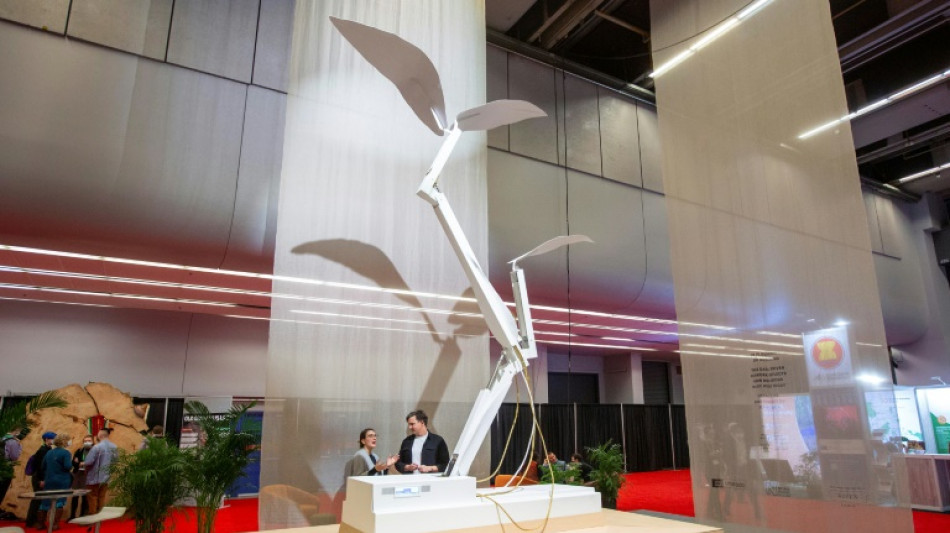
Robot plant grows, wilts on fate of UN nature talks / Photo: © AFP

Robot plant grows, wilts on fate of UN nature talks

It's not always easy to make sense of the complex environmental diplomacy taking place at a UN summit billed as humanity's last hope to save nature.

Text size:

That's why a scientist and artist have teamed up to build a large, data-driven robotic plant that withers or flourishes depending on countries' policy commitments: a tangible demonstration of how human actions will impact the world's threatened species.

Called "ECONARIO," the 5.5-meter (18-foot) tall artwork took a year to build from recycled steel and is currently on display in Montreal Convention Centre, keeping policymakers at the COP15 meeting on their toes as they attempt to hammer out a deal to protect ecosystems.

Its creator, Dutch artist Thijs Biersteker, told AFP the idea behind it is simple: "If the research does not reach us, then how can the research teach us?"

"Art reflects the time we're in, and it should reflect these important issues."

The plant feeds on data from the Biodiversity Intactness Index (BII) -- an estimated percentage of the original number of species that remain, and their abundance in any given area, despite human impacts.

Data scientist Adriana De Palma of London's Natural History Museum, who serves as research lead for the BII, told AFP it is based on a robust, peer-reviewed and open access methodology.

As negotiations happen, the team behind BII input, for example, how many countries have committed to implement a cornerstone pledge of protecting 30 percent of lands and oceans by 2030.

"We can then predict what that is going to mean for biodiversity in 20, 50 or 100 years," she said.

- Rooting for success -

New funding pledges by wealthy countries to assist lower income nations in protecting their biodiversity have helped to nudge up slightly the predicted global average of BII to 70.7 percent by 2050 -- meaning the average ecosystem will have that percentage of its natural ecological community left.

The current figure is 68.5 percent, set to drop to 66.4 percent if "business as usual" continues but rise to 76.4 percent in case of "real action" which the UN summit was meant to deliver.

For now, ECONARIO is cycling between the pessimistic and optimistic scenarios in order to show what could be possible -- but if policymakers fail to achieve an ambitious target, that will be reflected in a very sorry looking robotic plant.

"We shouldn't shy away from the hard numbers, it's not time to sugarcoat anymore," said Biersteker.

De Palma added they were in talks with North American museums to loan the artwork out after the UN summit concludes, and it will eventually return to Europe.

"Using a piece of art like this to really connect with people so they see the damage that individual choices, company choices and government choices are having on the world, is incredibly valuable," she said.

Z.Ma--ThChM