The China Mail - Tree count in Africa drylands could improve conservation: study

USD -
AED 3.67315
AFN 62.508602
ALL 82.901415
AMD 377.320103
ANG 1.790083
AOA 917.000446
ARS 1397.45603
AUD 1.43901
AWG 1.80225
AZN 1.700706
BAM 1.687977
BBD 2.01456
BDT 122.73608
BGN 1.709309
BHD 0.377588
BIF 2967.5
BMD 1
BND 1.279846
BOB 6.926967
BRL 5.284006
BSD 1.000203
BTN 93.723217
BWP 13.705842
BYN 2.961192
BYR 19600
BZD 2.011712
CAD 1.378275
CDF 2277.500338
CHF 0.791905
CLF 0.023254
CLP 918.179579
CNY 6.892698
CNH 6.90259
COP 3705.94
CRC 466.057627
CUC 1
CUP 26.5
CVE 95.375002
CZK 21.140432
DJF 177.720285
DKK 6.458295
DOP 59.874991
DZD 132.744974
EGP 52.575297
ERN 15
ETB 157.374952
EUR 0.864097
FJD 2.2267
FKP 0.74705
GBP 0.748095
GEL 2.714977
GGP 0.74705
GHS 10.905012
GIP 0.74705
GMD 73.000221
GNF 8780.00019
GTQ 7.659677
GYD 209.341164
HKD 7.82618
HNL 26.519884
HRK 6.514398
HTG 131.152069
HUF 338.600498
IDR 16919
ILS 3.12535
IMP 0.74705
INR 94.12285
IQD 1310
IRR 1315049.999853
ISK 124.289869
JEP 0.74705
JMD 157.845451
JOD 0.708962
JPY 159.145006
KES 129.505219
KGS 87.448496
KHR 4015.000082
KMF 425.000187
KPW 899.971148
KRW 1501.980286
KWD 0.30663
KYD 0.833571
KZT 482.866057
LAK 21550.000246
LBP 89549.999464
LKR 314.407654
LRD 183.602089
LSL 16.849649
LTL 2.95274
LVL 0.60489
LYD 6.395021
MAD 9.361979
MDL 17.4948
MGA 4164.999916
MKD 53.274154
MMK 2099.628947
MNT 3568.971376
MOP 8.061125
MRU 40.110041
MUR 49.241272
MVR 15.450211
MWK 1736.999739
MXN 17.821301
MYR 3.956501
MZN 63.899281
NAD 16.820108
NGN 1379.906022
NIO 36.720467
NOK 9.72285
NPR 149.95361
NZD 1.723707
OMR 0.384506
PAB 1.000203
PEN 3.473017
PGK 4.305501
PHP 60.074007
PKR 279.249903
PLN 3.69763
PYG 6526.476592
QAR 3.643996
RON 4.402503
RSD 101.500987
RUB 80.49933
RWF 1460
SAR 3.753711
SBD 8.051718
SCR 14.408321
SDG 600.99945
SEK 9.363065
SGD 1.280945
SHP 0.750259
SLE 24.550032
SLL 20969.510825
SOS 571.500489
SRD 37.340116
STD 20697.981008
STN 21.63
SVC 8.752314
SYP 110.977546
SZL 16.849782
THB 32.743003
TJS 9.597587
TMT 3.5
TND 2.904952
TOP 2.40776
TRY 44.34383
TTD 6.795811
TWD 31.96405
TZS 2569.999672
UAH 43.928935
UGX 3745.690083
UYU 40.762429
UZS 12205.000254
VES 456.504355
VND 26357
VUV 119.458227
WST 2.748874
XAF 566.134155
XAG 0.014408
XAU 0.000228
XCD 2.70255
XCG 1.802694
XDR 0.704159
XOF 568.499098
XPF 103.401522
YER 238.649518
ZAR 17.08035
ZMK 9001.198055
ZMW 18.929544
ZWL 321.999592
  • RBGPF

    -13.5000

    69

    -19.57%

  • BCC

    1.6900

    73.57

    +2.3%

  • RELX

    -1.3500

    32.46

    -4.16%

  • BCE

    0.0700

    25.83

    +0.27%

  • CMSC

    -0.0100

    22.87

    -0.04%

  • CMSD

    -0.1100

    22.63

    -0.49%

  • GSK

    0.9600

    52.95

    +1.81%

  • RIO

    0.9300

    86.77

    +1.07%

  • NGG

    0.2700

    82.33

    +0.33%

  • BTI

    -0.1600

    57.76

    -0.28%

  • RYCEF

    -0.4500

    15.6

    -2.88%

  • AZN

    1.7100

    185.78

    +0.92%

  • JRI

    0.1800

    11.86

    +1.52%

  • VOD

    0.1800

    14.66

    +1.23%

  • BP

    1.2200

    44.79

    +2.72%

Tree count in Africa drylands could improve conservation: study
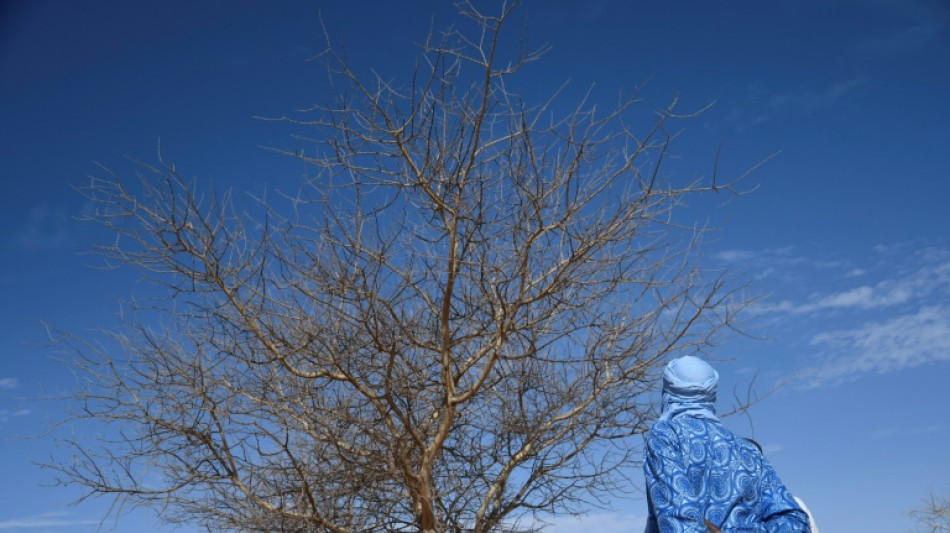
Tree count in Africa drylands could improve conservation: study / Photo: © AFP

Tree count in Africa drylands could improve conservation: study

A first count of trees in Africa's drylands has enabled scientists to calculate how much carbon they store and could help devise better conservation strategies for the region and beyond, a study said Wednesday.

Text size:

The number of trees in the vast region -- the count came to nearly 10 billion -- has not been known up to now, and the new data could prove crucial for slowing or preventing desertification, the authors said.

"(It) tells us about the carbon cycle and how much carbon we have in trees is mitigating climate change and our abuse of fossil fuels," Compton Tucker, co-lead author of the study published in the journal Nature, told AFP.

Dryland trees capture carbon for much longer than grasses and other non-woody species in the region, even if individually they do not store huge amounts.

The data show there are 9.9 billion trees within Africa's drylands: semi-arid Sub-Saharan Africa north of the Equator, which includes the Sahel and covers nearly 10 million square kilometres (four million square miles) of land from the Atlantic Ocean to the Red Sea.

That's the size of continental United States, plus Alaska, said Tucker, a senior Earth scientist at NASA.

By comparison, there are an estimated 400 billion trees in the Amazon.

Without accurate data on the number of trees in the Sahel, previous estimates largely overestimated the region's carbon-storage capacity, the study said.

The data could also help inform policies such as the Great Green Wall Initiative, which aims to restore savanna, grasslands and farmlands across the Sahel.

Policymakers, experts and donors can better track tree coverage -- and deforestation -- in the region, and understand how trees are being used by local communities.

"There is a lot of money in green finance dedicated to avoiding deforestation that has not been used due to a lack of reliable verification systems," said contributing author Philippe Ciais.

"High-resolution spatial data is crucial to improving the quality of carbon credits."

- Interactive map -

The researchers used machine learning to scan more than 300,000 high-resolution satellite images to map the crown area of individual trees in the drylands, defined as an arid region with low rainfall.

The authors hope to improve on the tool in the future by being able to map the trunk of the tree to determine its age and height, allowing for more accurate data on carbon storage capacity.

"When you want to estimate wood mass, it would be much better if -- in addition to the crown cover -- we had the height," co-lead author Pierre Hiernaux told AFP.

"It's almost possible but not yet."

Tucker said the same methodology could be used in other drylands including in Australia, the western United States or Central Asia.

An interactive map showing the location of individual trees and details the amount of carbon they store is available online.

Tucker hopes the data won't be used for harmful intentions.

"Any time you do something like this, you can certainly be used for bad purposes. We hope it's used for good."

The interactive map is available at: https://trees.pgc.umn.edu/app

R.Lin--ThChM