US transition to electric vehicles faces delays / Photo: © AFP/File

The US transition to electric cars has hit a speed bump, with concerns about vehicle range and limited charging capacity adding to core affordability issues.
Automakers in recent weeks have pushed back EV sales targets and delayed capital projects as they seek to reduce inventories of unsold EVs at dealerships.
"The slowdown in EV sales is much more pronounced than it is for other categories of vehicles and that isn't related to the economy," said Neil Saunders, managing director of GlobalData.
"The EV has a problem attached to it," he said. "It's a much more difficult and complex purchase because of the range of the vehicles and the charging infrastructure."
American consumers are accustomed to often-lengthy road trips for holidays or to visit friends and relatives, owing to the country's large size and limited public transit options.
But so far, the network of EV charging stations remains dodgy, with many areas either lacking infrastructure or equipped with unreliable machines.
- Range, pricing concerns -
More than three-quarters of drivers consider EVs reliable, according to a survey by the Consumer Technology Association (CTA), the organizer of the annual Consumer Electronics Show in Las Vegas.
But there are also significant doubts among drivers surrounding the autos over inadequate charging infrastructure (36 percent), battery range (39 percent) and vehicle affordability (38 percent).
The average EV sold in October for $51,762, some $13,000 below the year-ago level for the autos, but almost $4,000 above the average price of all autos.
In Europe, the elevated price of gasoline adds an incentive that allows consumers there to overlook the lofty upfront cost of the vehicle.
But that is less of a factor in the United States, where gas prices are only about half the level in France or Britain, according to Observatoire Cetelem 2024.
Industry leaders such as Tesla Chief Executive Elon Musk have also pointed to increased borrowing costs as a drag after a series of Federal Reserve interest rate hikes over the last year and a half.
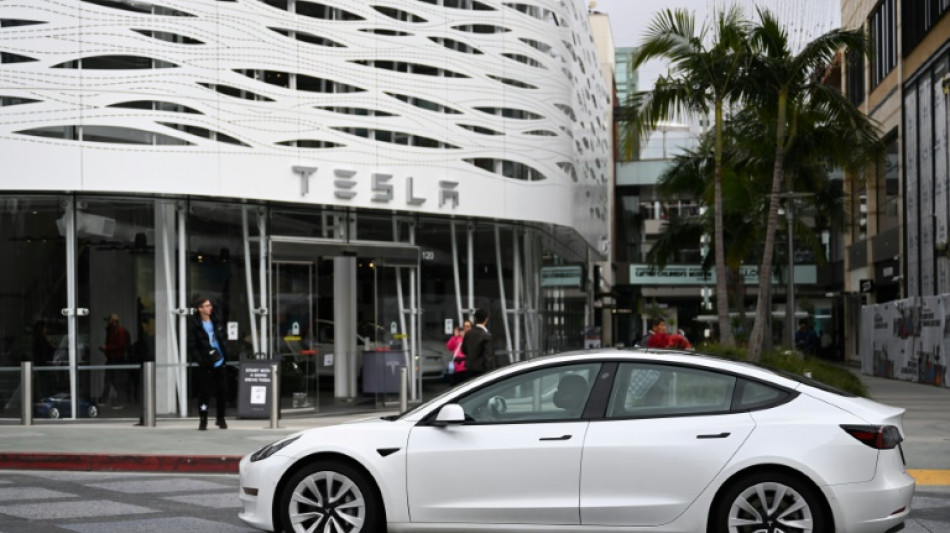
Tesla remains a dominant player in EVs, accounting for more than 55 percent of the 873,000 EV autos sold in the first 10 months of 2023, according to industry researcher Kelley Blue Book.
Ford Chief Executive Jim Farley predicted "some bumpiness" in the evolving US market.
"The dynamic changes in the market -- pricing, adoption rates, regulations -- are forcing us to further reduce the cost of our EVs," Farley said last month.
- Lowering costs -
Ford's rival and fellow Detroit giant General Motors recently pushed back until the end of 2025 a plan to convert its Orion, Michigan plant for EVs "to better manage capital investment while aligning with evolving EV demand," the company said last month.
"In addition, we have identified engineering improvements that we will implement to increase the profitability of our products," GM said.
Ford and Tesla too are looking to simplify their manufacturing processes to limit costs.
"Reducing the cost of our vehicles is our top priority," said Tesla Chief Financial Officer Vaibhav Taneja.
For its futuristic Cybertruck, which is expected to commence deliveries before the end of 2023, Tesla is "doing everything possible to simplify that vehicle" to reach efficiency "that is unheard of in the auto industry," Musk said.
Ford has also vowed to tweak its vehicle design and manufacturing in order to reduce complexity.
But the results are still unproven, according to Deutsche Bank analyst Emmanuel Rosner.
"What concerns us most is that automakers haven't cracked the economics to make an easy, affordable EV," Rosner said on CNBC.
Washington has mobilized in favor of EVs during the presidency of Joe Biden, approving $7.5 billion in funds for EV chargers and extending tax credits up to $7.500 for consumer purchases of the autos.
The Biden administration wants 50 percent of vehicles sales to be electric by 2030.
"The politicians wanted it to happen overnight, but you can't just set arbitrary targets, you've got to make sure the infrastructure's there," said Saunders of GlobalData.
"The long-term trajectory is probably good for EVs," but "it's something that's much slower-going," he predicted.
M.Chau--ThChM